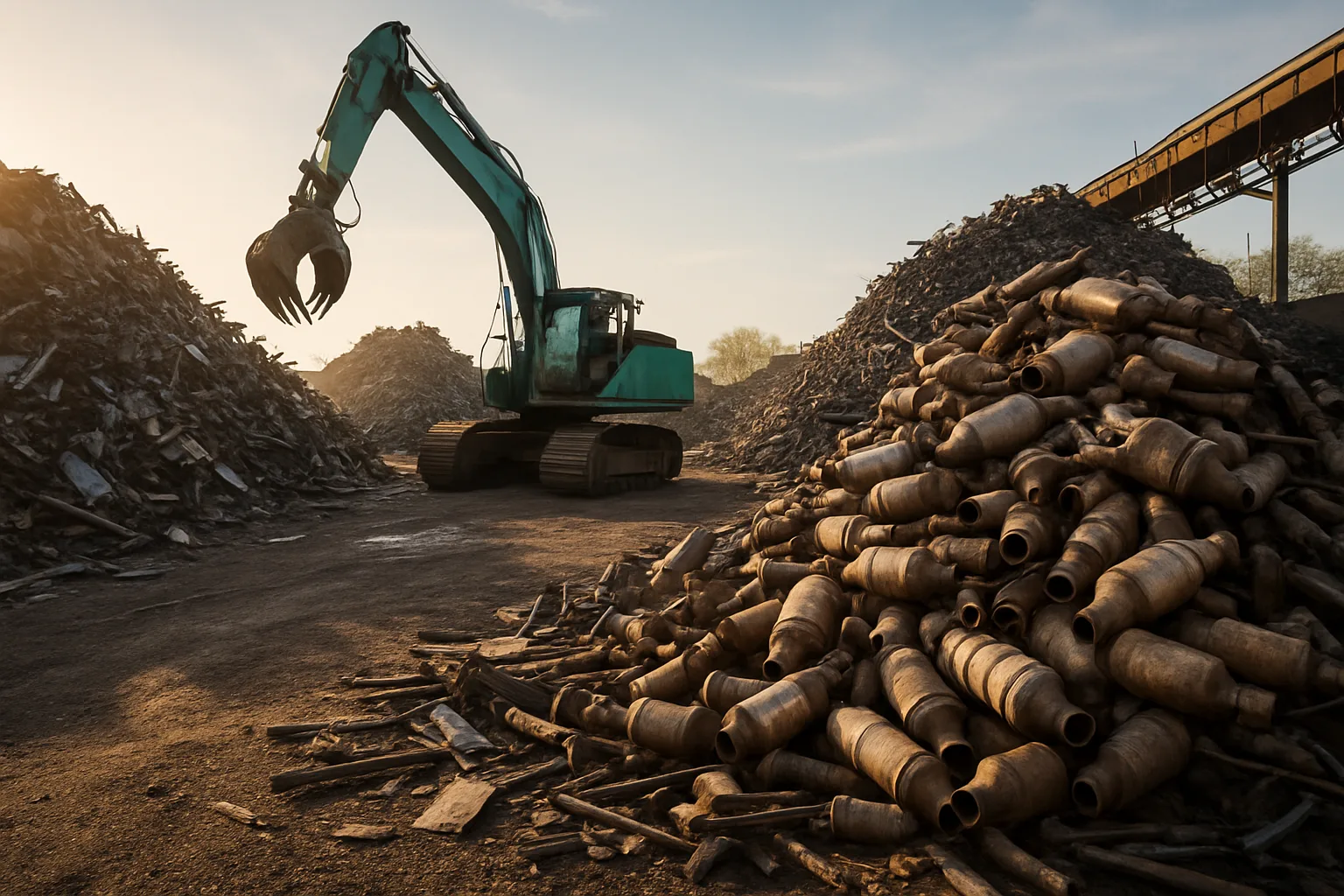
Most people treat a catalytic converter like a car part — something bolted under your vehicle that exists to pass emissions testing. But the moment that cat comes off a scrapped vehicle, it stops being a car part and starts being a commodity. Inside that steel shell sits a ceramic substrate coated with platinum, palladium, and rhodium — metals that trade on global markets and move based on mining output, EV adoption rates, and industrial demand. If you're sitting on a used cat in Prince George and you don't understand what it's actually worth, you're leaving money on the table.
This article breaks down the full lifecycle of a catalytic converter — from the factory floor to the smelter — so you understand exactly where the value lives, why cat converter prices Prince George fluctuate, and how to make sure you're getting a fair return when you sell.
From Factory to Exhaust System: What's Inside a Catalytic Converter
Catalytic converters are engineered to solve an emissions problem. Raw exhaust from a combustion engine contains hydrocarbons, carbon monoxide, and nitrogen oxides — all of which are harmful. The cat uses a chemical reaction to convert those gases into less harmful compounds before they exit the tailpipe.
That chemical reaction requires a catalyst. And the metals that work best — platinum, palladium, and rhodium — are part of what's known as the platinum group metals (PGMs). These are among the rarest elements on Earth. The quantities inside a single converter are measured in grams, not ounces, but PGM spot prices are high enough that even small amounts carry real value.
- Platinum: Used primarily in diesel converters. Historically the most recognized PGM, though palladium has outpaced it in recent years for gasoline applications.
- Palladium: The dominant metal in gasoline-engine converters. Demand from automotive manufacturers has kept palladium prices elevated throughout the 2020s.
- Rhodium: The rarest and most volatile of the three. Rhodium prices can swing dramatically — sometimes more than 50% in a single calendar year — which is one of the key reasons catalytic converter scrap value can shift so quickly.
The substrate — typically a honeycomb-shaped ceramic or metallic foil structure — holds the PGM coating and maximizes surface area for the chemical reaction. When a cat gets scrapped and processed, that substrate is what refiners are after.
The Vehicle Lifecycle: When Does a Cat Become Scrap?
A catalytic converter doesn't suddenly fail on day one. Most OEM cats are designed to last the life of the vehicle — often 200,000 kilometers or more under normal driving conditions. What triggers scrapping is typically vehicle age, collision damage, or the cost of replacing the cat exceeding the car's remaining value.
In British Columbia, where older vehicles often deal with both high-mileage usage and variable terrain, cats get pulled off everything from aging half-tons to high-kilometre fleet vehicles. Prince George, sitting at the intersection of major northern highways and servicing a large forestry and transportation sector, sees a steady volume of heavy-use vehicles cycling through end-of-life every year.
Once a vehicle is deemed not worth repairing, it typically moves through one of these paths:
- Auto wreckers: The vehicle is dismantled. Reusable parts are resold. The cat may be sold separately or along with the body.
- Scrap yards: The vehicle is crushed or shredded. The cat is ideally removed beforehand to capture its full value before it's lost in the shredder mix.
- Private sale: Individuals remove cats themselves and sell them directly to recyclers or through platforms that specialize in catalytic converter scrap price by vehicle.
The window between vehicle end-of-life and the cat hitting the scrap market is often where money is lost. Sellers who don't know their cat's make-specific value often accept the first number they hear. That's the problem worth solving.
Catalytic Converter Scrap Value: What Actually Drives the Price
Here's where it gets practical. The catalytic converter scrap value of any given unit isn't one number — it's a formula based on several moving parts.
PGM spot prices are the foundation. Platinum, palladium, and rhodium trade daily on commodity exchanges, and those prices directly influence what refiners pay for raw cats. When rhodium was at historic highs in 2021, scrap cat prices surged across North America. When prices correct — as they have in some periods during 2025 and into 2026 — scrap values follow. Checking current Canadian catalytic converter prices before you sell is not optional. It's the difference between a fair deal and a bad one.
Vehicle make and model is the second major factor. A converter from a Toyota Prius carries a different PGM loading than one from a Ford F-150 diesel. Luxury vehicles, certain hybrids, and large-displacement engines often have higher PGM content. Aftermarket cats — the cheaper replacements installed when OEM cats fail — typically contain far less precious metal and are worth significantly less at scrap.
Other factors that affect catalytic converter scrap price by vehicle include:
- Whether the cat is still intact or has a cracked/damaged substrate
- Whether it's been "foiled out" — meaning the substrate has already been removed, which makes it nearly worthless
- The series number or part number stamped on the shell (used to identify the unit in pricing databases)
- Current refinery capacity and processing backlogs
How PGMs Move From Scrap Cat to Refined Metal
Once a cat leaves the scrap yard, it enters a processing and refining chain that's more sophisticated than most sellers realize. Understanding this chain helps explain both why prices vary and why documentation matters.
Step 1 — Collection and sorting. Cats are collected from yards, auto wreckers, and individual sellers. They're sorted by type — domestic, foreign, small foreign, large foreign, flow through, pre-catalytic, and so on. Experienced sorters can identify high-value units by sight or by referencing the part number.
Step 2 — Decanning. The steel shell is cut away to expose the substrate. This is done mechanically and the steel casing has its own low scrap value. The substrate is what goes forward for processing.
Step 3 — Milling and sampling. The substrate is ground into a fine powder. A sample is taken and assayed to determine the exact PGM content. This assay result drives the final payment calculation for large lots sold on assay. Platforms like the SMASH Recycling auction platform bring competitive buyers to the table at this stage — so the price you receive reflects actual market demand, not just one buyer's offer.
Step 4 — Smelting and refining. The milled material goes into a smelter where base metals are separated. The PGM-rich fraction is then further refined using hydrometallurgical processes to isolate pure platinum, palladium, and rhodium. These refined metals re-enter the supply chain — used in new vehicle manufacturing, industrial processes, electronics, and yes, investment products.
That final point connects to a question some sellers ask: is platinum group metals a good investment? PGMs are genuine industrial commodities with real-world supply constraints and demand drivers. Whether refined PGMs belong in an investment portfolio is a question for a financial advisor — but understanding that PGMs have tangible industrial value explains why scrap cat prices aren't arbitrary. They're tied to real commodity markets.
Why Sellers in Prince George Need a Better Process
If you're selling scrap cats in Prince George, you already know the challenge. You're not in Vancouver or Calgary. The number of active buyers in your immediate market is limited. That makes it easy for a single buyer to set the price — and hard for you to know whether you're getting a fair deal.
This is the exact problem that competitive platforms solve. When you list your cats with visibility across multiple vetted buyers — rather than calling one yard and accepting their number — you get actual price discovery. More buyers means more competition. More competition means the price reflects what the market will actually pay for your material, not just what one buyer thinks they can get away with offering.
SMASH was built specifically for this dynamic. Sellers list their inventory — whether it's a single high-value OEM cat or a pallet of mixed units — buyers compete, and the seller sees what the market actually values their material at. For sellers in northern British Columbia dealing with limited local buyer pools, getting the best catalytic converter price in Canada often means getting access to buyers who aren't in your backyard. SMASH connects you to that market.
You can also explore Prince George scrap metal services specifically tailored to your area — so you're not navigating this process blind.
If you want to understand the pricing dynamics before you sell, read Canadian catalytic converter pricing guides that break down what's happening in the market right now. Selling informed is always better than selling urgent.
What to Do Before You Sell Your Scrap Cats
Whether you're an auto shop sitting on a bin of used cats, a private individual who just pulled one off a truck, or a small yard operator in Prince George looking to move a load — there are a few things worth doing before you accept any offer.
- Identify what you have. Look for the part number stamped on the shell. This is the fastest way to get an accurate price reference. OEM versus aftermarket matters enormously.
- Document the condition. Intact substrate, undamaged shell, no foiling — these all support a higher value. Photo documentation protects you and gives buyers confidence in what they're bidding on.
- Check current PGM-linked pricing. Scrap metal prices today are not the same as they were six months ago. Rhodium and palladium prices have moved meaningfully in 2026. Know the market before you negotiate.
- Get more than one offer. This is non-negotiable. One offer is not a market — it's a guess dressed up as a price.
- Use a platform that brings competition to you. SMASH does exactly this. No subscription, no guesswork. You list, buyers compete, you decide.
The lifecycle of a catalytic converter ends at the refinery. But your job — as the seller — is to make sure you capture as much of that value as possible before it gets there. If you're in Prince George or anywhere across British Columbia, you deserve access to a fair market. That's what this process, done right, delivers.
When you're ready to find out what your cats are actually worth, get the best Canadian price for your catalytic converter — get a free quote at best-catalytic-converter-price.ca.
Disclaimer: Catalytic converter scrap prices fluctuate based on PGM spot prices and market conditions. Always check current rates before selling.
Frequently Asked Questions
Q: What makes cat converter prices in Prince George different from other cities?
Cat converter prices are driven by PGM spot prices, which are the same everywhere — but your access to competitive buyers affects what offer you actually receive. In Prince George, a limited local buyer pool can suppress what sellers get if they only shop locally. Using a platform like SMASH that connects you to buyers across North America gives you real price discovery, not just a local yard's number.
Q: How do I know if my catalytic converter is OEM or aftermarket?
OEM cats typically have a manufacturer part number stamped on the shell and are heavier than aftermarket units. Aftermarket converters are often noticeably lighter and may have different heat shielding. When in doubt, a reputable buyer or platform can help you identify the unit and give you a realistic scrap value before you commit to a sale.
Q: How much is a catalytic converter worth as scrap in Canada?
Values vary significantly by vehicle make, model, and converter type. OEM cats from Toyota, Honda, and certain GM vehicles tend to carry higher PGM loadings than aftermarket replacements. Because palladium and rhodium prices move regularly, the only reliable way to know your cat's current scrap value in Canada is to check against live market pricing before you sell.
Q: Does a cracked or damaged catalytic converter still have scrap value?
Yes — but less. A cracked substrate means some of the PGM-coated ceramic has been lost, which reduces the recoverable metal content. A physically damaged shell with an intact substrate still has value. A foiled-out converter — where the substrate has already been removed — has almost none. Condition directly affects the offer you receive, so document your units accurately.
Q: Is it worth selling catalytic converters separately rather than with the full vehicle?
Almost always, yes. When a full vehicle goes to a shredder, the cat may not be removed first — and its PGM value gets diluted into the general shredder mix. Removing and selling the cat separately, before the vehicle is scrapped, typically captures significantly more value. This is standard practice for auto wreckers in British Columbia and makes sense for private sellers too.
Follow SMASH on LinkedIn for industry updates, scrap metal market insights, and pricing news across North America.