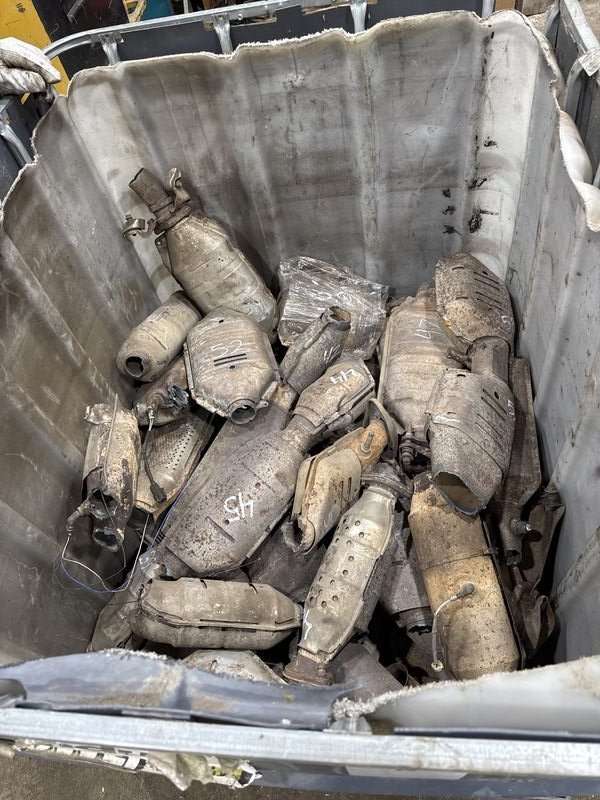
Most people selling a scrap cat have no idea what's inside it. They hand it over, get a number, and hope for the best. That's exactly how buyers get rich and sellers get shortchanged. Understanding what drives cat converter prices in Guelph — and across Canada — starts with three metals most people have never held in their hand: platinum, palladium, and rhodium.
These aren't exotic materials found in one or two converters. They're inside nearly every catalytic converter ever bolted to a vehicle. And their market value, measured in troy ounces on global commodity exchanges, is what makes your old converter worth anywhere from $20 to several hundred dollars — sometimes more. Knowing how that value is calculated is the difference between getting a fair price and leaving money on the table.
What's Actually Inside a Catalytic Converter
Crack open a catalytic converter and you'll find a ceramic or metalite honeycomb substrate coated with a thin wash of platinum group metals — PGMs for short. The three that matter most to scrap value are platinum (Pt), palladium (Pd), and rhodium (Rh). Each one plays a specific chemical role in the converter's job: reducing harmful exhaust emissions into less dangerous gases.
The amounts are small — measured in grams, not pounds — but these metals are dense and extraordinarily valuable per gram. A single converter might hold anywhere from one to several grams of combined PGMs, depending on the vehicle make, model, engine size, and the era it was manufactured. Larger trucks and SUVs typically carry more PGM loading than small economy cars. Diesel converters have their own profile, often leaning heavier on platinum.
- Platinum: Commonly found in diesel converters. Helps oxidize carbon monoxide and unburned hydrocarbons.
- Palladium: Dominant in gasoline converters since the late 1990s. Handles oxidation reactions at lower temperatures.
- Rhodium: The rarest of the three. Critical for reducing nitrogen oxides (NOx). Even tiny amounts have a major impact on converter value.
When a processor assays a load of cats, they're measuring exactly how much of each metal is present in the substrate. That assay result, combined with current spot prices for each metal, is what determines your payout. No guesswork — at least, not on their end.
How Platinum, Palladium, and Rhodium Spot Prices Drive Catalytic Converter Scrap Value
Global PGM prices are set on commodity markets — primarily the London Platinum and Palladium Market (LPPM) and COMEX. These prices fluctuate daily, sometimes dramatically, based on mining supply, industrial demand, geopolitical events, and currency movements. South Africa produces the majority of the world's platinum and rhodium. Russia supplies a significant share of palladium. Any disruption to those supply chains ripples directly into your catalytic converter scrap value.
Here's why this matters for a yard operator or collector in Guelph or anywhere in Ontario: the price your buyer quotes you today may be materially different from what they quote next Tuesday. PGM markets move. A processor who quotes you Monday morning is basing that number on weekend spot prices and their hedge position. By Friday, the math could look very different. This is one reason why getting multiple quotes — rather than calling one buyer and accepting their first offer — has a direct impact on your bottom line.
Rhodium is the most volatile of the three. It's also the thinnest market. Small shifts in demand from autocatalyst manufacturers can send rhodium prices swinging in ways that dwarf platinum or palladium moves. When rhodium is high, certain domestic cats that once seemed unremarkable become significantly more valuable. When it's low, those same units are a fraction of the price. Tracking where rhodium sits on any given day is essential if you're holding a load and deciding when to sell.
The Grade System — Why Not All Cats Are Worth the Same
Processors and buyers don't price every converter the same way. They use a grading system based on known assay data for specific converter types. Some buyers rely on proprietary databases. Others use industry-standard references built from years of assay history across millions of units. When a buyer looks at your converter, they're typically identifying it by its serial number, physical appearance, or substrate type — then matching it to a known grade with an established PGM content range.
This is where documentation becomes critical. If a buyer can't positively identify a unit, they'll grade it conservatively — which means lower. A well-documented inventory, with photos and serial numbers matched against a reference database, gives buyers confidence to pay closer to the actual value. Platforms like SMASH help you get competitive bids for your scrap in Canada by providing the structure for proper documentation and exposing your inventory to vetted buyers who compete for it — rather than one buyer setting the price in isolation.
Common grades include:
- Domestic (DOM) cats: North American-made converters. Generally well-documented with established PGM ranges.
- Foreign (FOR) cats: Imported vehicle converters, often with higher PGM loading.
- High-grade (HG) or pre-cat: Small converters positioned close to the engine. High PGM concentration relative to size.
- Bead cats: Use loose ceramic beads instead of honeycomb substrate. Require different processing.
- Foil/metalite cats: Metal substrate instead of ceramic. Process differently and grade differently.
- Diesel oxidation catalysts (DOCs): Platinum-heavy. Increasingly common as diesel trucks age out.
What Affects Your Payout Beyond the Spot Price
Spot price and grade are the two biggest levers, but they're not the only ones. Several other factors influence the final number you see on your cheque — or don't see because no one explained them to you.
Processing fees: Processors charge for smelting, assaying, and refining. These fees vary by processor and can be negotiated when you're moving volume. A single unit sold retail will carry a different cost structure than a full pallet sold to a toll refiner.
Moisture and damage: A converter that has been washed out, baked at high heat, or otherwise damaged before sale has reduced PGM content. Some buyers will discount heavily for units they suspect have been tampered with. Cores that arrive dry, intact, and cleanly cut from the vehicle hold the most value.
Settlement terms: Are you selling on a spot basis — getting paid immediately at a quoted price — or on a return basis — waiting for the actual assay results and splitting accordingly? Each model has trade-offs. Spot sales are faster but transfer market risk to the buyer, who prices that risk into the offer. Return-basis settlements can yield more but require trust in the processor's assay integrity.
For sellers in Ontario — whether you're running a salvage yard near Guelph, collecting from auto shops across the region, or aggregating from multiple sources — understanding these variables means you're negotiating from knowledge instead of guessing. To get the best catalytic converter price in Canada, you need to know what you're selling before you pick up the phone.
How SMASH Brings Transparency to Cat Converter Pricing in Canada
The traditional scrap selling model is broken. You call one buyer, they quote a number, you accept it because you have no reference point. That information gap is where margin gets extracted — from your pocket. The price discovery process that should protect sellers gets skipped entirely when there's only one voice in the room.
SMASH changes the dynamic. Instead of one phone call to one buyer, your documented inventory gets in front of multiple vetted buyers who compete against each other. Competition reveals the market. It doesn't invent a higher price — it finds the real one. For sellers moving regular volume of cats in Ontario and beyond, that difference compounds quickly over time.
The inventory tools built into the platform support VIN lookup, serial tracking, and photo documentation — the exact information that allows buyers to grade confidently and bid aggressively. A buyer bidding on a well-documented load of graded cats can move faster and bid tighter margins than one staring at an undocumented pile. That confidence flows back to the seller as better offers. If you're managing Guelph scrap metal services or working across multiple Ontario locations, the ability to document and auction inventory efficiently is a real operational advantage.
No subscription fees. SMASH earns when sellers earn. To read Canadian catalytic converter pricing guides and understand how the market works before your next sale, the information is there. And when you're ready to put your inventory in front of buyers who compete for it, the platform is ready too.
Reading the Market Before You Sell
Timing matters. Not every yard has the luxury of holding inventory until PGM prices recover — but understanding the market cycle helps you make smarter decisions about when to move volume versus when to wait. Rhodium in particular has historically shown sharp peak-and-trough patterns. Palladium has tracked the growth of gasoline vehicle production globally. Platinum has lagged as diesel adoption slowed in North America, though that picture continues to evolve as fuel cell technology develops demand.
Watching daily PGM spot prices takes five minutes. There are free tools to track platinum, palladium, and rhodium in real time. Pair that habit with a solid sense of your inventory grade mix, and you're operating with the same information your buyers use to set their offers. To check current Canadian catalytic converter prices and understand how today's PGM spot prices translate into real offers, don't guess — get a quote based on actual market data.
Disclaimer: Catalytic converter prices fluctuate daily based on platinum, palladium, and rhodium spot prices. Always check current rates before selling. The values referenced in this article reflect general market dynamics and should not be taken as guaranteed pricing.
---Frequently Asked Questions
Q: What determines the scrap value of a catalytic converter in Guelph?
The scrap value of a catalytic converter is primarily determined by the type and quantity of platinum group metals (PGMs) — platinum, palladium, and rhodium — found in its substrate. Current spot prices for those metals on global commodity markets, combined with the converter's grade and condition, set the floor and ceiling on what any buyer can reasonably offer. Sellers in Guelph should get multiple quotes rather than accepting the first number they hear.
Q: Why do cat converter prices change so often?
Because platinum, palladium, and rhodium trade on global commodity markets that move daily. Mining output from South Africa and Russia, industrial demand from automotive manufacturers, and macroeconomic factors all push PGM prices up and down. A converter worth a certain amount on Monday may be priced differently by Friday — which is why checking current rates before you sell always pays off.
Q: How do I know if I'm getting a fair price for my catalytic converter in Ontario?
The most reliable way is to get competing offers from multiple vetted buyers rather than relying on a single quote. Platforms like SMASH create that competition by letting buyers bid against each other on documented inventory. Knowing your converter's grade — whether it's a domestic cat, foreign, high-grade, or diesel DOC — also helps you evaluate whether an offer reflects real market value or a lowball designed to exploit a seller who doesn't know what they have.
Q: Does converter condition affect the price I get?
Yes, significantly. Converters that have been heat-damaged, washed out, or physically compromised will assay lower because the PGM content has been reduced or displaced. Buyers who suspect tampering will discount accordingly — sometimes heavily. Selling clean, intact units with proper documentation consistently returns better value than selling damaged or unidentified stock.
Q: What is the difference between selling on spot versus return basis?
A spot sale means you agree on a fixed price upfront and get paid immediately, regardless of what the assay actually returns. A return-basis sale means you wait for the processor's assay results and receive a payout based on actual PGM content recovered, minus processing fees. Spot sales are faster and carry no settlement risk for the seller, while return-basis settlements can yield more if you trust the processor and your inventory grades well. Which model works better depends on your volume, cash flow needs, and relationship with the buyer.
---If you're moving cats regularly — from a salvage yard, an auto shop, or a collection route across Guelph or anywhere in Ontario — the right information and the right buyers make a measurable difference. Get the best Canadian price for your catalytic converter by starting with a free quote at best-catalytic-converter-price.ca. You've done the work. Make sure you're getting paid for it.
Stay sharp on scrap metal market trends and PGM pricing updates — follow SMASH on LinkedIn for industry insights that keep you ahead of the market.