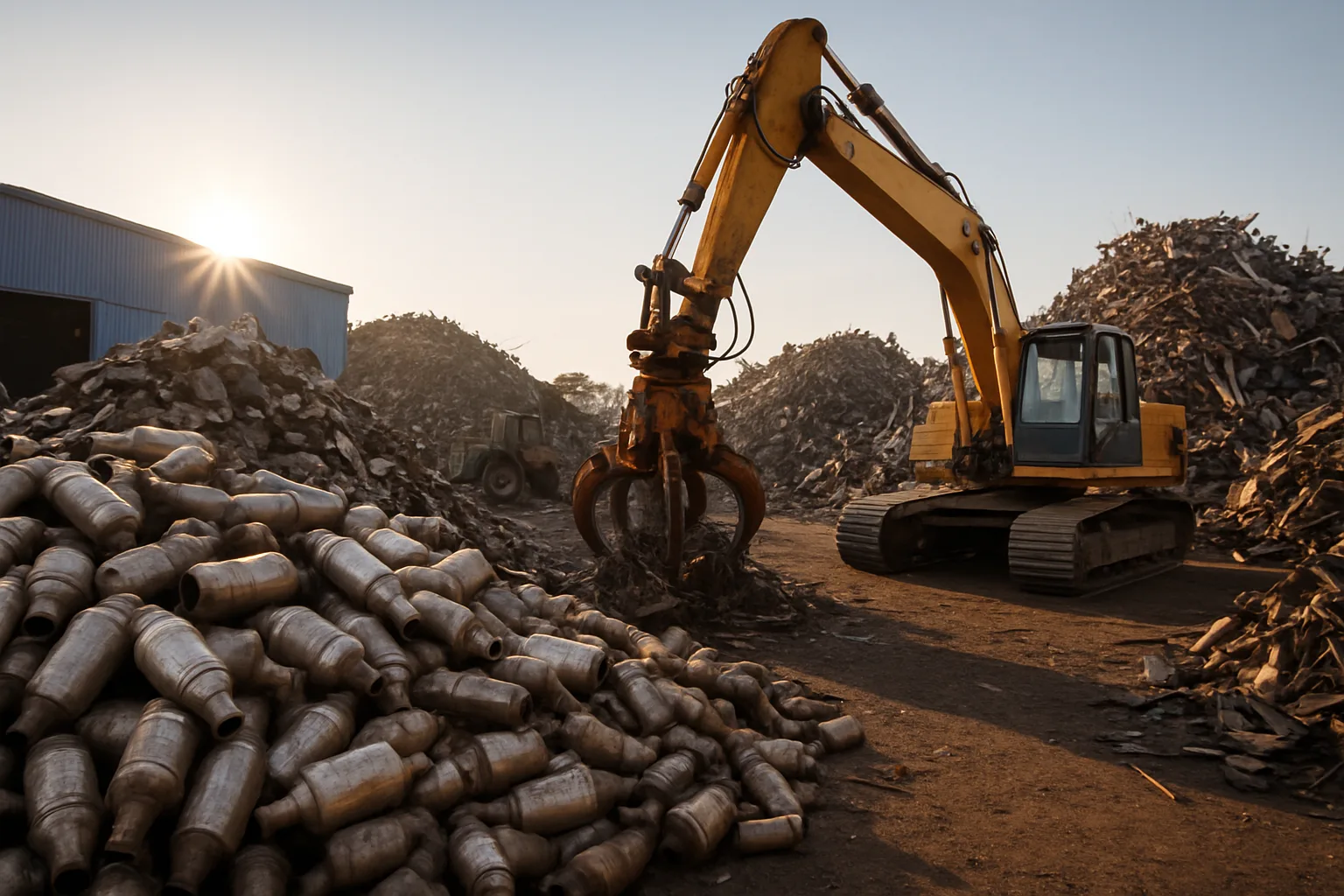
What Actually Happens to Your Catalytic Converter After You Sell It
Most sellers focus on the number on the cheque and never think twice about what happens next. That's fair — but understanding the assaying and smelting process that follows your sale can actually help you negotiate better, choose smarter buyers, and avoid getting low-balled. If you're sitting on a load of cats in Sydney, Nova Scotia, this is the process that determines what your material is truly worth.
The short version: your catalytic converter doesn't just get melted down in a backyard furnace. It goes through a rigorous metallurgical process to recover platinum group metals (PGMs) — specifically platinum, palladium, and rhodium. Each step in that chain affects how much value gets extracted, and how much of that value flows back to you as the seller.
If you want to get the best catalytic converter price in Canada, knowing this process isn't optional. It's the difference between accepting a lowball offer and walking away with what your material actually commands on the open market.
What's Inside a Catalytic Converter: The PGM Breakdown
Before we get into assaying and smelting, you need to understand what makes catalytic converters valuable in the first place. Inside every cat is a ceramic or metallic substrate — a honeycomb-structured core coated with a washcoat containing PGMs. These metals act as catalysts in the exhaust stream, converting harmful gases into less toxic emissions. After the converter's useful life ends, those same metals are recoverable and extremely valuable.
The three metals that drive catalytic converter scrap prices are:
- Platinum (Pt): Used primarily in diesel vehicle cats. Prices fluctuate significantly with industrial demand and mining output.
- Palladium (Pd): Dominant in gasoline engine converters. Has seen dramatic price swings over the past decade due to supply constraints and auto industry demand.
- Rhodium (Rh): The most volatile of the three. Even tiny quantities can represent significant value. A single high-grade converter can contain a few grams of rhodium — and those grams matter.
The exact loading — how many grams of each metal sit on that substrate — varies by make, model, year, and engine type. A domestic pickup truck cat from the early 2000s will have a completely different PGM profile than a late-model import. That's why identification matters before pricing. Whether you're selling from an auto shop in Sydney or collecting cores across Nova Scotia, knowing what you have before you negotiate is half the battle.
How Catalytic Converter Assaying Works — and Why It Matters for Price
Assaying is the analytical process used to determine exactly how much platinum, palladium, and rhodium is present in a sample of converter material. This is the step that converts raw scrap into a data-backed valuation — and it's where sellers who don't understand the process often leave money on the table.
There are two main assay methods used in the industry:
- Fire Assay (Cupellation): The traditional method. The converter substrate is crushed and milled into a fine powder, then a representative sample is fused with lead oxide at high temperatures. The lead absorbs the PGMs, forming a lead button. That button is then cupelled — heated in a porous cup — to remove the lead, leaving a bead of precious metals behind. This bead is analyzed using spectrometry to determine exact metal content. Fire assay is considered the gold standard for accuracy.
- XRF Scanning (X-Ray Fluorescence): A faster, non-destructive method often used for quick in-yard estimates. A handheld or benchtop XRF analyzer bounces X-rays off the material and reads the fluorescent energy emitted by different elements. It's fast and useful for sorting and pricing estimates, but it's less accurate than fire assay — especially for rhodium at low concentrations.
Here's why this matters to you as a seller: buyers who base their offers on fire assay data are working from real numbers. Buyers who rely entirely on visual ID or rough XRF scans are making educated guesses — and those guesses tend to favor the buyer. When you encounter a catalytic converter buyer in Sydney or anywhere else in Canada, ask them how they're pricing the material. The answer tells you a lot about how much of the actual value they're passing back to you.
Platforms like Canada's B2B scrap recycling marketplace SMASH are built on exactly this kind of transparency. When vetted buyers compete for your material with clear pricing methodology, the assay process stops being a black box and starts working in your favour.
The Smelting Process: From Crushed Substrate to Refined Metal
Once assaying establishes the composition of a batch, the actual metal recovery happens through smelting. This is a capital-intensive, industrial-scale process — not something a local yard does in-house. Most North American scrap catalytic converters ultimately travel to one of a handful of large-scale PGM refineries for processing.
Here's how the smelting process typically unfolds after the converters leave your hands:
- Collection and Decanning: The outer steel shell of each converter is removed (decanned) to expose the ceramic or metallic substrate inside. The steel goes to ferrous scrap. The substrate is what carries the value.
- Crushing and Milling: The substrate is crushed and ground into a uniform powder called "catalyst powder" or "spent catalyst." Consistent particle size is critical for accurate assaying and efficient smelting.
- Sampling: A statistically representative sample of the milled powder is pulled for fire assay. This sample determines the assay value that your settlement is based on — which is why lot segregation and proper documentation matter when you're selling.
- Smelting / Reduction: The bulk powder is smelted in a high-temperature furnace. A collector metal (often copper or iron) is used to capture the PGMs and separate them from the slag (waste oxides). The resulting PGM-rich alloy is called a matte or blister metal.
- Refining: The matte is further processed through hydrometallurgical or electrochemical refining to separate platinum, palladium, and rhodium into individual refined metals at high purity — typically 99.95% or better.
- Settlement: Once the refinery calculates your lot's final assay values and applies agreed deductions (refining charges, losses), you receive a settlement based on the recovered weights and current spot prices for each metal.
The entire process — from receiving a load to final settlement — typically takes several weeks, depending on the refinery's processing schedule and lot size. This timeline affects cash flow, which is why understanding it upfront matters when you're deciding how and where to sell your cats. Read Canadian catalytic converter pricing guides to better understand how settlement terms vary across buyers.
How Assay Results Connect to Scrap Metal Prices Today
Assay results don't exist in a vacuum. The value they generate is calculated against live PGM spot prices — the same prices that shift daily based on global markets, mining output, automotive demand, and macro-economic conditions. Scrap metal prices today are a direct function of what London Metal Exchange (LME) and NYMEX are reporting for platinum, palladium, and rhodium on the day your settlement is calculated.
This means two things for sellers:
- Timing can affect your return. A load priced during a palladium spike will yield more than the same load sold during a downturn. Not all buyers offer price protection or forward-locking, so it pays to know the market before you commit.
- The spread between spot price and your settlement matters. Refinery deductions, buyer margins, and transportation costs all reduce your net return below the raw spot value. Competition between buyers is the most reliable way to compress that spread.
Whether you're selling a handful of cats from a Nova Scotia auto shop or moving a larger volume from a collection route, the principle holds: more buyers bidding on your material means better price discovery. That's the core mechanic behind SMASH. Instead of one phone call to one buyer who sets the price, you put your load in front of a vetted pool of buyers and let competition do the work. Check current Canadian catalytic converter prices before you sell — and then let competition validate what you're seeing.
Disclaimer: Catalytic converter scrap prices fluctuate with PGM spot markets. Always verify current rates before selling. The information in this article reflects general market conditions as of June 2026.
What Sydney Sellers Should Know Before Choosing a Catalytic Converter Buyer
If you're based in Sydney, Nova Scotia, your options for selling catalytic converters may feel limited compared to a larger metro market. That's a real constraint — but it doesn't mean you're stuck accepting whatever a single local buyer offers. The key is knowing that geography doesn't have to determine your price.
Here's what to look for when evaluating any catalytic converter dealer near you — or any remote buyer willing to take your material:
- Pricing methodology: Are they pricing by visual ID, XRF, or fire assay-backed data? Each method has different accuracy, and the more rigorous the method, the fairer the price tends to be.
- Settlement terms: When do you get paid, and what deductions apply? Refining losses, treatment charges, and assay fees should be disclosed upfront.
- Buyer vetting: Is the buyer accountable? Can they provide references or a verifiable track record?
- Competition: Are you getting one offer or multiple? A single quote is a starting point, not a market price.
Platforms like SMASH exist specifically to solve the single-buyer problem. Whether you're selling from Sydney or anywhere else across Canada, you deserve a process where buyers compete for your material — not one where geography gives a single buyer an automatic advantage. That's the principle behind competitive catalytic converter auctions, and it's why more yards and collectors are moving away from cold calls and toward structured, transparent selling.
Frequently Asked Questions
Q: How does a catalytic converter buyer in Sydney determine what my cats are worth?
Most buyers start with visual identification — matching your converter to a known make, model, and year — and cross-reference against current PGM prices. More sophisticated buyers use XRF scanning or fire assay data to back their pricing. The method matters: fire assay is the most accurate, and buyers using it tend to offer more defensible prices.
Q: Can I sell catalytic converters remotely if I'm in Sydney, Nova Scotia?
Yes. Many buyers across Canada accept shipped or transported loads. With proper documentation — photos, serial numbers, vehicle info where applicable — you can get competitive quotes without being limited to local options. Platforms like SMASH connect sellers across Canada with vetted buyers, regardless of location.
Q: How long does it take to get paid after selling scrap catalytic converters?
It depends on the buyer and the settlement structure. Some buyers offer upfront "spot" pricing and pay immediately on pickup or drop-off. Others operate on a refinery-return basis, where payment comes after the lot is processed and assayed — which can take several weeks. Always clarify settlement terms before committing to a sale.
Q: What's the difference between catalytic converter scrap prices and the spot price of platinum and palladium?
Spot prices reflect the value of refined, pure metal. Scrap catalytic converter prices are derived from spot prices but adjusted for PGM loading percentages, refining costs, and buyer margins. The scrap price you receive will always be lower than raw spot — but how much lower depends on competition and the efficiency of the buyer's processing chain.
Q: Are catalytic converter scrap prices in Edmonton different from prices in Sydney or the rest of Canada?
PGM values themselves are set by global markets and don't change by region. However, local competition, transportation costs, and buyer margins can create regional price differences. Sellers in markets with fewer buyers — like some parts of Nova Scotia — may see less competitive offers if they don't actively seek out multiple quotes. That's exactly why using a competitive platform matters regardless of where you're located.
The assay and smelting chain is long, technical, and largely invisible to most sellers — but it's the engine that drives every price you're quoted. Understanding it puts you in a stronger position, whether you're an auto shop in Sydney selling a few cores a month or a collector moving volume across Nova Scotia. When you're ready to sell, don't settle for the first number you hear. Get the best Canadian price for your catalytic converter — get a free quote at best-catalytic-converter-price.ca.
Stay sharp on market movements and industry news by following SMASH on LinkedIn — practical scrap market insights, no filler.