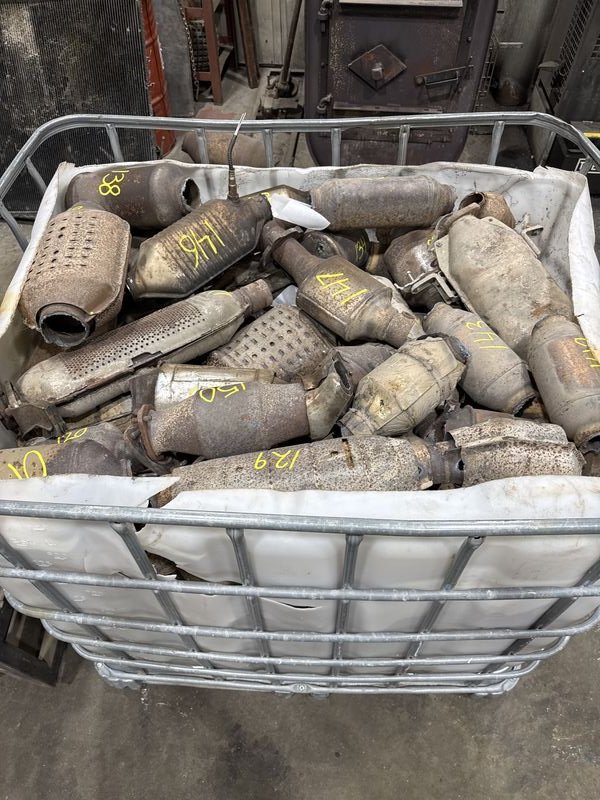
What's Actually Inside Your Catalytic Converter — And Why It's Worth Real Money
Most people have no idea that the converter bolted to the bottom of their vehicle contains some of the most valuable metals on the planet. The palladium price today sits in a range that makes a single catalytic converter worth anywhere from a modest payout to a surprisingly large cheque — depending on what's inside. If you're in Dartmouth or anywhere across Nova Scotia looking to sell a scrap cat, understanding what drives that value puts money in your pocket.
This isn't about guessing. It's about knowing the three metals that determine your payout, how their prices move, and why selling blind through one buyer is leaving money on the table. Let's break it down.
The Three Metals That Set Your Catalytic Converter's Value
Every catalytic converter contains a ceramic or metalite substrate coated with a washcoat. That washcoat holds platinum, palladium, and rhodium — the three platinum group metals (PGMs) that processors actually pay you for. These metals act as catalysts inside the converter, triggering chemical reactions that reduce harmful emissions from your engine. They don't get consumed in the process, which is exactly why they can be recovered and resold after the converter's useful life is over.
Here's what you're working with:
- Platinum (Pt): Used heavily in diesel catalytic converters. A stable workhorse in the PGM group. Prices fluctuate with industrial demand, mining output from South Africa, and broader commodity markets.
- Palladium (Pd): Dominant in gasoline-powered vehicle converters. Palladium has seen some of the most dramatic price swings of any commodity in the last decade, driven largely by tightening emissions regulations globally and supply constraints from Russia and South Africa.
- Rhodium (Rh): The smallest quantity but often the highest value per troy ounce. Rhodium is exceptionally rare, and its price can swing violently — sometimes dropping 70% or recovering just as fast. Even tiny amounts in a converter can shift the total payout significantly.
The actual gram loading of each metal varies enormously by vehicle make, model, year, and engine type. A standard aftermarket cat and an OEM converter from a luxury SUV are not worth the same. Not even close.
How the Palladium Price Today (and Platinum and Rhodium) Actually Affects Your Payout
PGM prices are set on global commodity markets — primarily the London Bullion Market and NYMEX — and quoted in USD per troy ounce. They move daily, sometimes hourly during volatile sessions. When the palladium price today rises, the value of every gasoline-engine catalytic converter in your pile goes up with it. When it drops, so does your quote.
This is why a converter you got quoted on six weeks ago might get a different number today. It's not the buyer changing their margin — it's the underlying market moving. Smart sellers track PGM spot prices before they call a buyer, and smarter ones use platforms that create real competition around their cats on the actual market day.
Here's the formula processors use (simplified):
- Identify the converter — by serial number, part number, or physical inspection.
- Estimate PGM content — based on assay data for that converter type.
- Apply current spot prices — platinum, palladium, and rhodium, quoted in USD/troy oz.
- Apply a return rate — the percentage of recoverable PGMs after smelting and assay, minus processing costs.
- Convert to CAD — at the current exchange rate, which adds another layer of variability for Canadian sellers.
That final CAD number is your offer. If you're only getting one offer, you have no way of knowing whether that return rate and PGM estimate are working in your favour. For sellers in Dartmouth and across Nova Scotia, this is a real problem — local options can be limited, which makes it even more important to access a broader buyer pool.
To check current Canadian catalytic converter prices and understand how today's PGM market translates to a real offer, you need current data — not last month's quote from a single contact.
Why a Catalytic Converter Price List by Number Matters
Every catalytic converter has an identifier — stamped on the body, printed on a label, or etched into the ceramic substrate. That number is your key to understanding what you actually have. Processors and buyers use catalytic converter databases that map serial numbers to known assay data. That means they already know the approximate PGM loading before they even open the unit.
If you don't know your converter's number, you're negotiating blind. The buyer knows more than you do. Using a catalytic converter price list by number — or a lookup tool — levels the playing field. You can see the category your converter falls into: low-grade, mid-grade, high-grade, or exotic/specialty. You'll immediately understand why a cat off a Honda Civic and a cat off a Ford F-250 diesel get quoted differently.
Here's what to look for when identifying your converters:
- Serial or part numbers stamped on the converter body or end cap
- OEM part numbers (usually alphanumeric, often 10-12 characters)
- Vehicle make, model, year, and engine displacement (helps narrow it down if the stamp is worn)
- Photos of both ends of the converter and the body — critical for remote quotes
Platforms like SMASH integrate serial tracking and photo documentation into the listing process. That documentation doesn't just help you — it gives vetted buyers the confidence to bid higher, because they're not pricing in uncertainty. Documented inventory consistently attracts more serious offers than an undescribed pile.
For deeper guidance on using part numbers and databases effectively, read Canadian catalytic converter pricing guides that walk through the lookup process step by step.
Scrap Metal Inventory Management: Why It Changes Everything
Whether you're an auto shop in Dartmouth pulling a few cats per month or a dismantler moving volume across Nova Scotia, how you track and document your inventory directly affects what you get paid. Loose, unlabelled cats in a bin with no documentation get treated as unknowns. Buyers price unknowns conservatively — that conservatism comes out of your pocket.
Good scrap metal inventory management for catalytic converters means:
- Logging each converter with its serial or part number at the time of removal
- Recording the source vehicle (year, make, model, engine) for converters with unreadable stamps
- Taking photos of each unit — including both end pipes and the converter body
- Grouping converters by grade before sale rather than selling mixed lots
- Storing converters safely to avoid damage to the substrate (cracked or broken substrates lose value)
This sounds like extra work. It is, upfront. But it pays off at the back end. A well-documented, accurately graded lot gives buyers everything they need to bid confidently and competitively. That confidence translates to stronger offers. Platforms like SMASH are built around this logic — inventory tools, VIN lookup, serial tracking, and photo documentation are all part of the process, not afterthoughts.
To get the best catalytic converter price in Canada, documentation is the single most controllable factor in your hands. The PGM market moves on its own. Your paperwork doesn't have to.
Scrap Catalytic Converter Prices in Dartmouth and Across Nova Scotia: What to Expect
Sellers in Dartmouth and across Nova Scotia face a specific challenge: regional buyer density is lower than in major metropolitan centres. Fewer local buyers means less natural price competition. That's not a knock on the market — it's just geography. The practical effect is that accepting the first quote you get is more common here, and often more costly.
The solution isn't to drive your cats to Toronto or Montreal. It's to bring competitive buyers to you digitally. That's the entire premise of auction-based platforms — your converters get in front of vetted buyers across North America, all bidding against each other in real time. The market comes to you. More buyers means better price discovery, period.
A few practical notes for Nova Scotia sellers in 2026:
- CAD/USD exchange rates matter — PGM prices are set in USD, so a weaker loonie reduces your CAD payout even when spot prices hold steady
- Shipping your cats to a processor is often worth it when the price differential more than covers freight — do the math before committing to a local offer
- GST/HST documentation requirements apply to commercial transactions — keep your paperwork clean
- Timing matters — selling on a day when PGM prices are trending up versus a dip day can make a meaningful difference on larger lots
Watching the palladium price today and the broader PGM market before you sell isn't obsessive — it's smart. A few days of patience around a price movement can recover the cost of freight and then some. For a catalytic converter scrap price lookup that reflects current market conditions and connects you with buyers who compete for your material, compare scrap metal bids from Canadian buyers through SMASH's auction platform.
Frequently Asked Questions
Q: What is the palladium price today and how does it affect my catalytic converter's value?
The palladium price today is set on global commodity markets in USD per troy ounce and changes daily. Since palladium is the dominant PGM in gasoline-engine catalytic converters, a rise or fall in its spot price directly changes the offer you'll receive. Always check current PGM spot prices before accepting a quote on your cats.
Q: How do I find out what my catalytic converter is worth using a serial number?
Look for the stamped or printed serial or part number on the converter body. You can cross-reference that number against catalytic converter price databases, which map known converter types to approximate PGM content and grade. Documented converters with readable numbers consistently receive stronger offers than unlabelled units.
Q: Are scrap catalytic converter prices in Dartmouth the same as in larger Canadian cities?
The underlying PGM-based value of a converter is the same regardless of geography — the metal content doesn't change. What differs is buyer competition. Sellers in Dartmouth and across Nova Scotia may have fewer local buyers, which is why accessing a national or North American buyer pool through an auction platform can make a meaningful difference in the final offer.
Q: Why does rhodium have such a big impact on catalytic converter prices if there's so little of it?
Rhodium is one of the rarest metals on Earth, and its price per troy ounce is typically far higher than platinum or palladium. Even a fraction of a gram in a converter's washcoat adds real value. Because rhodium prices can be extremely volatile, converters with higher rhodium content can swing significantly in value week to week.
Q: How does SMASH help me get a better price for my catalytic converters in Canada?
SMASH connects sellers with vetted buyers across North America through a competitive auction format. Instead of accepting one offer from one buyer, your documented inventory goes in front of multiple qualified buyers who bid against each other. More competition means better price discovery — and no subscription fees means you're not paying to access the market before you've made a dollar.
If you're sitting on catalytic converters and wondering whether you're leaving money on the table — you probably are. The difference between a single call and a competitive process can be significant, especially when PGM prices are active. When you're ready to find out what your cats are actually worth in today's market, get the best catalytic converter price in Canada with a free quote at best-catalytic-converter-price.ca. Know your numbers. Sell with confidence.
Disclaimer: Catalytic converter prices fluctuate daily based on platinum, palladium, and rhodium spot prices, exchange rates, and market conditions. Always verify current rates before selling.
Stay ahead of PGM market moves and scrap metal pricing trends — follow SMASH on LinkedIn for industry updates and insights that matter to recyclers and sellers across Canada.