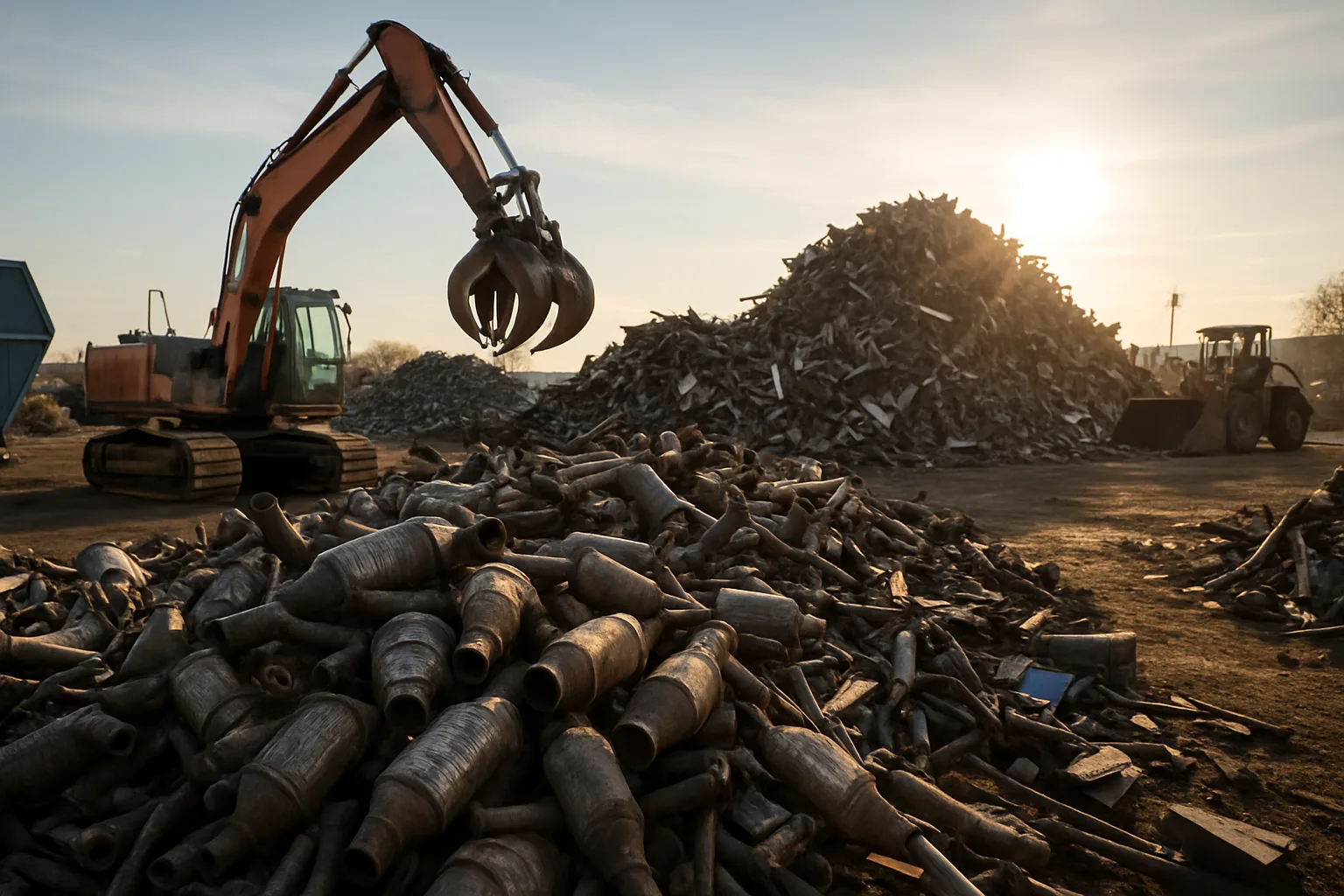
How Catalytic Converter Theft Is Quietly Destroying the Legitimate Scrap Market
Catalytic converter theft cost Canadian vehicle owners tens of millions of dollars in recent years — and the damage doesn't stop at the crime scene. Every stolen cat that moves through the grey market chips away at pricing transparency, drives buyers to tighten their compliance requirements, and makes life harder for the legitimate recyclers, auto shops, and collectors who are just trying to get fair value for their scrap. If you've noticed scrap catalytic converter prices in Oshawa feeling unpredictable lately, theft is part of the reason why.
This isn't a niche problem. It's reshaping how the entire recycling supply chain operates — from the junkyard in Ontario to the precious metal refiner processing platinum, palladium, and rhodium.
Why Stolen Cats Distort the Entire Recycling Market
Here's the core issue: catalytic converters contain real value. A single OEM cat from a late-model pickup or hybrid can carry meaningful quantities of platinum group metals (PGMs). That value doesn't disappear when a converter is stolen. It just flows through unofficial channels — no documentation, no accountability, no paper trail.
When stolen inventory floods the scrap market, it creates several compounding problems:
- Pricing opacity: Buyers who purchase undocumented cats have no way to verify make, model, or mileage — all factors that affect PGM content. That uncertainty gets priced into lowball offers for everyone.
- Buyer hesitation: Legitimate catalytic converter buyers in Ontario are increasingly cautious. Regulatory pressure means buyers who can't verify provenance face serious liability. That caution slows the whole market down.
- Reputation damage: Recyclers who do everything right still get lumped in with bad actors. First-time sellers face more scrutiny, more paperwork, and more friction — even when their inventory is completely clean.
- Suppressed competition: When buyers pull back from markets they see as risky, competition drops. Less competition means worse price discovery for legitimate sellers.
The honest scrap collector in Oshawa trying to move a pallet of cores ends up paying for a problem they didn't create.
What Regulators and Buyers Are Doing in Response
Ontario has tightened scrutiny around secondary metal dealers — and that trend is accelerating across Canada in 2026. Dealers are expected to maintain detailed records: who sold what, when, with what documentation. VIN lookups, serial tracking, and photo documentation have shifted from best practices to baseline expectations.
For individual sellers and small shops, this means more friction at the point of sale. Some buyers now require:
- Proof of vehicle ownership (or a bill of sale from a licensed dismantler)
- Government-issued ID matched to the transaction record
- Photos of the converter in situ before removal, where possible
- Serial numbers or OEM markings cross-referenced against the vehicle
None of this is unreasonable. But it does mean that sellers who come in unprepared get turned away or offered reduced rates while their documentation gets sorted. The documentation burden created by theft enforcement falls heaviest on people who were never part of the problem.
Platforms like SMASH are built for exactly this environment. When you list through a verified auction platform, the documentation requirements are built into the process — not an afterthought. SMASH Recycling — where verified buyers bid on your metal connects sellers with buyers who are already pre-vetted and operating within compliance frameworks. That matters when the regulatory environment is tightening.
The PGM Price Volatility Problem — And Why Oshawa Sellers Feel It First
Platinum, palladium, and rhodium prices move on global commodity markets. But the price you get for a scrap cat at the local level is also shaped by local supply chain dynamics — and theft disrupts those dynamics in ways that hit smaller markets like Oshawa and the surrounding Durham Region harder than they hit major hubs.
Here's why: larger markets have enough transaction volume that one bad actor doesn't skew the whole picture. In a mid-sized market, a spike in stolen inventory can flood local buyers quickly, making them defensive even on clean inventory. When buyers can't easily distinguish legitimate stock from compromised stock, they default to conservative pricing across the board.
This is why getting the best catalytic converter price in Canada increasingly requires more than just showing up with a converter in your trunk. You need documentation. You need to sell into a competitive environment. And you need buyers who are motivated to pay accurately — not buyers who are hedging against compliance risk by lowballing the whole lot.
For anyone moving volume — auto shops, dismantlers, small collectors — working with Oshawa scrap metal services that connect to a broader competitive buyer network is increasingly the smarter play.
How to Protect Your Price in a Theft-Disrupted Market
You can't fix the theft problem by yourself. But you can protect your position in a market that's been distorted by it. The sellers who get fair value in 2026 are the ones who make it easy for buyers to say yes without hesitation.
Here's what that looks like practically:
- Document everything at point of removal. Photos, VIN number, mileage reading, date of removal. It takes five minutes and eliminates the single biggest reason buyers discount clean inventory.
- Know your cat before you sell. A Honda Accord converter and a Ford F-250 converter carry very different PGM loads. Understanding what you have — and being able to prove it — directly affects your price.
- Don't settle for a single buyer quote. One phone call to one buyer is the old way. That's how you leave money on the table. Competition is what reveals the market.
- Use a catalytic converter auction format where possible. When multiple vetted buyers bid on the same inventory simultaneously, you get price discovery instead of price guessing. That's the structural advantage an auction provides.
- Check current pricing benchmarks. Scrap cat prices fluctuate with PGM spot prices. What you got six months ago may not reflect today's market. Read Canadian catalytic converter pricing guides to stay current on what drives value.
SMASH brings the catalytic converter auction model to the Canadian scrap market. Inventory tools, photo documentation, VIN lookup, and a network of vetted buyers in Ontario and across North America — it's the infrastructure that legitimate sellers need when the market is under pressure.
What "Legitimate" Looks Like — And Why It Commands a Premium
There's an irony in how theft has reshaped the market: fully documented, provenance-verified inventory is now worth more relative to undocumented stock than it was five years ago. Buyers who are operating properly — and who face real consequences for buying hot material — will pay a premium to work with sellers who make compliance easy.
This is especially true for higher-value converters. A large-substrate diesel cat or a hybrid converter with documented OEM provenance and clear chain of title isn't just easier to sell — it's actively desirable to serious buyers who need to demonstrate due diligence.
If you're an auto shop in Oshawa pulling cats from legitimate repairs and trade-ins, you're sitting on exactly the kind of inventory that compliant buyers want. The question is whether you're selling it through channels that surface that value, or just taking whatever the nearest buyer offers. Check current Canadian catalytic converter prices and understand what your documented inventory is actually worth before you accept the first number you hear.
Theft made the market harder. But it also created a real, structural advantage for sellers who do things right. Use it.
The Bottom Line for Ontario Sellers
Catalytic converter theft isn't going away overnight, and its effects on the legitimate recycling market in Ontario will continue to shape pricing dynamics, buyer behaviour, and compliance requirements throughout 2026 and beyond. The sellers who understand this aren't just better protected — they're better positioned to get accurate value for clean inventory in a market that increasingly rewards documentation and competition over convenience and guesswork.
If you're ready to stop guessing and start selling into a competitive, transparent environment, get the best Canadian price for your catalytic converter by requesting a free quote at best-catalytic-converter-price.ca. Your documented inventory deserves more than a single lowball offer.
Disclaimer: Scrap catalytic converter prices fluctuate with platinum, palladium, and rhodium spot prices. Always verify current rates before selling.
Frequently Asked Questions
Q: Why are scrap catalytic converter prices in Oshawa so inconsistent right now?
Several factors drive price inconsistency: PGM spot price swings, tighter buyer compliance requirements driven by theft enforcement, and local supply fluctuations. Selling through a competitive auction format — rather than relying on a single buyer quote — helps reveal the actual market price for your specific inventory.
Q: How does catalytic converter theft affect legitimate sellers trying to sell in Ontario?
Theft creates regulatory pressure that falls on all sellers, including legitimate ones. Buyers in Ontario face stricter documentation requirements and compliance scrutiny, which often results in more conservative pricing for undocumented inventory. Sellers who come prepared with photos, VINs, and proof of ownership consistently get better results.
Q: What documents do I need to sell a scrap catalytic converter in Oshawa?
At minimum, most buyers in Ontario will ask for government-issued ID, proof of vehicle ownership or a bill of sale from a licensed dismantler, and photos or records linking the converter to a specific vehicle. The more documentation you have, the more competitive the offers you'll receive.
Q: What metals inside a catalytic converter actually drive its scrap value?
Platinum, palladium, and rhodium — the platinum group metals (PGMs) — are the primary value drivers. The exact PGM content varies significantly by vehicle make, model, year, and engine type, which is why knowing what you have before you sell is essential to getting a fair price.
Q: Is a catalytic converter auction a legitimate way to sell scrap cats in Canada?
Yes. A catalytic converter auction connects your inventory to multiple vetted buyers simultaneously, creating price competition that benefits the seller. Platforms like SMASH operate within compliance frameworks designed for the Canadian scrap market, making the auction format both legitimate and practical for recyclers and auto shops across Ontario.
Stay current on scrap metal market trends and pricing insights — follow SMASH on LinkedIn for regular industry updates.
```