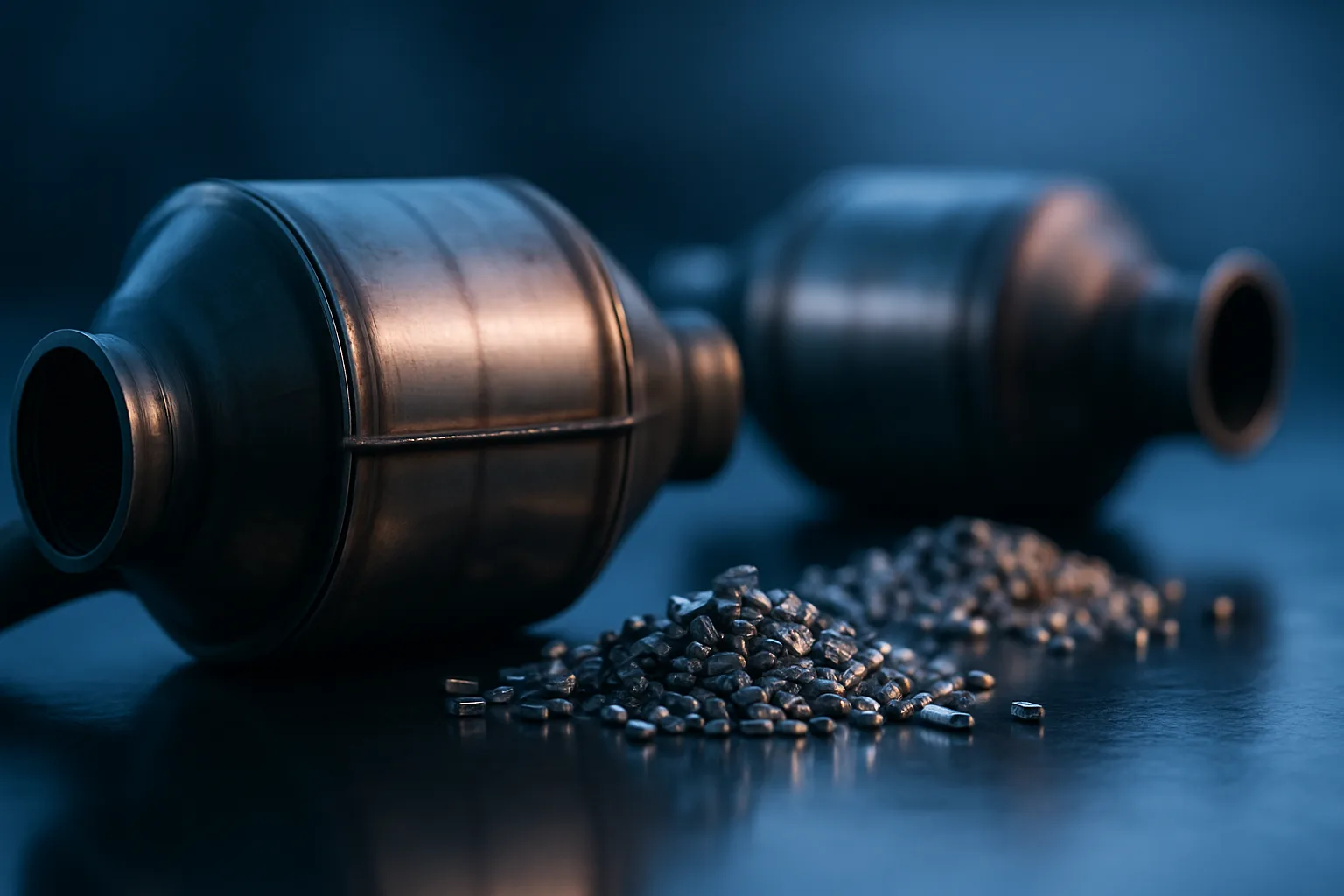
Canada tightened vehicle emissions standards again in 2026 — and every time that happens, platinum group metals get more valuable. If you're sitting on a pile of scrap cats and wondering why the market keeps moving, this is the article for you.
Emissions regulations don't just affect automakers. They ripple straight through to the scrap yard, to the recycler, and to every catalytic converter buyer in Brampton and across the country. Understanding that connection helps you sell smarter — and stop leaving money on the table.
Why Emissions Rules Drive Up Platinum Group Metal Prices
Every catalytic converter contains a washcoat loaded with platinum, palladium, and rhodium — the three platinum group metals (PGMs) that do the actual work of converting exhaust gases into less harmful emissions. Stricter standards mean tighter conversion thresholds. Automakers respond by loading more PGM per unit into new cats. More PGM per unit means higher demand from miners and refiners. Higher demand means tighter supply. Tighter supply pushes prices up.
This isn't a theoretical chain. It's played out every time a major regulatory body — whether that's Transport Canada, the EPA, or the EU — moves the goalposts on allowable emissions. The Euro 7 standards that started phasing into global supply chains in 2025 and 2026 have directly pushed automakers to respecify their catalyst formulations. That respecification flows downstream, and it affects what refiners are willing to pay for recovered PGMs from scrap cats right here in Ontario.
- Platinum (Pt): Used primarily in diesel catalysts. Demand remains steady as diesel commercial vehicles still dominate certain freight corridors.
- Palladium (Pd): Dominant in gasoline catalysts. Historically tight supply has kept palladium values elevated.
- Rhodium (Rh): The smallest component by weight, often the highest by value. Rhodium is essential for NOx reduction — a key target in modern emissions rules.
The short version: tighter rules create more demand for PGMs in new production, which pulls available supply toward the front of the supply chain. That makes recovered PGMs from scrap converters more attractive — and better priced — for buyers who need to source material without waiting on slow mining cycles.
What This Means for Catalytic Converter Recycling in Brampton and Across Ontario
Brampton sits at the intersection of some of the busiest auto salvage and fleet management activity in Ontario. The city's industrial corridors handle significant volumes of end-of-life vehicles, commercial fleet turnover, and auto body work. That translates into a consistent supply of scrap catalytic converters looking for buyers.
When PGM prices are elevated — driven by regulatory pressure on new vehicle production — buyers get more aggressive about sourcing scrap cats. Catalytic converter recycling in Brampton benefits directly from this dynamic. More competition among buyers means better price discovery. It also means sellers who know how to position their inventory — clean photos, accurate part identification, credible volume — capture more of that upside.
The problem is that most sellers in Ontario don't have visibility into what buyers are actually paying. One yard calls one buyer, gets one number, and takes it. That's not a market price. That's whatever one buyer wanted to pay that day. Platforms like SMASH Recycling — where verified buyers bid on your metal exist precisely to fix that problem. When multiple vetted buyers see your inventory at the same time, you get competition instead of guessing.
How Regulations Shape the Scrap Metal Recycling Market in Canada
Canada's approach to vehicle emissions has tightened consistently across the 2020s, and 2026 is no exception. The alignment between Canadian standards and U.S. EPA benchmarks means that most vehicles on Canadian roads are built to meet increasingly strict converter performance thresholds. As older vehicles age out and get scrapped, the converters they carry reflect years of regulatory escalation — meaning higher PGM loadings compared to vehicles from a decade ago.
For anyone involved in scrap metal recycling in Canada, this matters. The average scrap cat from a mid-2010s vehicle can carry meaningfully more recoverable PGM than a unit from the early 2000s. Knowing the vehicle make, model, year, and the specific converter part number (or better yet, the serial number) gives you leverage when you're negotiating. It's the difference between selling a commodity and selling a documented asset.
Buyers on professional platforms don't just want volume — they want information. A well-documented lot with clear photos, part identification, and accurate counts moves faster and draws more bids than a vague description of "50 mixed cats." If you want to get the best catalytic converter price in Canada, documentation is your competitive advantage.
Sell Catalytic Converter Near Me for Cash — What You Actually Need to Know
If you've searched "sell catalytic converter near me for cash," you've already noticed how fragmented the market is. Local buyers vary wildly in terms of what they'll pay, how transparent they are about assay results, and whether they're equipped to handle larger volumes properly. One buyer in Brampton might focus on high-grade foreign cats. Another might specialize in domestic units. Some won't touch aftermarket converters at all.
Here's what experienced sellers know:
- Identify before you sell. Don't hand over a mixed box without knowing what's in it. Even a basic visual sort — domestic, foreign, small foreign, large foreign, diesel — gives you more leverage.
- Photo documentation matters. Buyers need to verify what they're bidding on. Clear photos of the biscuit (the internal substrate), the shell condition, and any visible serial numbers increase buyer confidence and support better bids.
- Volume moves the needle. Individual units rarely command premium pricing. Aggregating inventory — whether from multiple vehicles or steady shop output — gives you more to work with.
- Get more than one number. A single quote is not a market price. Competitive bids are a market price.
This is exactly the model that SMASH Recycling — where verified buyers bid on your metal is built on. Instead of cold-calling buyers one at a time, you list your inventory once, vetted buyers see it simultaneously, and the auction format does the work of price discovery for you. No subscription. No guessing. SMASH only wins when you win.
Want to read Canadian catalytic converter pricing guides before you list? That's a smart move — knowing the landscape helps you set realistic expectations and spot a low-ball offer when you see one.
Platinum Group Metals Recycling: What Buyers Are Actually Looking For
Whether you're dealing with a local platinum group metals recycling operation or a national buyer with refinery relationships, the evaluation process is largely the same. Buyers assess your lot based on estimated PGM content — and that estimate depends on how accurately they can identify what they're looking at.
For sellers in Ontario, that means:
- Part number lookups: Many buyers cross-reference converter serial numbers against databases that estimate PGM content by OEM spec. If you can read the number off the shell, you can often get a much more precise bid.
- Visual substrate condition: A cracked or blown-out biscuit has lower recoverable PGM than an intact one. Buyers discount for this. Documenting condition upfront removes ambiguity.
- Vehicle source: A catalytic converter from a full-size North American pickup with a V8 engine will generally carry more PGM than one from a compact import. Buyers know this. So should you.
- Foil vs. ceramic substrate: Some high-performance and aftermarket cats use metallic foil substrates. These process differently than ceramic and aren't interchangeable in buyer evaluation.
Understanding these variables doesn't require a chemistry degree. It requires paying attention to what you're selling. Sellers who treat their converter inventory as a documented asset consistently outperform those who treat it as bulk scrap. If you want to check current Canadian catalytic converter prices, start by knowing what you have.
The 2026 Market: Where PGM Prices Stand and What Sellers Should Watch
PGM prices remain sensitive to a tight cluster of variables in 2026: South African mining output (still the dominant global source for platinum and palladium), industrial demand from the hydrogen economy (which consumes platinum), and ongoing regulatory pressure from major vehicle markets. Rhodium, despite its volatility over the past several years, continues to hold significant value when recovered in sufficient quantity from high-grade units.
For sellers in Brampton and across Ontario, the practical takeaway is this: the forces pushing PGM demand higher aren't going away. Emissions regulations globally are tightening, not loosening. Electric vehicle adoption, while growing, hasn't collapsed the ICE fleet fast enough to reduce scrap cat volumes in the near term. If anything, the transition period — where both ICE and hybrid vehicles are on the road simultaneously — sustains and in some cases increases demand for converter recycling services.
This is a good environment for informed sellers. The market is active. Buyers are competing. And the infrastructure for transparent, competitive selling — through platforms like SMASH — is accessible in a way it wasn't five years ago.
If you have scrap cats sitting in your yard, in your shop, or in your garage, now is the time to document them, identify them, and get them in front of competitive buyers. Start by getting a free quote at best-catalytic-converter-price.ca — it costs you nothing to find out what your inventory is actually worth in today's Canadian market.
Disclaimer: Catalytic converter prices and PGM values fluctuate with market conditions. Always check current rates before selling. The information in this article reflects general market dynamics as of August 2026 and is not a guaranteed price quote.
Frequently Asked Questions
Q: How do I find a reliable catalytic converter buyer in Brampton?
Look for buyers who are transparent about their pricing method — whether they use assay results, part number databases, or visual grading. Avoid buyers who won't explain how they arrived at a number. Platforms like SMASH connect sellers with vetted buyers and bring competitive bidding to the process, which is a meaningful step up from a single cold call.
Q: How much is a scrap catalytic converter worth in Ontario right now?
Values vary widely depending on the make, model, converter type, and current PGM spot prices. A domestic large-format cat from a full-size truck will fetch significantly more than a small foreign unit from a compact car. Check current rates at best-catalytic-converter-price.ca before you sell — prices fluctuate and a current quote is always more reliable than a number from last week.
Q: Does catalytic converter recycling in Brampton require any paperwork?
Yes. Ontario regulations require sellers of catalytic converters to provide valid government-issued ID and, in many cases, documentation of vehicle ownership or source. Reputable buyers enforce these requirements to comply with provincial anti-theft regulations. Keep your paperwork ready — it speeds up the transaction and establishes your credibility as a seller.
Q: Why does rhodium make some catalytic converters worth so much more?
Rhodium is the rarest of the three primary PGMs used in converters, and it's essential for reducing nitrogen oxide (NOx) emissions — a key target in modern emissions standards. Even small quantities of rhodium recovery can significantly affect the total value of a converter lot. High-grade foreign cats and certain OEM domestic units tend to carry higher rhodium content than aftermarket replacements.
Q: Is it better to sell catalytic converters individually or in bulk in Canada?
Generally, bulk lots attract more serious buyers and better pricing per unit because buyers can justify more thorough evaluation and processing at higher volumes. That said, a single exceptionally high-grade unit can command a strong individual price if it's properly identified. Aggregating inventory where possible — especially for shops and yards — consistently produces better outcomes than selling one unit at a time.
Follow SMASH on LinkedIn for ongoing scrap metal market insights, PGM price commentary, and industry updates across North America.