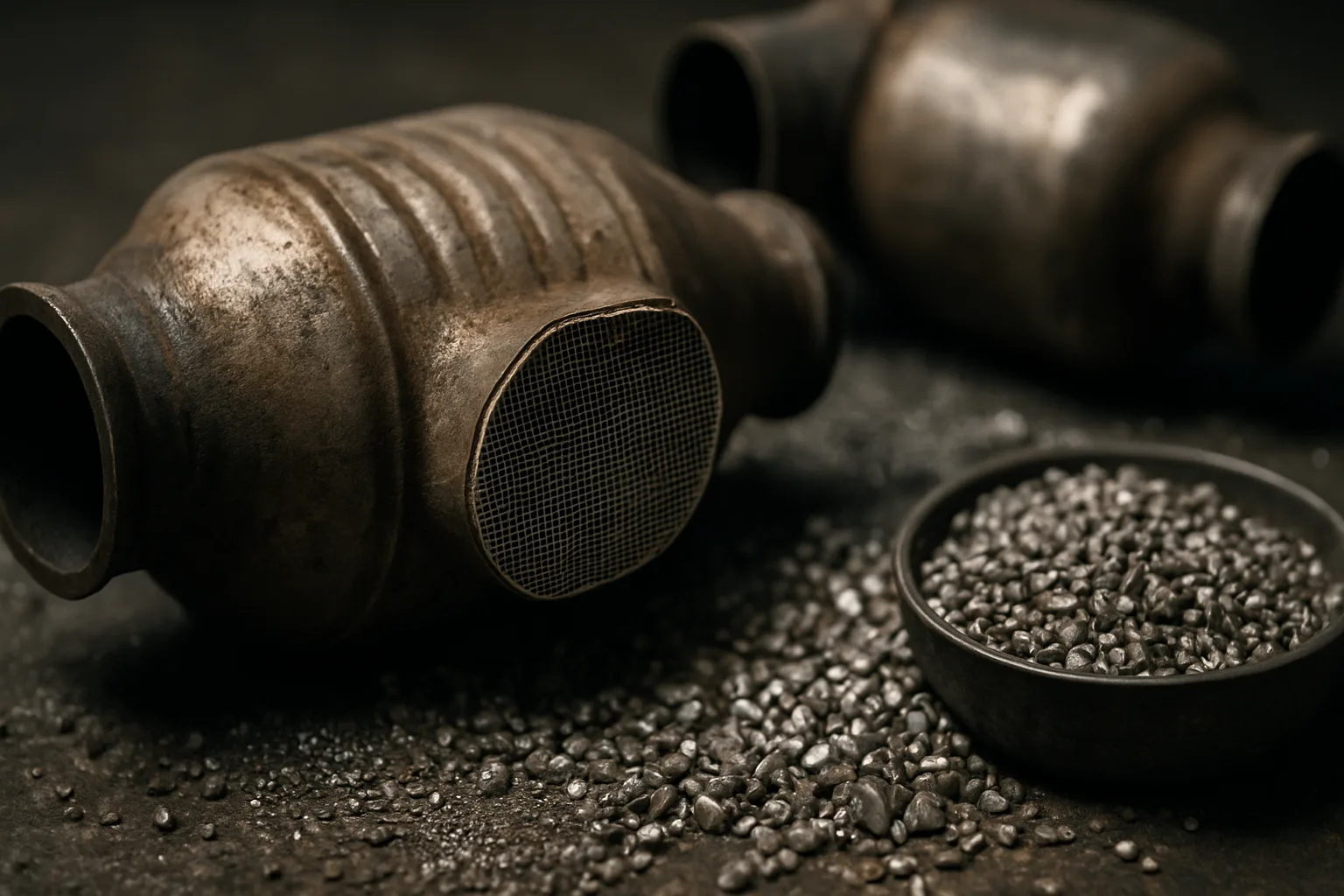
Most people have no idea what's sitting underneath their vehicle. A catalytic converter isn't just a piece of exhaust equipment — it's a compact vault of platinum, palladium, and rhodium. And when that vehicle reaches end-of-life, that vault gets opened. Understanding the full lifecycle of a cat converter helps you make smarter decisions at every stage, especially when it comes time to sell. If you're in Moncton or anywhere across New Brunswick, knowing what happens to your cat after you hand it over can mean the difference between getting fair market value and leaving serious money on the table.
This week's market recap digs into the full journey — from the moment a cat is manufactured to the final recovery of precious metals — and where scrap catalytic converter prices Moncton sellers can position themselves to capture real value.
---Stage One: What Gets Built Into a Catalytic Converter
Every catalytic converter starts with a ceramic or metallic substrate — a honeycomb-like structure coated with a washcoat that carries the precious metals. Those metals do the actual work. Platinum oxidizes hydrocarbons and carbon monoxide. Palladium handles similar reactions at different temperature ranges. Rhodium converts nitrogen oxides. Together, they reduce harmful emissions before exhaust exits your tailpipe.
The amounts are measured in grams, not ounces. A typical passenger vehicle cat might contain anywhere from one to ten grams of combined platinum group metals (PGMs), depending on the make, model, and engine type. Diesel vehicles often carry more platinum. Hybrids sometimes carry more palladium. That range matters enormously when you're trying to understand why two converters that look identical on the outside can be worth very different amounts at the scrap yard.
- Platinum (Pt): Used heavily in diesel converters, strong oxidation catalyst
- Palladium (Pd): Dominant in gasoline engines, volatile price history
- Rhodium (Rh): Rarest and often most valuable per gram, critical for NOx reduction
Stage Two: The Working Life and When Cats Fail
A properly functioning catalytic converter can last 150,000 to 200,000 kilometres — sometimes longer. They fail for predictable reasons: oil burning from engine wear, coolant contamination from a blown head gasket, physical damage from road debris, or simply reaching the end of their thermal lifespan after years of extreme heat cycling. When they fail, the honeycomb substrate can crack or collapse internally — what the trade calls a "rattler." That structural damage affects the recovery value.
A rattler isn't worthless. But it typically recovers fewer PGMs than an intact unit because the substrate has shifted and some of the washcoat — and the metals it carries — may have been lost or contaminated. When you sell, buyers who know their business will distinguish between a clean intact unit and a damaged one. Transparency about condition is worth something. Platforms that let you document and photograph your inventory before a sale give buyers that confidence — and confidence translates to stronger bids.
Stage Three: Removal, Sorting, and Getting Ready to Sell
This is where most sellers either win or lose value. Once a cat is cut off a vehicle, the clock starts ticking on your negotiating position. If you accept the first offer you get — from a single buyer, on a single phone call — you've already lost the competition that drives price discovery.
Sorting matters here. Not all cats are equal, and not all buyers price them the same way. Different buyers have different smelter relationships, different assay results, and different demand profiles depending on what their downstream processors are running. A serial number, a VIN lookup, and clear photo documentation of your unit — intact or otherwise — are tools that open the door to more buyers and better offers. For anyone handling volume in Moncton scrap metal services, this step separates the yards running a professional operation from those leaving money behind on every load.
Common categories you'll encounter when sorting:
- High-grade / foreign cats: Often from European and Japanese imports, high PGM content
- Domestic cats: North American makes, generally mid-range returns
- Small foreign / small domestic: Lower PGM content, typically lower per-unit value
- Diesel cats / DPFs: Different PGM profile, often processed separately
- Aftermarket / universal cats: Lower PGM content, significantly lower value
- Foil / wire mesh cats: Metallic substrate, different processing requirements
How Cat Converter Prices in Moncton Are Actually Determined
If you want to understand cat converter prices Moncton — or anywhere else in Canada — you need to understand the pricing chain. Buyers quote you based on their estimate of PGM content, discounted by their processing costs, their margin, and current spot prices for platinum, palladium, and rhodium on commodity markets. Those spot prices move daily. A rhodium spike or a palladium correction can shift what your load is worth by a meaningful percentage in the span of a week.
That's why chasing a single quote from a single buyer is the wrong move. You're getting one interpretation of your cat's value, filtered through that buyer's margin requirements and their read on the market. SMASH — a vetted scrap metal auction platform serving yards and buyers across North America — creates competition around that single-buyer dynamic. When multiple vetted buyers bid on your cats, the market reveals what your load is actually worth. That's not hype. That's how price discovery works in every liquid market. To check current Canadian catalytic converter prices and understand where your units sit in the current market, real-time information is your best starting point.
A few factors that move cat converter prices in 2026:
- Live PGM spot prices (platinum, palladium, rhodium fluctuate independently)
- Assay results from smelters — actual recovered PGM content per lot
- Condition of the units (intact vs. damaged substrate)
- Volume — larger lots often attract more buyer interest
- Documentation quality — serial numbers, photos, and VIN data increase buyer confidence
- Market demand cycles — automotive production trends affect PGM demand downstream
Stage Four: Processing and Precious Metal Recovery
Once cats reach a processor, the real chemistry begins. Processors use one of two main methods: pyrometallurgical (smelting at extreme heat) or hydrometallurgical (chemical leaching). Both methods recover PGMs from the substrate and washcoat, but they differ in cost, throughput, and what else they can recover alongside the precious metals.
After smelting or leaching, the recovered PGMs go through refining to separate platinum, palladium, and rhodium into pure form. Those refined metals re-enter the market — going back into new catalytic converters, industrial catalysts, electronics, and other applications. It's a tight loop. The automotive supply chain for PGMs depends heavily on secondary recovery from scrap. That's why catalytic converter buyers New Brunswick — and across Canada — are connected to a global downstream that takes this material seriously.
The recovery rate matters to your price. Processors who achieve higher recovery rates can pay more upstream. Buyers who work with high-efficiency processors can be more competitive. This is another reason why SMASH and the network it connects you to matters: vetted buyers with strong downstream relationships are in a position to quote more aggressively because they lose less in processing.
Where Sellers in New Brunswick Fit Into This Chain
Whether you're an auto wrecker in Moncton pulling cats off end-of-life vehicles every week, or an individual with a handful of units from a home mechanic job, your position in this chain is the same: you have material that holds real value, and the goal is to capture as much of that value as possible before it passes to the next hand.
The old approach — call one buyer, take the offer, ship the load — works fine for the buyer. It doesn't work for you. New Brunswick sellers who are getting the best catalytic converter price in Canada are doing it by creating competition, documenting their inventory properly, and working with platforms that put multiple buyers in the room. For more strategies and market context, read Canadian catalytic converter pricing guides to stay ahead of market shifts. And for the auction infrastructure that makes competitive selling possible, smashrecycling.ca is the platform built for exactly this.
Whether you're comparing notes with Brown's Aluminum & Catalytic Converter Scrap Yard or evaluating what buyers in other regions are paying, the principle is the same: information and competition are your two most powerful tools. Use them.
If you're ready to stop guessing and start selling with data behind you, the best next step is simple. Get a free quote at best-catalytic-converter-price.ca — and find out what your cats are actually worth in today's Canadian market.
Disclaimer: Catalytic converter prices fluctuate with daily PGM spot prices. The values you receive for your units depend on current market conditions, unit type, and condition at time of sale. Always verify current rates before making selling decisions.
---Frequently Asked Questions
Q: How are scrap catalytic converter prices in Moncton determined?
Prices are based on the type and quantity of platinum group metals (PGMs) your converter contains, current commodity spot prices for platinum, palladium, and rhodium, and the processing costs your buyer carries. Because those spot prices move daily, the price you get today may differ from what you'd get next week. Working with a competitive auction platform like SMASH helps ensure you're getting current market value rather than a single buyer's discounted offer.
Q: Does a damaged or rattling catalytic converter have any scrap value?
Yes — a rattler still contains PGMs, but typically at a reduced recovery rate compared to an intact unit. The internal substrate has shifted, meaning some washcoat and precious metal content may have been lost. Buyers will typically offer less for damaged units, but they are still worth selling. Always document the condition honestly and let competing buyers price the risk.
Q: How many catalytic converters do I need before it's worth selling?
There's no strict minimum, but larger volumes generally attract stronger buyer interest and more competitive bids. Even a small lot of well-documented cats with serial numbers and photos can generate real competition on a platform like SMASH. Single units are also worth pricing out — don't assume quantity is the only factor.
Q: Are catalytic converter prices in New Brunswick different from other provinces?
The underlying PGM commodity prices are the same across Canada — they're set by global markets. What varies is the buyer network in your region and the competition you can generate around your lot. Sellers in Moncton and across New Brunswick who access national buyer networks through auction platforms get exposure to more bids than those who rely on local buyers alone.
Q: What information should I have ready before selling my scrap catalytic converter?
The more documentation you provide, the better. Ideally, have: the serial number or part number stamped on the converter, the vehicle make, model, and year (VIN lookup helps), clear photos of the unit showing condition, and an indication of whether it's intact or damaged. Buyers use this information to assess PGM content and price accordingly — better documentation means more confident bids and potentially stronger offers.
---Stay current on scrap metal market trends and PGM price movements — follow SMASH on LinkedIn for weekly industry updates and catalytic converter market insights.