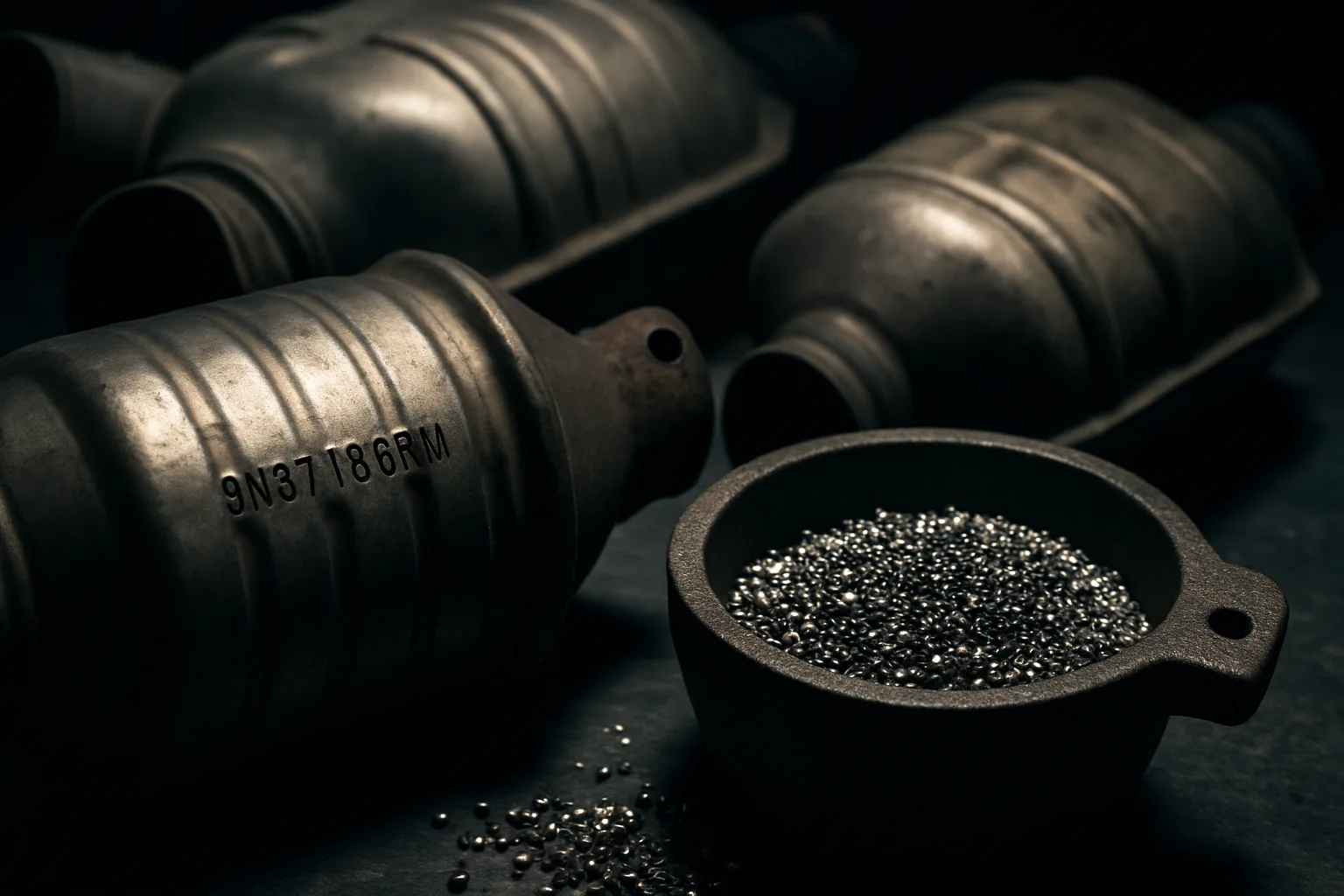
What That Serial Number on Your Catalytic Converter Actually Tells You
Most people selling scrap catalytic converters leave money on the table — not because the market is bad, but because they don't know what they're holding. That serial number stamped on your cat isn't just a manufacturer code. It's a direct link to the precious metal content inside, and it's one of the most important factors determining scrap catalytic converter prices in Dartmouth and across Canada.
If you've ever wondered why two converters that look nearly identical can have wildly different values, the answer is almost always in the serial number. Learning to read them — or at least knowing what to do with them — can mean the difference between a fair payout and a lowball offer you didn't know to question.
Why Serial Numbers Matter for Catalytic Converter Pricing
Inside every catalytic converter is a ceramic or metallic substrate coated with platinum group metals (PGMs): platinum, palladium, and rhodium. These are the materials buyers actually care about. The amount of each metal varies significantly by make, model, year, and application — and the serial number is the key to identifying exactly which converter you have.
Buyers who know what they're doing use serial number databases and catalytic converter price lists with pictures to cross-reference your unit against known assay data. That data tells them — with reasonable accuracy — how much platinum, palladium, and rhodium to expect per unit. Rhodium alone has historically commanded prices in the thousands of dollars per troy ounce, making even small variations in content a big deal financially.
- Platinum (Pt): Used primarily in diesel converters. Adds baseline value to most units.
- Palladium (Pd): Dominant in gasoline converters. One of the most price-sensitive PGMs on the market.
- Rhodium (Rh): Present in smaller amounts but often the highest-value metal by weight in a given unit.
Without the serial number, a buyer has to guess — or default to a conservative low estimate to protect themselves. With it, they can price confidently and competitively. That competitive pricing is exactly what platforms like the SMASH Recycling auction platform are built around.
Where to Find the Serial Number on a Catalytic Converter
Serial numbers aren't always easy to spot, especially on older or rusty units. Here's a practical breakdown of where to look based on converter type.
OEM (Original Equipment Manufacturer) Converters
These are factory-installed units. The serial number is typically stamped or embossed directly into the metal shell — often on the top, side, or end cap of the converter body. On older vehicles, corrosion and road grime can obscure it. A wire brush and good lighting help. The format varies by manufacturer but usually includes a combination of letters and numbers.
Aftermarket Converters
Aftermarket units — think brands like Walker, MagnaFlow, or Eastern — have their own numbering systems. These are often printed on a sticker, stamped on a metal tag, or embossed near the inlet or outlet pipe. Important note: most aftermarket converters contain significantly less PGM content than OEM units. Their scrap value is lower, sometimes substantially. Knowing this upfront prevents disappointment.
Foreign (Import) and Pre-Owned Units
Japanese domestic market and European vehicles often use converters with different substrate configurations and PGM loading. Serial numbers on these units may follow formats you won't recognize if you're used to North American vehicles. This is where a catalytic converter price list with pictures and a knowledgeable buyer becomes especially valuable — visual identification combined with serial verification gives the most accurate result.
If you're in Dartmouth or anywhere in Nova Scotia and you're sorting through a mixed batch from a dismantler or fleet teardown, photograph every serial number before you move or stack units. Once they're mixed up, identification gets harder and your negotiating position weakens.
How to Use a Serial Number to Estimate Your Converter's Value
Once you have the serial number, here's how the identification process actually works — and how to use it to your advantage when selling.
- Search a buyer's database or price list. Reputable catalytic converter buyers maintain lookup tools. You enter the serial number and get a reference value based on current PGM spot prices and known substrate data. Some tools are publicly accessible; others are buyer-facing only.
- Cross-reference with pictures. Visual identification helps confirm you have the right unit. Shell shape, inlet/outlet size, and stamping location all provide secondary confirmation. A serial number match that doesn't match the physical description of the converter is a red flag worth questioning.
- Factor in condition. A converter that's been overheated, cracked, or has a melted substrate has degraded PGM content. Physical damage lowers value — no serial number lookup changes that. Be honest about condition; experienced buyers will inspect on arrival anyway.
- Compare against current spot prices. PGM prices move daily. A converter worth one price on Monday may be worth noticeably more or less by Friday. Always check current market conditions before agreeing to a price. To check current Canadian catalytic converter prices, use a live pricing resource rather than relying on a quote from two weeks ago.
- Get multiple offers. This is where most sellers leave money behind. One buyer, one phone call, one number. That's the old way. Competition reveals the real market value of your material — a fact that getting the best catalytic converter price in Canada depends on entirely.
Common Serial Number Formats by Manufacturer
You don't need to memorize every format, but understanding the general patterns helps you confirm you're reading the right thing — and not confusing a part number with the actual serial or model identifier buyers use for pricing.
- GM / Chevrolet / GMC: Often a 7-10 digit alphanumeric code stamped on the body. Look for codes starting with "GM" or a numeric sequence near the inlet flange.
- Ford: Ford OEM units frequently carry a part number formatted as a series of letters and digits (e.g., F-prefix codes). These correlate to specific vehicle applications and known PGM loadings.
- Toyota / Honda / Nissan: Japanese OEM converters tend to have high PGM content relative to their size. Serial codes are often stamped near the air tube port or on the mid-shell. These units are frequently among the higher-value cats in a mixed load.
- Diesel trucks (Ford 6.0/6.4, Duramax, Cummins): Diesel OEM cats are larger and platinum-heavy. The serial format varies, but the physical size alone is a tip-off that you're holding a higher-value unit. Confirm with the number before pricing.
- Aftermarket codes (Walker, Eastern, MagnaFlow): These use their own SKU or part number systems. Buyers recognize these immediately — don't expect OEM pricing on aftermarket units regardless of what the serial number looks like.
For sellers in Dartmouth or across Nova Scotia working through high-volume dismantling operations, sorting by these categories before approaching buyers is worth the time. Mixing high-value OEM units with low-value aftermarket converters in the same quote request tends to pull your average price down.
Why Selling Through a Competitive Platform Gets You More
Here's the honest reality of the traditional scrap converter market: most sellers deal with one buyer, accept one number, and never know if they left money behind. The buyer knows exactly what your serial numbers mean. You might not. That information gap is where margin quietly disappears.
SMASH changes that dynamic. When you list your converters through SMASH, vetted buyers compete against each other for your material. Your serial numbers and documentation go to multiple buyers simultaneously. The competition does what competition always does — it moves prices toward actual market value rather than toward whatever a single buyer is comfortable paying that day.
For yards and collectors in Dartmouth and across the Atlantic provinces, access to a broader buyer network matters. Local market depth isn't always what you'd find in larger metro centers. A scrap metal auction platform like SMASH bridges that gap directly. To read Canadian catalytic converter pricing guides and understand how competitive pricing works in practice, the resources are there — use them.
Document your units properly. Photograph serial numbers clearly. Know what you're holding before you talk to buyers. That's the whole game.
If you're ready to stop guessing and start selling with real price discovery behind you, the next step is straightforward. Get the best catalytic converter price in Canada — submit your inventory, get competing offers, and walk away knowing you got what your material was actually worth.
Disclaimer: Catalytic converter prices fluctuate daily based on platinum, palladium, and rhodium spot prices. All values should be verified against current market rates at time of sale. The information above is for general guidance only.
Frequently Asked Questions
Q: How do I find out how much my catalytic converter is worth by serial number?
Look up your serial number in a buyer's database or use an online catalytic converter price list that cross-references serial numbers with current PGM spot prices. The serial number identifies your specific unit's substrate type and precious metal loading — that's what drives the price. For accurate Canadian valuations, check with buyers who price in CAD and account for current market conditions.
Q: What are cat converter prices like in Dartmouth, Nova Scotia right now?
Cat converter prices in Dartmouth follow national Canadian market rates, which fluctuate with platinum, palladium, and rhodium spot prices. OEM converters from popular makes like Toyota, Honda, and GM tend to command stronger prices than aftermarket units. To get accurate current pricing, use a platform that puts your material in front of multiple catalytic converter buyers in Nova Scotia and beyond — competition is your best tool for price discovery.
Q: Is there a catalytic converter price list with pictures I can use to identify my unit?
Yes — several buyers and pricing services publish visual reference guides that pair converter images with serial number ranges and approximate values. These are useful for initial identification, especially when serial numbers are partially obscured. Visual ID alone isn't enough for final pricing; always confirm with the serial number before agreeing to a sale.
Q: Do aftermarket catalytic converters have the same scrap value as OEM units?
No — and often the difference is significant. Aftermarket converters are manufactured to meet emissions standards at lower cost, which typically means reduced PGM loading compared to factory OEM units. When you're sorting a mixed load, separating aftermarket from OEM before pricing is worth doing. Buyers will identify them either way, so knowing upfront protects your expectations.
Q: Why should I use a scrap metal auction platform instead of selling directly to one buyer?
A single buyer gives you one price take it or leave it. A competitive auction platform puts your documented inventory in front of multiple vetted buyers at once. More buyers bidding on the same material means better price discovery — the market, not one buyer's margin target, determines what you get. For sellers in Dartmouth or anywhere in Nova Scotia, that access to a broader buyer pool can make a measurable difference per unit.
---Stay current on scrap metal market trends and PGM pricing shifts — follow SMASH on LinkedIn for regular industry updates and catalytic converter market insights.