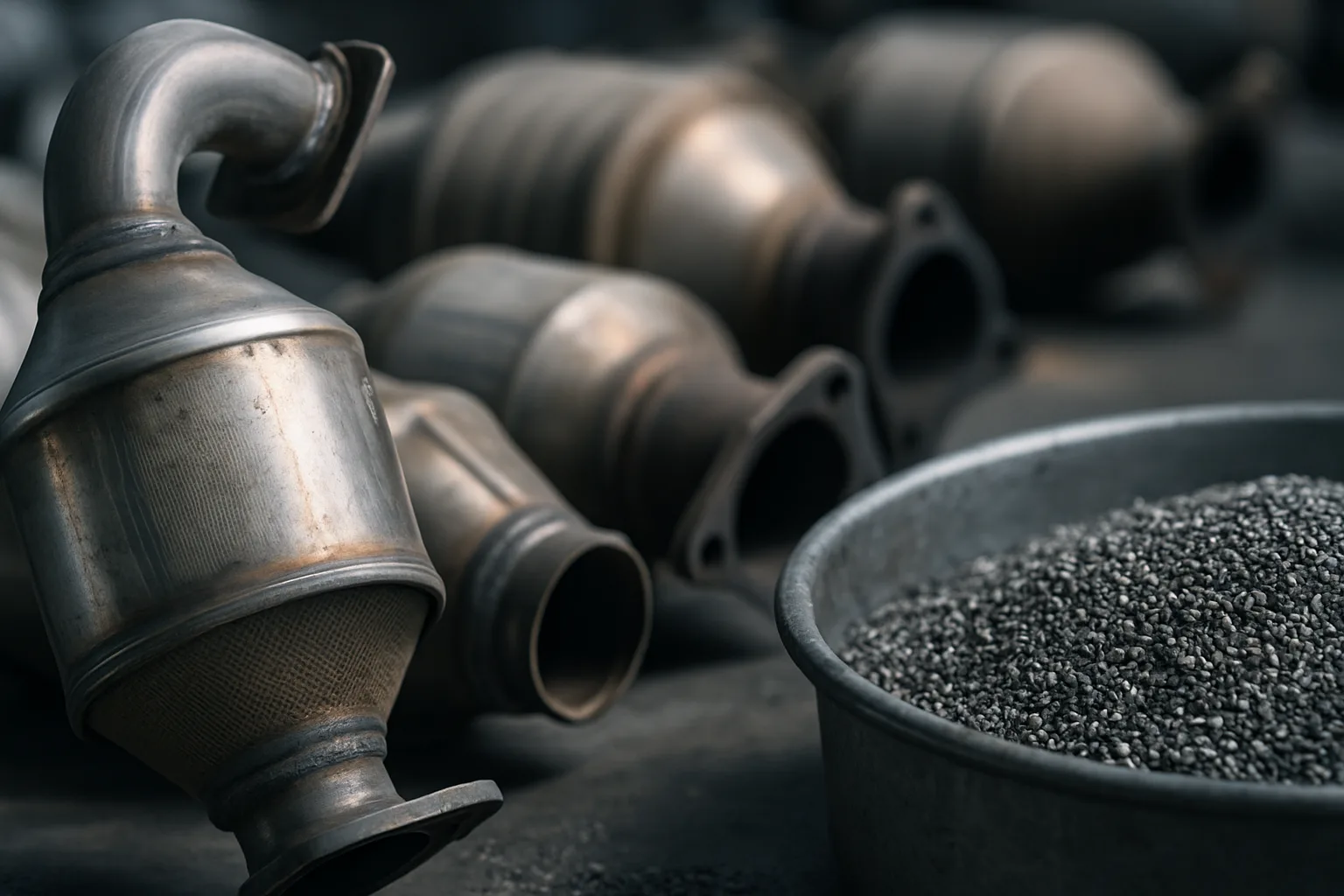
What's Actually Inside a Catalytic Converter — and Why It's Worth Real Money
Most people have no idea that the component bolted under their car contains some of the most valuable metals on earth. We're talking platinum, palladium, and rhodium — precious metals that drive the scrap catalytic converter market and determine what your cat is actually worth. If you're in Gatineau or anywhere across Quebec trying to figure out what your converter fetches, understanding what's inside it is the first step to getting a fair price.
This week's market recap breaks down the precious metals inside catalytic converters, explains why their prices swing so dramatically, and shows you how to stop leaving money on the table when you sell.
---The Three Precious Metals That Determine Your Cat Converter Value
Every catalytic converter contains a ceramic or metallic substrate coated with a precise blend of platinum group metals (PGMs). These PGMs are what buyers — and recyclers — actually want. The converter housing, the ceramic honeycomb, the heat shields? Those are secondary. The PGMs are the prize.
Here's how each metal works inside the converter:
- Platinum (Pt): Handles the oxidation of carbon monoxide and unburned hydrocarbons into CO₂ and water. It's the workhorse. Diesel vehicle converters tend to carry more platinum than gasoline units.
- Palladium (Pd): Excels at breaking down hydrocarbons at lower temperatures, making it dominant in gasoline-powered vehicles. Palladium loadings have increased significantly over the last decade as emissions standards tightened.
- Rhodium (Rh): The rarest of the three. Rhodium handles nitrogen oxide (NOx) reduction — a function neither platinum nor palladium performs as efficiently. Because rhodium is so scarce, its price is historically volatile, and it has the highest per-gram value of the three metals in most market conditions.
The actual PGM loading — meaning the weight of each metal per converter — varies dramatically depending on the vehicle make, model, engine size, and year of manufacture. A small economy car converter might carry fractions of a gram of each metal. A large truck or luxury SUV converter can hold several grams. That spread is exactly why two converters that look identical on the outside can have very different scrap values.
Rhodium Price Today: Why One Metal Moves the Market
If you've been watching the scrap catalytic converter market in 2026, you already know that rhodium price movement can shift what your cat is worth almost overnight. Rhodium has no major substitute for its primary industrial use — automotive emissions control — which means supply constraints hit hard and fast.
Rhodium is mined almost exclusively as a byproduct of platinum mining in South Africa, with smaller volumes coming from Russia. Global supply is thin. When automaker demand rises or mining output dips, rhodium prices can spike sharply. When recycling supply floods the market or EV adoption reduces demand, prices can compress just as quickly.
This is why checking the rhodium price today matters before you sell. A converter you held six months ago may now be worth more — or less — simply because rhodium moved. Platforms built for price discovery, like SMASH, exist precisely because static price lists and single-buyer quotes don't capture real-time market conditions. If you're relying on one phone call to set your price, you're guessing.
For reference, palladium has also experienced notable price swings in 2026 as the automotive industry's shift toward battery electric vehicles continues to reshape long-term PGM demand forecasts. Palladium is more heavily weighted toward internal combustion engine vehicles, so as EV penetration grows, the market is watching palladium loadings carefully.
Why Cat Converter Values Vary So Much Across Vehicle Types
Sellers often expect a simple answer: "What's my cat worth?" The honest answer is — it depends on which cat you have. And that's not a dodge. It reflects how the recycling market actually works.
Here are the main factors that determine scrap catalytic converter value in Canada:
- Vehicle make and model: Luxury vehicles and trucks with larger engines typically carry higher PGM loadings. High-performance or specialty vehicles often have premium converters.
- OEM vs. aftermarket: Original equipment manufacturer converters carry real PGM loads. Cheap aftermarket replacements — particularly those that became common after catalytic converter thefts surged in prior years — often contain minimal precious metals and yield far less at scrap.
- Converter condition: Burned-out, cracked, or substrate-damaged converters recover fewer PGMs during the smelting process. Buyers adjust bids accordingly.
- Serial number and VIN traceability: A documented converter with verifiable origin gives buyers confidence. That confidence translates into better bids. SMASH's serial tracking and VIN lookup tools exist for exactly this reason.
- Current PGM spot prices: Platinum, palladium, and rhodium prices are set globally and updated constantly. Your converter's scrap value moves with them.
If you're in Gatineau and you've pulled a batch of cats from a shop teardown or a salvage job, don't treat them as a commodity lot without documentation. Itemized, photographed, and serial-tracked inventory consistently attracts stronger buyer interest than an undocumented pile. The work upfront pays off at settlement.
Scrap Metal Recycling Canada: How the Cat Converter Supply Chain Works
Understanding where your converter goes after you sell it helps you negotiate more confidently. Scrap metal recycling in Canada for catalytic converters follows a defined path:
You sell the converter to a buyer or aggregator. That buyer collects enough volume to ship a load to an assay and smelting facility — typically in Canada, the U.S., or Europe. The facility processes the substrate, recovers the PGMs, and pays the buyer based on the confirmed metal content and current spot prices. The buyer's margin sits between what they paid you and what the smelter returns.
That margin is where the old, broken system costs you money. If one buyer sets your price, you have no leverage. You're accepting their margin as fixed. Competitive bidding — the model SMASH uses — pushes that margin tighter because buyers have to outbid each other to win your inventory. More buyers means better price discovery. That's not marketing language. That's how commodity markets are supposed to work.
To get the best catalytic converter price in Canada, you need access to multiple serious buyers — not a single contact with a take-it-or-leave-it number. Quebec sellers, including those in Gatineau and the surrounding region, are increasingly moving toward auction-based platforms because the math is straightforward: competition works in the seller's favor.
How SMASH Makes Price Discovery Work for Canadian Cat Sellers
SMASH is a vetted buyer auction platform built for scrap metal — including catalytic converters. The platform isn't a price list. It's a live competitive market. You document your inventory, list it, and vetted buyers bid. The auction format does the price discovery work that a single cold call never can.
For catalytic converter sellers specifically, the SMASH platform supports:
- Photo documentation — so buyers assess what they're bidding on, not what they assume
- Serial number and VIN tracking — critical for converter provenance and buyer confidence
- Vetted buyer network — no tire-kickers, no time-wasting lowball calls
- Auto-invoicing — paperwork handled, not piled up
- No subscription fees — SMASH earns when you earn
Sellers in Gatineau and across Quebec can smashrecycling.ca to learn how the platform works and get started. If you're sitting on a load of cats and haven't tested competitive bidding yet, you don't know what your inventory is actually worth to the market.
To go deeper on how Canadian pricing works across different converter types and vehicles, read Canadian catalytic converter pricing guides that break down the market in practical terms.
What the 2026 Market Means for Sellers Right Now
The 2026 scrap catalytic converter market reflects ongoing tension between two forces: continued ICE vehicle demand driving short-term PGM consumption, and longer-term EV growth that's reshaping how analysts think about platinum and palladium over the next decade. Rhodium remains tightly supplied. Palladium pricing is being watched closely as EV penetration numbers update quarterly.
What this means practically: the window where your converters carry strong value is not guaranteed to stay open indefinitely. Holding inventory without selling isn't a neutral position — it's a bet on price direction. If you don't have a reason to hold, sell into a competitive market now and let buyers tell you what the market thinks your load is worth today.
The best time to check current Canadian catalytic converter prices is before you commit to any single buyer's number. Know what the market says first.
Whether you're an auto shop clearing a backlog, a salvage yard in the Gatineau area, or a private seller with a few units, the process is the same: document your inventory, understand what metals you're holding, and sell through a platform where buyers compete. That's how you stop guessing and start getting paid what your cats are actually worth.
Disclaimer: Precious metal prices — including platinum, palladium, and rhodium — fluctuate daily based on global market conditions. All scrap catalytic converter values change with spot prices. Always verify current rates before finalizing any transaction.
---Frequently Asked Questions
Q: What precious metals are inside a catalytic converter?
Every catalytic converter contains a combination of platinum, palladium, and rhodium — known collectively as platinum group metals (PGMs). The exact blend and quantity depends on the vehicle make, model, engine type, and year of manufacture. These PGMs are what give your scrap converter its market value.
Q: How do I get the best catalytic converter price in Gatineau?
The most reliable way to get a strong price in Gatineau is to document your converters properly — photos, serial numbers, VIN data where available — and sell through a platform where multiple vetted buyers compete for your inventory. A single buyer quote gives you one data point. A competitive auction gives you the market. Platforms like SMASH are built to create that competition for Canadian sellers.
Q: Why does the rhodium price matter when I sell my cat?
Rhodium is the rarest and often most valuable of the three PGMs in a catalytic converter. Because it's in tight supply globally, its price is highly volatile. When rhodium prices rise, your converter is worth more. When they fall, values compress. Checking the current rhodium price before selling helps you time your transaction and negotiate from a position of knowledge.
Q: Is an aftermarket catalytic converter worth less as scrap?
Generally, yes. Aftermarket converters — especially cheap replacements — often contain significantly lower PGM loadings than OEM units. When you bring them in for scrap, the recovered metal content is lower, so the payout is lower. If you have a mix of OEM and aftermarket units, it's worth separating and documenting them distinctly.
Q: Can I sell scrap catalytic converters from Quebec to buyers across Canada?
Yes. The scrap catalytic converter market in Canada is national, not local. Buyers across the country — and in some cases the U.S. — bid on Canadian inventory. Selling through an auction platform removes the geographic limitation of a single local buyer and opens your inventory to a broader, more competitive market.
---If you're ready to stop guessing and start getting real market value for your converters, the smartest move is straightforward: document your inventory, get multiple eyes on it, and let competitive bidding set the price. Get the best Canadian price for your catalytic converter — get a free quote at best-catalytic-converter-price.ca.
Follow SMASH on LinkedIn for weekly scrap metal market insights, PGM price updates, and industry news that helps you sell smarter.