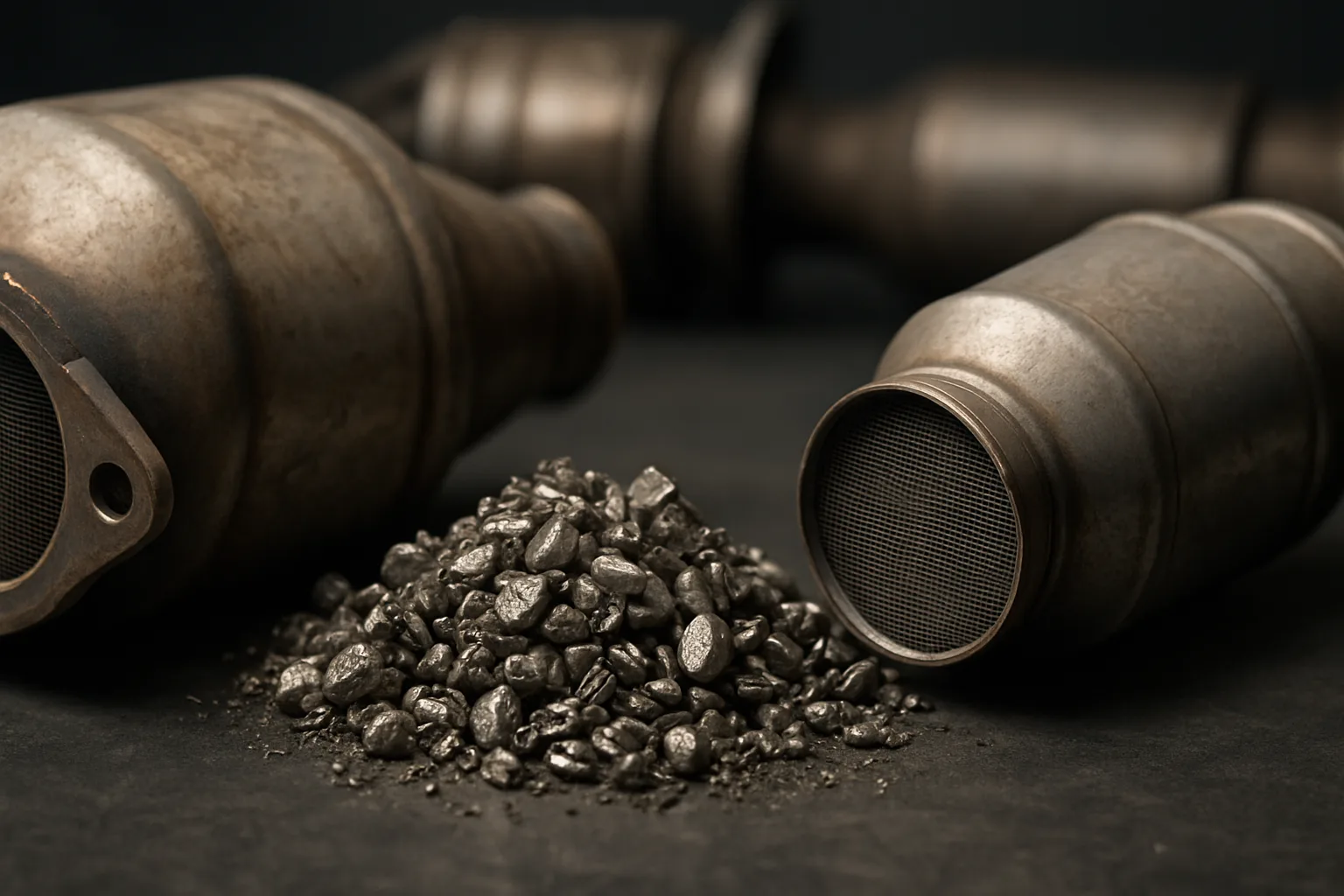
Why Two Catalytic Converters That Look Identical Can Be Worth Completely Different Money
Pull two catalytic converters off the shelf. Same size. Similar weight. Both bolt-fit a 2019 Honda Accord. One is worth $180 in scrap. The other might fetch $40. Understanding why that gap exists is the difference between leaving money on the table and knowing exactly what you're holding. If you're selling cats in Hamilton or anywhere across Ontario, this matters more than you might think.
The short answer: OEM converters are loaded with platinum group metals (PGMs) — platinum, palladium, and rhodium — at concentrations that aftermarket units simply don't match. But the full picture is more nuanced than that. Getting the best catalytic converter price in Canada starts with knowing exactly what type of converter you have before you name a number.
OEM vs Aftermarket: What's Actually Inside the Converter
An OEM (original equipment manufacturer) catalytic converter is built to meet strict emissions standards set by the vehicle manufacturer. To hit those targets reliably over a vehicle's full life cycle, OEM units are loaded with higher concentrations of PGMs — platinum, palladium, and rhodium — embedded into a ceramic or metallic substrate. These metals are the catalysts that break down harmful exhaust gases into less toxic compounds. More catalyst loading means better performance and a longer service life.
Aftermarket converters are engineered to a price point. They work — they'll pass an emissions test — but they do it with lower PGM loading. The substrate may be thinner. The metals may be applied less densely. Some offshore-manufactured units contain minimal PGM content. That directly translates to lower scrap value, because when a refiner processes the substrate, there's simply less recoverable metal to price out.
Here's what that means practically for scrap value:
- OEM converters from high-end vehicles (BMW, Mercedes, Toyota hybrids, Lexus) can carry significant rhodium and palladium content — driving values up considerably
- Standard OEM converters from domestic makes still typically outperform aftermarket on PGM load
- Aftermarket converters — especially high-volume brands like Walker or MagnaFlow direct-fit units — will assay lower because that's baked into their manufacturing cost
- Counterfeit or grey-market converters may contain almost no recoverable PGMs and are nearly worthless at the refinery
Why Cat Converter Prices Hamilton Buyers Quote Vary So Much
If you've gotten quotes for the same converter and seen wide variation, this is why. A buyer who knows what they're looking at will identify OEM vs aftermarket before quoting. One who doesn't — or who quotes a flat rate regardless — will either lowball OEM units to protect their margin or overpay on aftermarkets and adjust later. Neither situation serves you well.
Hamilton has a strong scrap and auto recycling sector, partly fed by the region's industrial and automotive service history. Yards in Hamilton and across Ontario are processing a mix of OEM pulls from wreckers and aftermarket units from shops replacing emissions components. The problem is that not every buyer in that pipeline applies the same diligence to identifying what they're actually buying. That's where sellers get burned.
Platforms like SMASH change that dynamic. Instead of relying on one buyer's interpretation of your converter's value, you get vetted buyers competing based on documented inventory. When you read Canadian catalytic converter pricing guides alongside actual market bids, the picture gets a lot clearer, fast.
How Platinum, Palladium, and Rhodium Drive Catalytic Converter Scrap Value
The three PGMs inside a catalytic converter each serve a specific chemical role in the emissions process — and each has its own market price driven by global industrial demand. Palladium has historically been the dominant value driver in gasoline converters. Rhodium, used in smaller quantities, can swing wildly in price and carries extraordinary value per troy ounce when markets are tight. Platinum tends to dominate in diesel converters.
What this means for catalytic converter scrap value is that a unit's worth isn't just about how much PGM is present — it's about which PGMs are present and what those metals are trading for on the day your converter gets processed. A high-rhodium OEM unit from a luxury vehicle can have its value move significantly based on rhodium market swings alone. Aftermarket units, with lower and less varied PGM loading, tend to have more stable but much lower scrap values.
Key factors that influence the final assay price:
- PGM concentration — measured in grams per unit after processing
- Substrate condition — a cracked or rattled-out substrate means lost catalyst material and lower yield
- OEM vs aftermarket classification — refiners and buyers apply different price schedules
- Vehicle application — a Toyota Prius or BMW X5 converter carries different assay expectations than a base model domestic sedan
- Market timing — PGM spot prices change daily; your converter's value changes with them
This is exactly why a static catalytic converter price list Canada can only tell you so much. It gives you a benchmark, not a guarantee. The real number comes from competitive bids against documented inventory, not a single-buyer phone call.
How to Identify What You're Holding Before You Sell
Knowing whether your converter is OEM or aftermarket before you approach a buyer puts you in a stronger negotiating position. Here's how to make that determination:
Check for manufacturer markings. OEM converters typically carry a stamped part number, the vehicle manufacturer's code, or a casting mark tied to a specific make and model. Aftermarket units often show third-party brand stamps — names like Walker, Bosal, Davico, or DEC. If you see a brand name that isn't the vehicle OEM, that's an aftermarket unit.
Use VIN-based lookup tools. The vehicle the converter came from tells you a lot. Platforms like SMASH include VIN lookup functionality that connects converters to their vehicle origin — a critical step for price accuracy when processing mixed loads. If you're pulling converters from a wrecker or processing vehicles as part of Canada's B2B scrap recycling marketplace, this kind of documentation directly affects what buyers will pay.
Look at physical size and weight. OEM converters from higher-end vehicles tend to be heavier and denser — a function of more substrate material and higher PGM loading. Lightweight units that feel hollow are often lower-value aftermarkets or damaged units with substrate loss.
Photo document everything. Serial numbers, part stamps, condition — good documentation gives buyers confidence and supports better bids. This is especially true when selling a volume of mixed units where buyers need to assess the load before committing to a price.
Getting the Best Catalytic Converter Scrap Price Canada — Especially in Hamilton
For individuals, auto shops, and collectors in Hamilton selling the occasional converter or a full pallet of mixed cats, the process matters as much as the converter itself. Showing up to a single buyer without documentation and expecting top dollar is how OEM units get priced like aftermarkets. The buyer isn't going to volunteer the difference if it costs them margin.
Competitive quoting through a platform that requires buyer vetting and transparent bidding gives you a real market price — not one buyer's best offer. That's the core of what SMASH delivers for scrap metal recycling Canada-wide. More buyers in the room means each unit gets priced closer to its actual assay value, not its convenience value to a single local contact.
If you're regularly processing cats through an auto shop or wrecker operation in Hamilton or across Ontario, the difference between OEM and aftermarket pricing compounds quickly across a year's volume. Tracking what you're selling — OEM vs aftermarket, vehicle application, condition — and routing that to a competitive market directly affects your bottom line.
To check current Canadian catalytic converter prices and understand what your specific units are worth today, the conversation has to start with the right documentation and the right buyers. Not a guess. Not one call.
Disclaimer: Catalytic converter prices fluctuate daily based on PGM spot markets. The values discussed in this article reflect general market dynamics as of July 2026 and should not be used as a fixed price reference. Always verify current rates before selling.
If you're in Hamilton and want a fair read on what your OEM or aftermarket cats are actually worth right now, it's worth starting with a free quote rather than a best guess. Get the best catalytic converter price in Canada — the process is straightforward, the buyers are vetted, and you'll know exactly what you're working with before you commit to anything.
Frequently Asked Questions
Q: How do I know if my catalytic converter is OEM or aftermarket?
Look for manufacturer part numbers or vehicle OEM codes stamped on the housing — these typically indicate an original unit. Third-party brand names like Walker, Davico, or Bosal indicate an aftermarket replacement. VIN-based lookup tools can also help connect a converter to its original vehicle application.
Q: Why are cat converter prices in Hamilton sometimes lower than I expected?
Single-buyer quotes often don't reflect full market value — especially if the buyer isn't differentiating between OEM and aftermarket units. Getting multiple competitive bids from vetted buyers, with documented inventory, typically results in more accurate pricing. The converter type, condition, and vehicle application all affect the final number.
Q: Does converter condition affect scrap value?
Absolutely. A rattled-out or cracked substrate means catalyst material has been lost — which reduces the recoverable PGM content and lowers the refinery yield. Buyers account for this when pricing. A converter in solid, intact condition will assay better and command a higher price than a damaged unit from the same vehicle.
Q: How often do catalytic converter scrap prices change in Canada?
PGM spot prices — the main driver of catalytic converter scrap value — move daily on global commodity markets. Rhodium in particular can be highly volatile. Catalytic converter scrap prices in Canada track these movements, which is why checking current rates close to your sale date matters more than relying on older price lists.
Q: Is it worth separating OEM and aftermarket converters before selling a mixed lot in Ontario?
Yes — especially at volume. Selling a mixed load without separating OEM and aftermarket units can result in the whole load being priced at the lower aftermarket rate. Sorting, documenting, and presenting them as separate categories gives buyers a clearer picture and gives you a stronger basis for negotiating individual pricing on higher-value OEM units.
---Stay current on PGM markets, scrap metal pricing, and industry news by following SMASH on LinkedIn — useful updates for anyone working in scrap and recycling across Canada.