Most scrap sellers leave money on the table — not because they picked the wrong buyer, but because they couldn't identify what they had. If you're sitting on a pile of catalytic converters and you don't know how to read the serial numbers, you're essentially guessing at your own inventory. That's a problem worth fixing before you ever pick up the phone.
The platinum price today directly affects what your cats are worth. But the platinum, palladium, and rhodium content in any given converter varies wildly depending on make, model, year, and application. The serial number — stamped, etched, or cast right on the unit — is the key to knowing which is which. Get comfortable reading it, and you stop guessing. You start negotiating.
This guide is built for sellers in Prince George and across British Columbia who want to get serious about their cat inventory. Whether you're an auto shop with a bin full of cores, a collector doing weekend runs, or a yard operator building volume, understanding how to decode a converter serial number changes how you sell.
Why Serial Numbers Matter When Platinum Prices Are Moving
Catalytic converters aren't priced by weight alone. They're priced by their precious metal content — specifically platinum, palladium, and rhodium. A high-grade converter from a late-model foreign vehicle can be worth several times more than a standard domestic unit that weighs the same. The only way to tell them apart at a glance is the serial number.
When the platinum price today spikes — and it moves, sometimes significantly week to week — the difference between a high-grade and low-grade cat becomes even more pronounced. Buyers who know their serial numbers lock in better deals. Sellers who don't know theirs leave that value on the table. It's that simple.
- High-grade converters: Common in foreign makes — Toyota, Honda, Subaru — and late-model trucks. Typically carry higher loadings of palladium and rhodium.
- Standard domestic converters: Common in older GM, Ford, and Chrysler vehicles. Still valuable, but at a different tier.
- Pre-converters and aftermarket cats: Thinner substrate, lower PGM loading, priced accordingly.
- Direct-fit and OEM units: Usually worth more than universal-fit aftermarket units due to higher substrate quality.
If you're selling in Prince George and you're handing over a mixed load without sorting by grade, you're letting the buyer do the sorting — and they'll price the whole load toward the bottom. Don't do that.
How to Find and Read a Catalytic Converter Serial Number
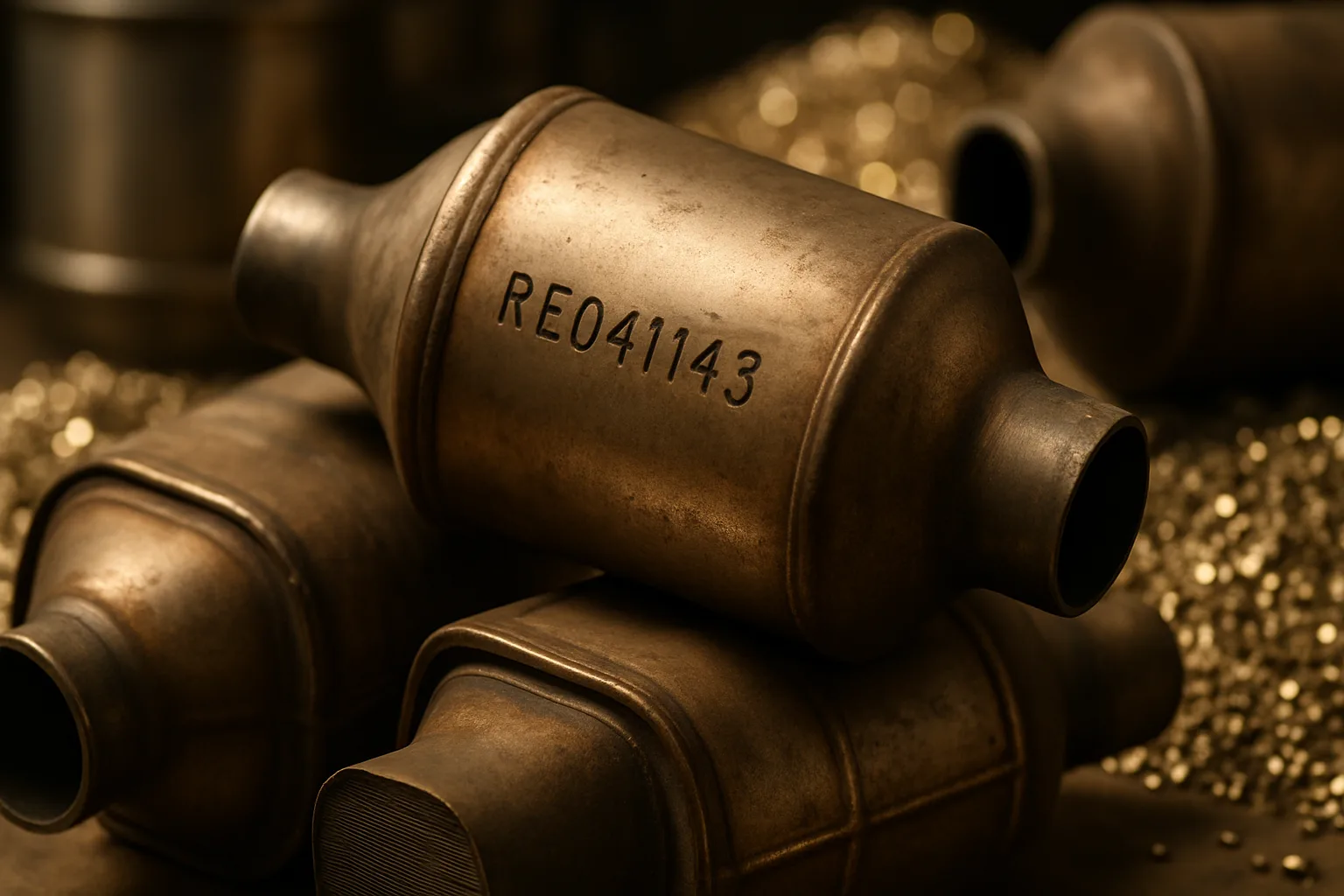
The serial number on a catalytic converter is usually stamped or etched into the metal body of the unit, cast into the end cone, or printed on a label or tag. On older units, it may be difficult to read — covered in grease, rust, or carbon buildup. Clean it off before you try to read it. A wire brush and a few seconds of effort can be worth real money.
Here's where to look, depending on the type of converter:
- OEM (original equipment manufacturer) converters: Look for a stamped number on the body of the shell, typically near the inlet or outlet pipe. It may include letters followed by numbers — for example, a Toyota unit might show a part number beginning with "170" or a manufacturer code specific to that chassis.
- Pre-converters (small secondary units): Often have a number near the flange. These are small but can carry high rhodium content.
- Aftermarket converters: Usually have a manufacturer brand code (like MagnaFlow or Walker) plus a part number. These are typically lower-grade and priced differently from OEM units.
- Foil-wrapped or California-spec converters: May have additional regulatory codes alongside the serial number. These often carry higher loading due to stricter emissions standards.
Once you have the number, cross-reference it against a read Canadian catalytic converter pricing guides or use a catalytic converter price list. Some buyers publish reference guides — though the accuracy and currency of those lists vary. The better approach is to get a real quote from a platform where buyers compete for your load.
Common Serial Number Formats by Vehicle Origin
Serial number formats aren't universal. They vary by manufacturer country, OEM versus aftermarket, and model generation. Knowing the general pattern for each origin helps you sort faster and identify outliers in your inventory.
Japanese OEM converters (Toyota, Honda, Subaru, Nissan) are among the most referenced in scrap catalytic converter buying. Toyota units in particular are widely known for high palladium content. Their serial numbers often begin with a numeric part code stamped on the body — something like a 5-to-8 digit sequence. The substrate in these units is typically high-density ceramic honeycomb.
European OEM converters (BMW, Mercedes, Volkswagen, Volvo) tend to carry strong loadings of platinum and rhodium. Serial numbers may include a mix of alphanumeric characters and country/factory codes. Pre-converters (the smaller secondary unit) on European vehicles are often higher value per gram than the main body converter.
North American domestic converters (GM, Ford, Stellantis/Chrysler) use OEM numbers that often align with GM part number systems or Ford engineering codes. Late-model F-150 and full-size truck converters have risen in scrap value as PGM loadings increased to meet modern emissions standards.
- Truck converters in British Columbia often see strong demand due to the region's resource sector and fleet operations — Prince George yards frequently handle heavy-duty commercial units.
- Never assume an aftermarket replacement unit is worth the same as the OEM it replaced. It usually isn't.
- If a converter has been coated, repaired, or shows signs of core replacement, flag it — the substrate condition affects value.
Documenting Your Inventory Before You Sell — Why It Changes Your Price
Reading the serial number is step one. Documenting it properly is step two — and it's where most sellers still fall short. A buyer looking at a well-documented load of cats, with serial numbers recorded, photos taken, and grades sorted, will price that load with more confidence. More buyer confidence means more competitive bids. More competition means better price discovery for you.
Platforms like SMASH are built around exactly this principle. When you list a load with documented serial numbers and photo evidence, you're not asking a single buyer to trust your word — you're giving multiple vetted buyers the data they need to compete. That's a fundamentally different dynamic than a cold call to one recycler down the road.
Here's a practical documentation process before you list or quote a load:
- Clean each converter enough to read the serial number clearly.
- Photograph both the serial number and the full unit — both ends if possible.
- Record the number alongside the vehicle make, model, and year if known.
- Sort by grade: high-grade foreign, standard domestic, aftermarket/low-grade, pre-converters.
- Note any physical damage — cracked substrate, holes in the shell, or signs of tampering.
If you're running a shop or small yard in Prince George and processing more than a few units a week, building this documentation habit pays off fast. You're also protected — if there's ever a dispute about what was in a load, your photos and records settle it.
You can get the best catalytic converter price in Canada when buyers have the information they need to bid confidently. Documentation is how you give them that.
How SMASH Helps Prince George Sellers Get Competitive Prices
Here's the old way of selling cats in a market like Prince George: you call one buyer, describe what you have, accept their number, and load the truck. You never know if that price was fair. You never know what the market was actually paying that day. The platinum price today could be up — and you'd have no way of knowing what that means for your specific units.
SMASH flips that entirely. Instead of one call to one buyer, your documented load goes to multiple vetted buyers through a competitive auction format. They see your serial numbers, your photos, your grades. They bid. You see the results in real time. No subscription fees — SMASH only wins when you do.
For sellers across Prince George scrap metal services, this kind of competition is exactly what's been missing. Distance from major metro markets shouldn't mean you settle for lower prices. With documented inventory and a platform built for price discovery, geography matters a lot less than it used to.
To check current Canadian catalytic converter prices and understand what your sorted, documented load could realistically bring, don't guess — get a quote from a platform where buyers compete.
And if you want to see how other North American recyclers are approaching catalytic converter sales, find the best price for your scrap in Canada and see what competitive pricing actually looks like.
Disclaimer: Catalytic converter prices fluctuate with platinum, palladium, and rhodium spot prices. Values referenced in any guide or price list may not reflect current market conditions. Always verify current rates before selling.
If you're ready to stop guessing and start getting paid what your cats are actually worth, get a free quote at best-catalytic-converter-price.ca. Document your load, know your serial numbers, and let buyers compete for your inventory.
Frequently Asked Questions
Q: How does the platinum price today affect what I get paid for my catalytic converters?
Platinum, palladium, and rhodium are the three precious metals inside a catalytic converter substrate. Buyers use live or near-live spot prices to calculate the value of the PGMs in each unit. When the platinum price today rises, high-grade converters with strong platinum content pay out more — which is why knowing your serial numbers and grades matters so much before you sell.
Q: Where can I find a catalytic converter buyer in Prince George?
Local auto recyclers and scrap yards in Prince George do purchase cats, but the price you get from a single local buyer may not reflect the full market value of your load. Using a platform like SMASH puts your documented inventory in front of multiple vetted catalytic converter buyers in British Columbia and across North America, so you're not limited to one offer.
Q: What's the difference between a high-grade and low-grade catalytic converter?
High-grade converters — typically OEM units from Japanese and European vehicles — carry higher loadings of palladium and rhodium relative to their size. Low-grade units include aftermarket replacements, bead-type converters, and older domestic cats with lower PGM content. The serial number and substrate type help buyers determine the grade, which directly affects the price paid.
Q: Can I sell catalytic converters through an auction format in Canada?
Yes. Platforms like SMASH operate a catalytic converter auction format that connects sellers with vetted buyers across North America, including British Columbia. You document your load, list it, and buyers bid competitively. There are no subscription fees, and the auction format creates real price competition rather than a single take-it-or-leave-it offer.
Q: Why don't I just use a catalytic converter price list to know what my cats are worth?
Price lists — including international references like catalytic converter price lists from South Africa or the U.S. — can give you a general sense of relative grades, but they're often outdated or based on different market conditions than what's current in Canada. Live quotes from active buyers, based on your documented serial numbers and current PGM spot prices, are always more accurate than a static list.
Follow SMASH on LinkedIn for ongoing scrap metal market insights, catalytic converter pricing trends, and industry updates across North America.