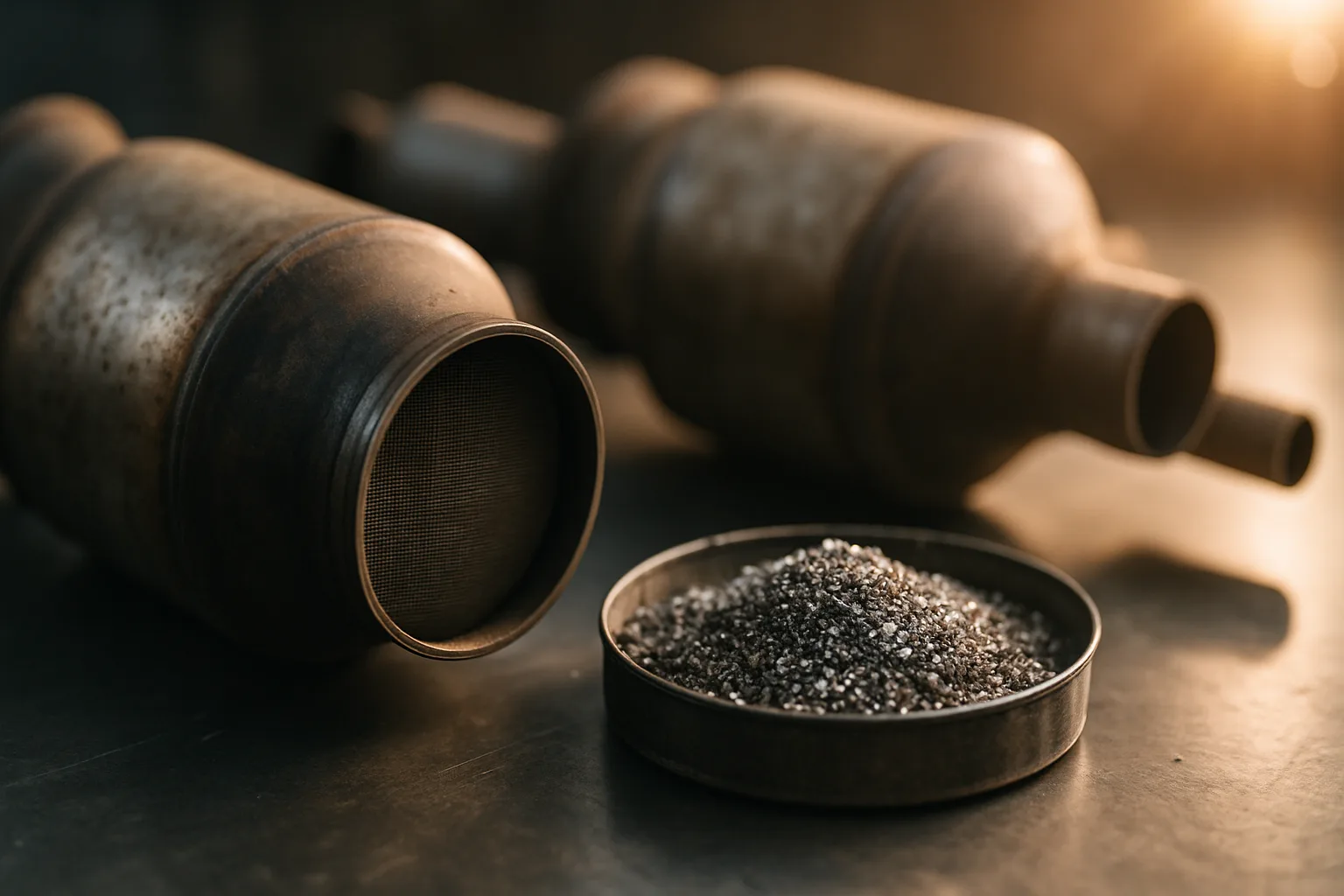
Why Catalytic Converter Scrap Prices Change Every Single Day
Most people assume scrap prices are stable — that a catalytic converter worth $150 today will be worth $150 next week. That assumption costs sellers real money. Catalytic converter values are tied directly to the live spot prices of three precious metals: platinum, palladium, and rhodium. When those markets move, your cat's value moves with them — sometimes by a significant margin overnight.
If you're trying to sell catalytic converters online and you don't understand what's driving the price you're being quoted, you're negotiating blind. This guide breaks down how daily market fluctuations work, what actually determines your converter's value, and how to make sure you're not leaving money on the table when you sell.
The Three Metals That Drive Every Catalytic Converter Quote
Inside every catalytic converter is a ceramic or metalite substrate coated with a precise combination of platinum group metals (PGMs). These metals are what recyclers and processors are actually paying for — not the steel shell, not the size, not the brand name on the car it came from.
Here's what each metal does and why it matters to your price:
- Platinum: Used in diesel converters and many gasoline units. Platinum is sensitive to automotive industry demand shifts and global mining output, particularly from South Africa and Russia.
- Palladium: Heavily weighted in gasoline converters. Palladium has historically been one of the most volatile of the three PGMs — it can swing dramatically based on supply constraints and EV adoption trends.
- Rhodium: The rarest of the three. Rhodium can carry an enormous per-ounce value, and even small rhodium content in a converter can significantly boost its worth. It's also the most volatile — it can drop or spike faster than the others.
Checking the platinum price today is a starting point, but you need all three spot prices to understand where your converters stand. A single-metal view gives you an incomplete picture. Reputable platforms and buyers calculate value using assay data or known PGM loading averages for each converter type — not guesswork.
What Actually Causes Daily Price Swings
Understanding that PGM prices fluctuate is one thing. Knowing why they fluctuate gives you a real advantage when timing your sales or evaluating quotes. Several factors drive daily movement.
Currency markets: PGMs are priced globally in USD. For Canadian sellers, the CAD/USD exchange rate adds another layer of movement. A strengthening Canadian dollar can soften the CAD-denominated price you receive even if spot prices hold steady in USD.
Mining and supply disruptions: South Africa produces the majority of the world's platinum and rhodium. Any labour disputes, power grid issues, or logistical interruptions in that region send ripples through the market within hours.
Automotive and industrial demand: Stricter emissions regulations globally continue to push demand for catalytic converters — even as EV adoption grows, internal combustion vehicles still dominate the roads in 2026. Industrial demand for platinum in hydrogen fuel cells is also an emerging price driver.
Macroeconomic signals: Interest rate decisions, inflation data, and geopolitical tension all affect precious metal markets. PGMs aren't immune to the same forces that move gold and silver.
The takeaway: even if you can't predict every move, being aware of these drivers lets you recognize when market conditions favour selling and when they don't.
Why Your Location Affects the Price You're Offered — and How to Overcome It
If you're in Guelph or anywhere across Ontario, you've probably noticed that local buyers quote you based on what they think the market is — not what the market actually is. A single buyer at a local yard doesn't need to be competitive. They need to meet their own margin targets. That's a conflict of interest baked into the transaction.
This is the core problem with the traditional single-call, single-buyer model. Whether you're selling a handful of cats or a pallet of mixed converters, one buyer with one price is not price discovery. It's just someone's offer.
The catalytic converter scrap price in Ontario you deserve is the one that comes from real competition. When multiple vetted buyers see your inventory and submit bids, you get a market-validated number — not a guess, not a lowball designed to leave margin on the table for the buyer.
That's exactly where a B2B scrap metal marketplace like SMASH changes the equation. Instead of calling one buyer and hoping for the best, your documented inventory goes in front of multiple qualified buyers. Competition does what competition is supposed to do — it reveals what your material is actually worth on a given day. If you want to get the best catalytic converter price in Canada, a competitive process is the most reliable way to get there.
How to Document Your Catalytic Converters Before You Sell
Buyers pay more when they know exactly what they're bidding on. Ambiguity creates risk, and buyers price risk into their offer — meaning they bid lower when they're uncertain about what they're getting. Good documentation eliminates that uncertainty and gives buyers the confidence to bid at full market value.
Here's what proper converter documentation looks like:
- Photos of both ends and the body: Buyers want to see the substrate condition, check for cracks or foil damage, and confirm the unit hasn't been cut open or tampered with.
- Serial numbers or part numbers: These link the converter to known assay data. A converter with a readable serial number is worth more than an unidentified unit because buyers can look up historical PGM loading averages.
- Count and condition notes: Is it a full unit or a half? Is the substrate intact? Are there any signs of overheating (discolouration, melted substrate)?
- Vehicle make, model, and year if known: This matters. The converter off a 2019 Ford F-150 has a different PGM profile than one off a compact economy car from the same year.
Platforms like SMASH support serial tracking and photo documentation as standard parts of the listing process. That infrastructure exists specifically because documented lots attract stronger bids. If you're selling through a channel that doesn't ask for this information, that's a signal they're not maximizing your return.
Whether you're running a busy auto shop in Guelph or collecting cats across multiple locations in Ontario, building this documentation habit pays off consistently. You can also read Canadian catalytic converter pricing guides to go deeper on valuation methodology and what buyers actually look for.
Timing Your Sale: Reading the Market Without Being a Trader
You don't need to watch commodity markets all day to sell smarter. A few practical habits can help you time your sales better and avoid selling into weak market conditions when you don't have to.
Watch weekly trends, not minute-by-minute ticks. For most sellers, weekly price direction is enough context. If rhodium has dropped 15% in two weeks and shows no sign of recovery, holding a large batch for another week may be worth the storage consideration — or it may not. The point is to make the decision consciously.
Don't batch-dump when you don't have to. Accumulating a larger, well-documented lot often attracts more serious buyers than moving individual units sporadically. Buyers prefer lots they can efficiently assess and process.
Sell into strength when you have flexibility. If your operation allows some timing flexibility, selling when PGM markets are trending up — rather than reacting to cash flow pressure in a down market — is simply better economics.
For sellers in markets like Guelph and across Ontario, being connected to a platform that shows you real-time competitive bids is more valuable than any single market prediction. SMASH Recycling — where verified buyers bid on your metal — gives you that live competitive signal instead of a static quote from one buyer who may not be watching the same market you are.
If you're specifically looking for Guelph scrap metal services, there are options tailored to your local area that connect you to this broader competitive network.
Selling Catalytic Converters Online: What the Process Actually Looks Like
For anyone new to selling converters through an online platform rather than a local yard, the process is more straightforward than you might expect. You don't need to be a commodity trader or a metals expert. You need accurate documentation and a platform that works for you.
Here's the general flow when you sell catalytic converters online through a competitive marketplace:
- Document your inventory: Photos, serial numbers, counts, and condition notes. The more detail, the better your results.
- Submit your lot: Your documented inventory goes into the platform and becomes visible to vetted, qualified buyers.
- Buyers bid competitively: Instead of one quote, you get multiple bids from buyers who are motivated to win the material.
- Accept the best offer: You see the bids and make the call. No pressure, no single-buyer leverage over you.
- Complete the transaction: Logistics, invoicing, and documentation are handled through the platform — not cobbled together through phone calls and handshakes.
The result: you sell at a market-validated price with documentation that protects both parties. Whether you're an auto shop moving a few cats a month or a yard processing larger volumes, this process works at any scale. Check current Canadian catalytic converter prices to see where the market sits before you list.
Price disclaimer: Catalytic converter scrap prices fluctuate daily based on live PGM spot prices, exchange rates, and market conditions. Always verify current rates before making selling decisions. The information in this article is for educational purposes and does not constitute a price guarantee.
If you're ready to stop guessing and start selling into real competition, SMASH makes it straightforward. No subscription fees. No single-buyer pressure. Just documented inventory, vetted buyers, and a process built for sellers who take their returns seriously. Get the best Canadian price for your catalytic converter — get a free quote at best-catalytic-converter-price.ca.
Frequently Asked Questions
Q: How often do catalytic converter scrap prices change in Canada?
Catalytic converter prices can change daily — sometimes multiple times in a single day — because they're tied directly to live spot prices for platinum, palladium, and rhodium. The CAD/USD exchange rate adds additional movement for Canadian sellers. Always check current rates before committing to a sale.
Q: What makes one catalytic converter worth more than another?
The primary driver is PGM content — specifically how much platinum, palladium, and rhodium is loaded onto the substrate. This varies significantly by vehicle make, model, year, and emission standard tier. A readable serial number helps buyers look up known assay data, which often results in a stronger bid.
Q: Can I sell catalytic converters online if I'm in Guelph or elsewhere in Ontario?
Yes. Online B2B marketplaces like SMASH are designed specifically for this — you document your inventory, submit it to vetted buyers across the network, and receive competitive bids regardless of your location. Sellers in Guelph and across Ontario use this model to access a broader buyer pool than any single local yard can offer.
Q: Why is the price I'm quoted locally often lower than what I see online?
A local buyer with no competition has no pressure to offer full market value. Their quote reflects their margin targets, not the actual market. Competitive online platforms create price discovery — multiple buyers bidding on the same documented lot will naturally push toward real market value.
Q: Is it worth holding onto my catalytic converters if prices are down?
It depends on your cash flow flexibility and storage capacity. If PGM markets are in a confirmed downtrend with no near-term recovery signal, holding has a cost. If prices have dropped temporarily and your operation can absorb a short wait, timing your sale into stronger market conditions can make a meaningful difference — especially on larger lots.
Follow SMASH on LinkedIn for ongoing scrap metal market insights and industry updates: linkedin.com/company/scrap-metal-auction-sales-hub.