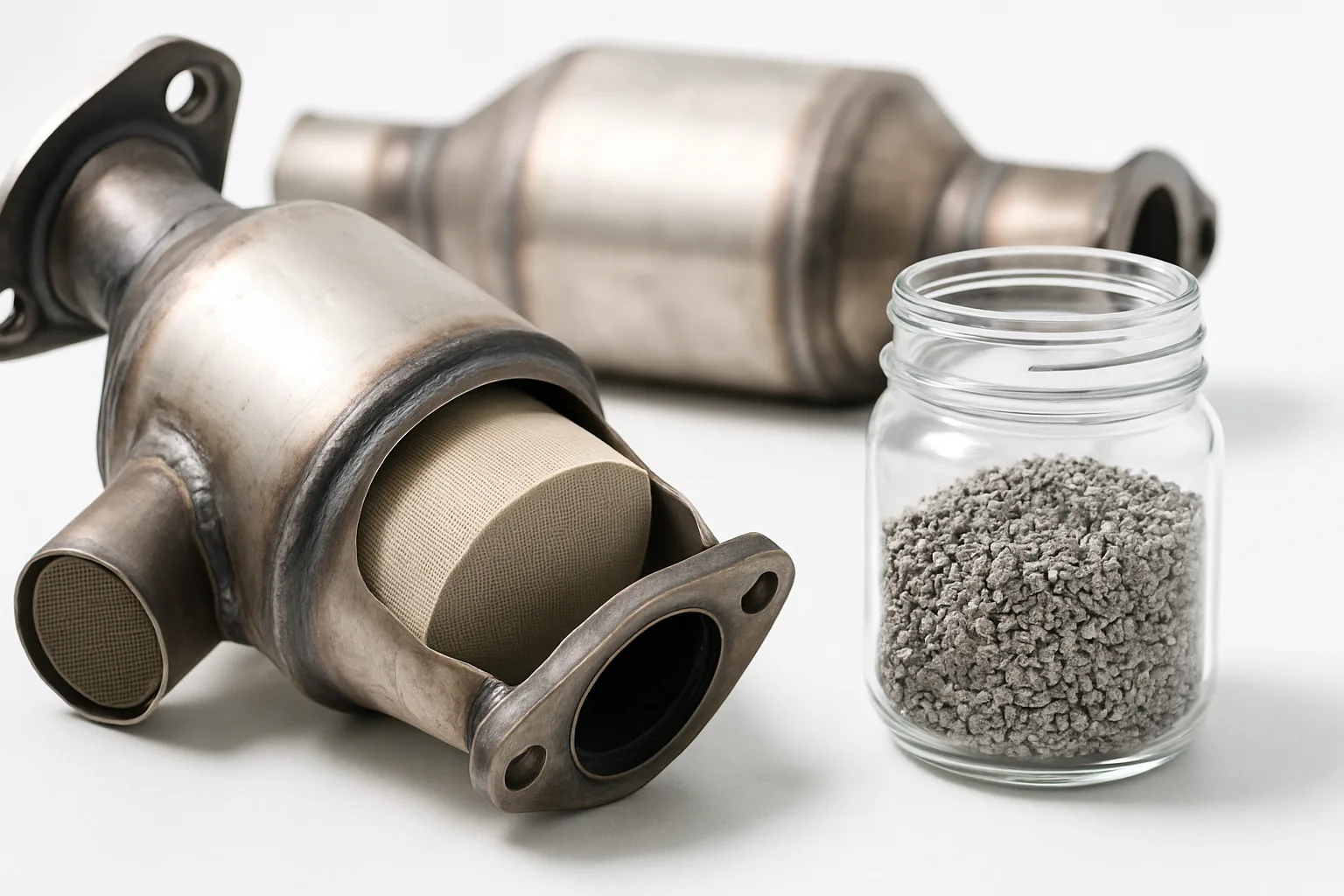
Most people know a catalytic converter has scrap value. Few know why. The answer sits inside a ceramic honeycomb smaller than a loaf of bread — and it contains some of the most valuable metals on the planet. Understanding what's inside changes how you approach selling. It also explains why catalytic converter scrap value swings so dramatically and why getting a competitive price matters more than most sellers realize.
If you're sitting on a pile of spent cats in Charlottetown or anywhere across Prince Edward Island, this breakdown will help you sell smarter.
---The Three Precious Metals That Drive Catalytic Converter Scrap Value
Catalytic converters work by converting toxic exhaust gases into less harmful emissions. That chemical reaction requires a catalyst — and automakers use three platinum group metals (PGMs) to do the job: platinum, palladium, and rhodium. Each one is rarer than gold. Each one trades on global commodity markets. And each one is recoverable through the refining process.
Here's the key point: the value in your scrap cat isn't the steel shell or the ceramic substrate. It's the PGM loading — the precise quantity of these metals embedded in the wash coat of the substrate. That's what refiners pay for. That's what drives your payout.
- Platinum (Pt): Used more heavily in diesel-engine converters. Historically traded in a broad range and is a critical recovery target for refiners.
- Palladium (Pd): Dominant in gasoline-engine converters. Palladium has seen significant price volatility over the past several years and remains a key driver of catalytic converter scrap price in Canada.
- Rhodium (Rh): The wildcard. Rhodium is produced in tiny quantities globally and has historically spiked to extraordinary levels. Even small amounts in a converter can represent significant value.
These three metals are not present in equal amounts. Loadings vary by manufacturer, engine type, vehicle age, and emissions standards at the time of production. A converter from a late-model SUV carries a very different PGM profile than one from a compact economy car built fifteen years ago. That's why two converters that look identical on the outside can pay out at very different rates.
---Palladium Price Today — And Why It Shifts Your Payout
Of the three PGMs, palladium gets the most attention from scrap sellers right now — and for good reason. It's the dominant metal in gasoline converters, which represent the bulk of vehicles on Canadian roads. When you hear buyers talking about palladium price today, they're referencing the live spot price trading on commodity exchanges. That price moves daily. Sometimes hourly.
This volatility matters enormously for sellers. A converter worth a certain amount on a Monday may be worth noticeably more or less by Friday — not because anything changed about the part itself, but because PGM markets responded to supply signals, currency movements, or shifts in industrial demand. South Africa and Russia produce the vast majority of the world's palladium, and any disruption to that supply chain ripples through to what a Charlottetown seller receives for their cats.
The practical takeaway: don't sit on cats indefinitely hoping to time the market. That strategy rarely works for individual sellers. But do make sure you're getting a price that reflects live market conditions on the day you sell — not a flat offer based on a buyer's internal pricing from three weeks ago. That's where transparency matters. Platforms like get competitive bids for your scrap in Canada through SMASH bring multiple buyers into the process so the offer you receive reflects actual market conditions, not a single buyer's margin.
---Why Converter Type Determines Cat Converter Value
Not all catalytic converters are equal, and knowing the difference helps you set realistic expectations before you pick up the phone or submit a load. The scrap industry broadly categorizes converters into several grades — and those grades exist because of the real differences in PGM content.
Common converter types and what drives their value:
- Domestic (North American) converters: Generally higher PGM loadings due to stricter historical emissions standards. Often the most valuable category in the Canadian market.
- Foreign (import/Asian market) converters: Typically lower PGM loadings. Still valuable, but usually priced below domestic grades.
- Pre-converters and small pipe: The smaller units mounted upstream of the main converter. Lower value but still worth separating and selling.
- Diesel oxidation catalysts (DOCs): Platinum-heavy. Value tracks platinum markets more than palladium.
- DPF (Diesel Particulate Filters): A growing category with recoverable PGM content. Not a traditional cat, but increasingly relevant for recyclers.
- After-market converters: Lower PGM loading than OEM units. Refiners pay less for these because the catalyst content is reduced.
Knowing what you have before you sell gives you leverage. A reputable buyer will identify your converter type and price accordingly. A less transparent buyer may lump everything together at a lower flat rate — capturing the spread as their margin. If you're moving volume from a shop or a collection route in Prince Edward Island, that difference compounds quickly across a full load.
To get the best catalytic converter price in Canada, you need buyers who are pricing by grade — not buyers offering blanket flat rates regardless of what you've actually got.
---How Catalytic Converter Recycling Companies Calculate Your Price
Here's what actually happens after your converter leaves your hands. A catalytic converter recycling company processes your units through one of two main pathways: assay-based settlement or a database-priced spot purchase.
Assay-based settlement means your load gets sampled and analyzed at a refinery. The actual PGM content is measured, and you receive a payment based on recovered metal minus processing fees and a refiner's margin. This method is most accurate but takes longer and typically suits larger volumes.
Database pricing is what most sellers encounter in the spot market. Buyers use historical assay data linked to specific converter part numbers or serial numbers to estimate PGM content. They apply a current metal price and their margin, and offer you a price per unit. The accuracy of this method depends entirely on the quality of the buyer's data — and how honestly they apply it.
This is why documentation matters. When you sell catalytic converters online through a competitive platform, photo documentation and serial tracking let buyers price with confidence. Better data from the seller often translates to stronger offers because the buyer has less uncertainty to hedge against. A well-documented load beats a mystery load every time.
You can read Canadian catalytic converter pricing guides to go deeper on how refinery settlement works and what to expect from different buyer types across the country.
---Selling Catalytic Converters in Charlottetown — What Local Sellers Need to Know
Charlottetown and the broader Prince Edward Island market present a specific challenge: geography. Sellers in smaller regional markets often have fewer local buyer options, which makes price discovery harder. With one or two buyers in your area, the competitive pressure that drives better pricing simply doesn't exist in the same way it does in a major urban centre.
That's not a dead end — it's an argument for going online. When you sell catalytic converters in Prince Edward Island through a platform that connects you with vetted buyers across Canada, your geography stops being a disadvantage. Your cats compete on quality and documentation, not on how many buyers happen to have a yard within driving distance.
Practically speaking, sellers in Charlottetown should also factor in logistics. Shipping costs on a small load will eat into your margin. Batch your converters where possible. A load of 10-20 units ships at a very different cost-per-unit than a single piece. If you're running an auto shop or doing collection work, build up enough volume to make the economics work clearly in your favour before pulling the trigger on a sale.
SMASH works with sellers across Canada — including smaller markets — to bring competitive bids to loads that would otherwise get one take-it-or-leave-it offer. No subscription. No guessing. Just vetted buyers competing for your material.
---How to Get the Best Catalytic Converter Scrap Price in Canada Right Now
The market in mid-2026 remains active for PGM-bearing material. Supply chain pressures, ongoing automotive production, and the slow but steady growth of electric vehicle adoption (which will eventually reduce future converter supply) all factor into how refiners and buyers are positioning themselves. For sellers, this is still a strong time to move quality material — provided you're getting a price that reflects the market, not one buyer's appetite.
Here's a straightforward framework for getting the best outcome:
- Identify your converter types. Separate domestic, foreign, diesel, and aftermarket units. Don't mix grades in a way that forces a buyer to price the whole load to the lowest common denominator.
- Document what you have. Photos, serial numbers, and part identification all help buyers price accurately — and reduce the uncertainty premium they build into their offers.
- Get multiple offers. One buyer, one offer is not price discovery. It's guessing. Competition reveals the market.
- Understand the metal market. You don't need to be a commodities trader, but knowing whether palladium is trading up or down gives you context for evaluating any offer you receive.
- Factor in all costs. Shipping, processing fees, and settlement timelines all affect your net. Compare apples to apples.
When you're ready to move material, check current Canadian catalytic converter prices and get a free quote. The difference between a market-reflective price and a flat offer from a single buyer can be significant — especially across a high-volume load.
Disclaimer: Catalytic converter prices fluctuate daily based on live PGM spot markets. Always verify current rates before finalizing a sale. Prices referenced in general terms throughout this article do not constitute a price guarantee or offer.
---Frequently Asked Questions
Q: What precious metals are inside a catalytic converter?
Catalytic converters contain three platinum group metals: platinum, palladium, and rhodium. These metals act as the catalyst that converts harmful exhaust gases into less toxic emissions. The specific combination and quantity of each metal varies by vehicle make, model, engine type, and production year.
Q: How is catalytic converter scrap value calculated?
Value is based on the PGM content of the converter — how much platinum, palladium, and rhodium it contains — multiplied by live spot prices for each metal, minus refining and processing costs. Converter type, condition, and buyer competition all influence the final offer a seller receives.
Q: Can I sell catalytic converters online from Charlottetown?
Yes. Selling online through a vetted platform is often the best option for sellers in Charlottetown and across Prince Edward Island, where local buyer competition may be limited. Online platforms connect you with multiple buyers across Canada, creating the price competition that single-buyer local transactions lack.
Q: Does the palladium price today affect what I get for my scrap cats?
Directly, yes. Palladium is the dominant PGM in gasoline converters, which represent the majority of scrap cats in the Canadian market. When palladium spot prices rise or fall, buyer offers move with them. Checking live PGM market conditions before you sell gives you important context for evaluating any offer.
Q: Is it worth separating converter types before I sell?
Absolutely. Mixing high-value domestic converters with lower-value aftermarket or foreign units forces a buyer to price the whole load conservatively. Separating by grade lets buyers price each category accurately — and that usually means a better total payout for the seller, especially on larger loads.
---If you're ready to stop guessing what your cats are worth, the next step is straightforward. Get the best Canadian price for your catalytic converter — get a free quote at best-catalytic-converter-price.ca. Whether you're clearing out a single converter or moving a full pallet from a shop in Charlottetown, competition and transparency get you closer to the real market price.
Follow SMASH on LinkedIn for ongoing scrap metal market insights, PGM price updates, and industry news across Canada.