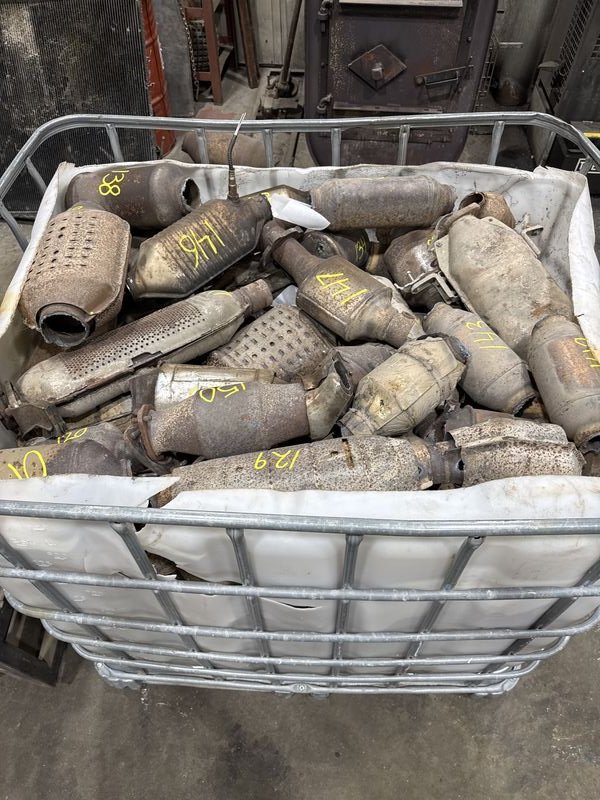
Stricter emissions rules are reshaping the global demand for platinum group metals — and that directly affects what your scrap catalytic converter is worth today.
If you run an auto shop in London, Ontario, or you're sitting on a pile of spent cats from fleet work, this isn't abstract policy news. Tightening emissions standards across North America, Europe, and beyond are keeping demand for platinum, palladium, and rhodium elevated. That demand is baked into OEM catalytic converter value right now. Understanding why helps you sell smarter.
This article breaks down how emissions regulations drive PGM demand, what that means for catalytic converter prices today in Canada, and how platforms like SMASH help you access real competitive pricing instead of guessing.
What Are the Platinum Group Metals — and Why Do They Matter in Catalytic Converters?
Platinum group metals — platinum, palladium, and rhodium — are the three elements that make a catalytic converter do its job. They sit on a ceramic or metallic honeycomb substrate inside the converter and trigger chemical reactions that convert toxic exhaust gases into less harmful compounds.
Rhodium handles NOx reduction. Palladium and platinum oxidize hydrocarbons and carbon monoxide. Without these metals, modern emissions control doesn't work. That's why every OEM catalytic converter contains measurable quantities of all three — and why the scrap value of a used cat is tied directly to commodity markets for these metals.
- Platinum (Pt): Used heavily in diesel catalysts; also found in gasoline converters. Mined primarily in South Africa and Zimbabwe.
- Palladium (Pd): Dominant in gasoline engine converters. Russia and South Africa are the top producers.
- Rhodium (Rh): The rarest and most valuable of the three. Even small loadings command serious price premiums.
When you sell a scrap cat, you're essentially selling a fractional share of these three metals. The OEM catalytic converter value is a direct function of how much PGM loading is in that specific unit — and what those metals are trading for on the day you sell.
How Emissions Regulations Drive Demand for Platinum, Palladium, and Rhodium
Governments around the world keep ratcheting up vehicle emissions standards. In North America, the Environmental Protection Agency and Transport Canada have pushed increasingly strict limits on NOx, hydrocarbons, and particulate matter. In Europe, Euro 7 standards — phased in from 2025 — set some of the tightest tailpipe limits ever legislated. These aren't optional targets. Automakers that miss them face serious penalties.
Tighter standards mean automakers need more efficient catalysts. More efficient catalysts often require higher PGM loadings or more precisely engineered formulations. That means more platinum, palladium, and rhodium per vehicle — not less. Even as electric vehicles gain market share, the internal combustion engine fleet globally is still enormous and still growing in many markets. The demand side of the PGM equation stays strong.
There's also a secondary effect: stricter standards make the performance difference between an OEM converter and an aftermarket unit wider. OEM converters carry heavier, more precisely tuned PGM loadings designed to meet certification thresholds. That's part of why OEM catalytic converter value in the scrap market holds up better than aftermarket units. You're recovering better metal when you pull an OEM cat.
OEM Catalytic Converter Value in Canada: What London and Ontario Shops Need to Know
If you're an auto shop in London or anywhere across Ontario, you're generating spent catalytic converters regularly. Whether it comes from a routine exhaust replacement, a collision repair, or an end-of-life vehicle, that converter has real value — and the value is not the same from unit to unit.
OEM converters from full-size trucks, SUVs, and European makes tend to carry higher PGM loadings. A cat off a late-model Ford F-150 or a BMW 3 Series is a different animal than the converter off a compact economy car. Serial number tracking and VIN lookup matter here. Platforms like SMASH Recycling — where verified buyers bid on your metal use serial tracking and photo documentation to help buyers price accurately — which means sellers get quoted on what they actually have, not a generic average.
For shops processing multiple units at a time, this becomes a real revenue difference. Lumping high-value OEM units in with low-grade aftermarket cats and accepting one blended price leaves money on the table. Proper identification and competitive bidding are how you close that gap. If you're in London and want to understand what your specific units are worth, London scrap metal services through this platform can help you get accurate, market-based quotes.
Catalytic Converter Prices Today: A Global Market With Local Impact
PGM prices are set on global commodity exchanges — London Metal Exchange, NYMEX, and OTC markets. South African supply dynamics matter enormously here. South Africa produces over 70% of the world's platinum and a significant share of rhodium. Any disruption — power grid instability, labor action, infrastructure issues — ripples through global PGM pricing within days. It's worth noting that discussions around catalytic converter scrap prices in South Africa and export dynamics are closely watched by North American refiners, because it signals upstream supply pressure.
What this means practically: catalytic converter prices today in Canada can shift week to week. The price your shop gets in October 2026 may be different from what the same units would fetch in January 2027. Timing matters, and so does market access.
That's exactly why selling through a competitive auction format beats taking a single quote from one buyer. When one buyer gives you a price, you have no idea if you're at market or 15% below it. Competition reveals the real number. Read Canadian catalytic converter pricing guides to understand how to benchmark your loads before you sell.
Disclaimer: Catalytic converter scrap prices fluctuate based on daily PGM spot prices, unit type, and market conditions. Always verify current rates before selling. Nothing in this article constitutes a price guarantee.
Why a B2B Scrap Metal Marketplace Changes the Game for Cat Sellers
The old way of selling scrap cats looks like this: a buyer calls, throws out a number, you either take it or you don't. You have no idea what the actual market is paying. You have no leverage. The transaction is fast, but you're not confident you got a fair number.
A B2B scrap metal marketplace like SMASH flips that dynamic. Your inventory gets listed with proper documentation — photos, serial numbers, unit identification. Vetted buyers see it and compete. You see real bids. That's price discovery, not price-taking.
SMASH operates with no subscription fees. There's no upfront cost for sellers to list. The platform only works when the seller does. Auto-invoicing and documentation features mean less admin headache when you close a deal. For shops in Ontario processing a steady volume of converters, that operational efficiency adds up fast.
The SMASH scrap metal auction model is built for exactly this kind of commodity: high individual value, significant unit-to-unit variation, and a buyer pool that spans refiners and processors across North America. More eyes on your inventory means the price reflects the actual market — not one buyer's margin target.
Selling Smart: How to Maximize Your Scrap Cat Value in 2026
Understanding why PGM demand is strong is useful context — but what you actually want is to sell your converters at the best possible price. Here's how to approach that in practice:
- Identify your units properly. Don't let OEM high-value converters get mixed in with low-grade aftermarket units. Serial number lookups and VIN data help you know what you have before you sell.
- Document with photos. Buyers price with more confidence when they can see condition clearly. Better confidence means stronger bids.
- Use competitive bidding. Single-buyer quotes don't give you market data. Auction formats do. More buyers competing on your load reveals what the market will actually pay.
- Watch PGM spot prices. Rhodium and palladium especially can be volatile. If prices are running up, that's not the moment to rush a sale through the cheapest channel you have.
- Sell to vetted buyers. Fraud and low-ball tactics are real in this market. Verified buyer networks protect you and ensure you're dealing with legitimate processors and refiners.
For shops in London and across Ontario, the combination of accurate unit identification and competitive buyer access is the clearest path to getting the best catalytic converter price in Canada. The market is there. The demand is real. The question is just whether you're selling into it properly.
As emissions standards continue to tighten globally, PGM demand isn't going away. If anything, the transition period — where ICE vehicles still dominate the fleet but EVs are growing — sustains a complex, active recycling market for converters. Now is a good time to sell smart, not just sell fast.
If you're ready to find out what your units are worth in today's market, check current Canadian catalytic converter prices and get a free quote. Don't leave the market rate on the table.
Frequently Asked Questions
Q: What are the platinum group metals found in catalytic converters?
The three platinum group metals in catalytic converters are platinum (Pt), palladium (Pd), and rhodium (Rh). Each plays a specific role in reducing exhaust emissions. Rhodium handles NOx reduction, while palladium and platinum oxidize hydrocarbons and carbon monoxide. The mix and loading amount varies by vehicle make, model, and whether the converter is OEM or aftermarket.
Q: Why does OEM catalytic converter value differ from aftermarket units?
OEM converters are engineered to meet strict factory emissions certification requirements, which typically means higher and more precisely calibrated PGM loadings. Aftermarket converters are built to lower price points and often carry less platinum, palladium, and rhodium by volume. That difference in loading translates directly into scrap value — OEM units generally return more per piece at the refinery.
Q: How do emissions regulations affect catalytic converter scrap prices in Canada?
Stricter emissions standards require automakers to use more effective — and often heavier — PGM loadings in new vehicles. This keeps upstream demand for platinum, palladium, and rhodium elevated, which supports scrap prices for used converters. When global regulatory pressure tightens, refiners compete for secondary PGM supply, which includes scrap catalytic converters sold by shops and recyclers across Ontario and the rest of Canada.
Q: Where can I sell scrap catalytic converters in London, Ontario?
Shops and collectors in London can access competitive pricing through platforms that connect sellers with vetted buyers across North America. SMASH uses an auction model where verified buyers bid on documented inventory, which provides real price discovery rather than a single take-it-or-leave-it quote. Proper unit identification before you sell helps ensure you're not underpricing high-value OEM units.
Q: How often do catalytic converter scrap prices change in Canada?
Prices can shift week to week — sometimes day to day — based on PGM spot prices on global commodity markets. Palladium and rhodium in particular can be volatile. Supply disruptions in major producing countries like South Africa have historically caused sharp price swings. Always check current market rates before finalizing a sale, and consider selling through a competitive platform to ensure your price reflects live market conditions.
Follow SMASH on LinkedIn for industry updates, scrap metal market insights, and pricing trends that affect your bottom line.