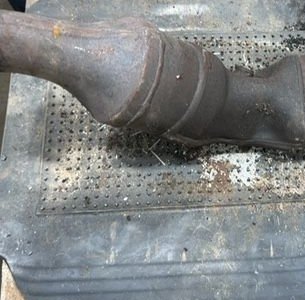
What Actually Happens to Your Catalytic Converter After You Sell It
Most sellers focus on one number: what the buyer is offering today. But very few people understand why that number exists — and what happens between the moment you hand over your cat and the moment precious metals get extracted from it. If you're trying to get the palladium price today reflected in your payout, you need to understand the assaying and smelting process. Because that process is where your money lives.
This week's market recap breaks down how catalytic converter processing actually works, why it matters for your sale price, and how platforms like the SMASH Recycling auction platform are changing the way yards and collectors access competitive pricing on their cats.
Why the Platinum Group Metals Inside Your Cat Drive Everything
A catalytic converter isn't just a hunk of metal. Inside that outer shell sits a ceramic or metallic substrate coated with a precise blend of platinum, palladium, and rhodium — the three platinum group metals (PGMs) that make the emissions control chemistry work. These are some of the rarest and most valuable metals on earth. Rhodium, in particular, can swing dramatically in value from one quarter to the next.
When buyers quote you a price on a cat, they're really making a bet on what's inside. They're estimating:
- Which vehicle the converter came from (make, model, year)
- The substrate loading — how much PGM was applied during manufacturing
- The condition of the substrate (cracked, missing, or intact)
- The current spot price of platinum, palladium, and rhodium
The palladium price today is one of the most closely watched inputs in the whole equation. Palladium is used heavily in gasoline engine converters, which are the most common type in North America. When palladium moves, cat scrap prices move with it — often within days. That's why timing your sale matters, and why checking current pricing before you sell is never a wasted step.
If you want to understand where your converter sits in that pricing picture, check current Canadian catalytic converter prices before you commit to any offer.
How Catalytic Converter Assaying Works — The Science Behind Your Payout
Assaying is the process of determining exactly how much of each PGM is present in a given batch of catalytic converters. It's precise, technical, and it's the foundation of every legitimate pricing model in the industry. Here's how it works in practice.
After converters are collected and sorted, processors typically follow one of two assay pathways:
- Sampling and fire assay: The converter substrate is crushed, homogenized into a fine powder, and a representative sample is taken. That sample undergoes fire assay — a high-temperature fusion process that isolates PGMs from base metals. The resulting button of metal is then analyzed using techniques like inductively coupled plasma (ICP) spectrometry to get exact PPM (parts per million) readings for platinum, palladium, and rhodium.
- Full-lot smelting with assay: For larger volumes, the entire lot gets smelted first. During smelting, PGMs are collected into a collector metal (often iron or copper). That collector is then sampled and assayed. This method is more accurate for large, mixed batches because it eliminates the sampling variability you can get with individual units.
Both methods produce assay certificates — documents that show exactly how many troy ounces of each PGM were recovered per ton of material processed. Those numbers are then matched against the spot prices for platinum, palladium, and rhodium to calculate the gross value of the lot. After refining costs and processor margins are deducted, what's left is what trickles back to you as the seller.
This is why documented inventory matters so much. Yards that photograph their cats, track serial numbers, and record VINs give processors better data — which reduces uncertainty and can improve settlement terms. Platforms built around transparency, like the SMASH Recycling auction platform, are designed with that documentation layer built in from the start.
Smelting — Where Your Catalytic Converter Actually Becomes Money
Once assaying confirms what's in a lot, smelting is the step that physically separates the PGMs from everything else. The substrate — whether ceramic cordierite or metallic foil — doesn't survive the furnace. What gets recovered is a concentrated PGM-bearing alloy that refiners then process further to produce market-grade platinum, palladium, and rhodium.
Here's what's happening at a high level inside a smelter:
- Crushed converter substrate is loaded into a high-temperature electric arc furnace or plasma furnace alongside a collector metal
- Temperatures reach roughly 1,400–1,600°C — hot enough to melt the substrate and drive PGMs into the collector phase
- The slag (waste material) floats to the top and is separated
- The PGM-rich collector metal sinks to the bottom and is tapped off
- That collector is then further refined using hydrometallurgical or pyrometallurgical techniques to separate out individual PGMs
The whole process from collected converter to refined metal can take anywhere from a few weeks to a couple of months depending on the processor, lot size, and refinery queue. Settlement terms — when you actually get paid — are negotiated upfront and typically reference the assay certificate plus the spot price on a specified pricing date.
For sellers in Vancouver and across British Columbia, understanding this timeline is important. A quote you receive today is based on today's spot prices. If your settlement date is 60 days out, your final payout will reflect the market at that point. That's why working with buyers who offer transparent terms — and why getting competitive bids rather than accepting a single offer — protects your position.
Scrap Catalytic Converter Prices in Vancouver — What Local Sellers Need to Know
The scrap catalytic converter prices Vancouver sellers see can vary significantly depending on who they're selling to and how. Walk-up pricing at a single buyer gives you one data point. That buyer knows the assay values. You may not. That information gap is where sellers lose money.
Vancouver and the broader British Columbia market has a healthy volume of cat scrap moving through it — from auto recyclers, collision shops, independent mechanics, and collectors. The challenge is that most of that material gets quoted and purchased through informal channels: a phone call, a price on a whiteboard, a handshake deal. There's no competition, no documentation, and no transparency on what the material actually assayed out at after the fact.
A B2B scrap metal marketplace approach flips that model. When multiple vetted buyers compete for your lot, the price they offer reflects their actual assessment of the material's value — not what they think you'll accept. That's the core logic behind competitive auctions for cat scrap, and it's why more yards in Vancouver are exploring that channel for higher-volume loads.
If you're managing a consistent flow of cats out of a shop or yard in the Lower Mainland, it's worth reading through the Canadian catalytic converter pricing guides to understand how different converter types and grades are valued in the current market.
For local options, Vancouver scrap metal services can connect you with buyers who understand the regional market and can quote your material competitively.
How to Get a Better Price — What Smart Sellers Do Differently
The gap between a mediocre cat payout and a strong one usually comes down to a few repeatable practices. This isn't complicated — it's just discipline applied consistently.
Know what you have before you sell. Use VIN lookups and serial tracking to identify converter types. A direct-fit OEM converter from a 2022 pickup truck is worth significantly more than a generic aftermarket unit. Buyers know this. You should too.
Document everything. Photos of the converter before and after removal, weight records, and VIN data all build a more accurate picture of your lot. Documented lots attract more confident bids. More confident buyers means less discount for uncertainty baked into the offer.
Get more than one offer. This sounds obvious, but most sellers don't do it consistently. The palladium price today is public information. The PGM loading of your specific converter type is knowable. There's no reason to accept the first number you're given.
Time your sale when possible. PGM prices move. If palladium is in a dip cycle and you have flexibility on timing, holding a week or two while monitoring the market can make a meaningful difference on larger volumes. That said, don't try to time the market perfectly — few people do that well consistently.
Platforms like SMASH remove several of these friction points by building documentation tools, vetted buyer networks, and competitive auction formats into a single workflow. If you're selling volume, that infrastructure pays for itself quickly. To get the best catalytic converter price in Canada, the structure of your sale matters as much as the timing.
Disclaimer: Catalytic converter prices fluctuate daily based on PGM spot prices and market conditions. Always check current rates before selling.
Frequently Asked Questions
Q: How does the palladium price today affect what I get for my scrap catalytic converter?
Palladium is one of the three primary PGMs extracted from catalytic converters, and it's particularly dominant in gasoline engine cats. When the palladium spot price rises, buyers can offer more for palladium-rich converters. When it drops, payouts drop proportionally. Checking live PGM spot prices before you negotiate gives you a real baseline for evaluating any offer.
Q: What is assaying and do I need to understand it to sell my cat scrap in Vancouver?
Assaying is the lab process that determines how much platinum, palladium, and rhodium is in your converter material. You don't need to run assays yourself — but understanding that buyers are pricing based on assay data means you know why documentation, converter identification, and competitive bidding matter. Vancouver sellers dealing in volume especially benefit from working with buyers who offer transparent assay-based settlements.
Q: How long does it take to get paid after selling catalytic converter scrap?
Payment timelines depend on the buyer and the settlement terms agreed upfront. Spot-price purchases at a yard can settle same-day. Consignment or toll-refining arrangements — where you're paid based on actual assay results — typically take 30 to 90 days depending on the processor. Always confirm settlement terms before you hand over material.
Q: Are scrap catalytic converter prices in Vancouver different from the rest of Canada?
The underlying PGM spot prices are global, so the base value of a converter is consistent. Regional differences come down to buyer competition, local demand, transportation costs, and whether you're dealing through a single buyer or a competitive marketplace. British Columbia sellers with access to multiple buyers generally see tighter, more competitive pricing than those relying on a single local yard.
Q: What makes a B2B scrap metal marketplace better than selling directly to a local yard?
A B2B scrap metal marketplace introduces competition into the sale. Instead of one buyer setting the price, multiple vetted buyers bid on your material — which tends to surface a price closer to actual market value. For high-value material like catalytic converters, where individual lots can be worth thousands of dollars, that competition can make a meaningful difference in your final settlement.
If you're sitting on a pile of cats and you're not sure what they're worth in today's market, don't guess. The process from your converter to a refined PGM settlement is complex — but getting a fair price on your end doesn't have to be. Start with accurate information, document your material, and put your lot in front of more than one buyer. That's how you protect your margin. When you're ready to move your material, get a free quote at best-catalytic-converter-price.ca and find out what your converters are actually worth in Canada's current market.
Stay current on PGM market moves and scrap pricing insights by following SMASH on LinkedIn — practical updates for yards, collectors, and auto shops across North America.