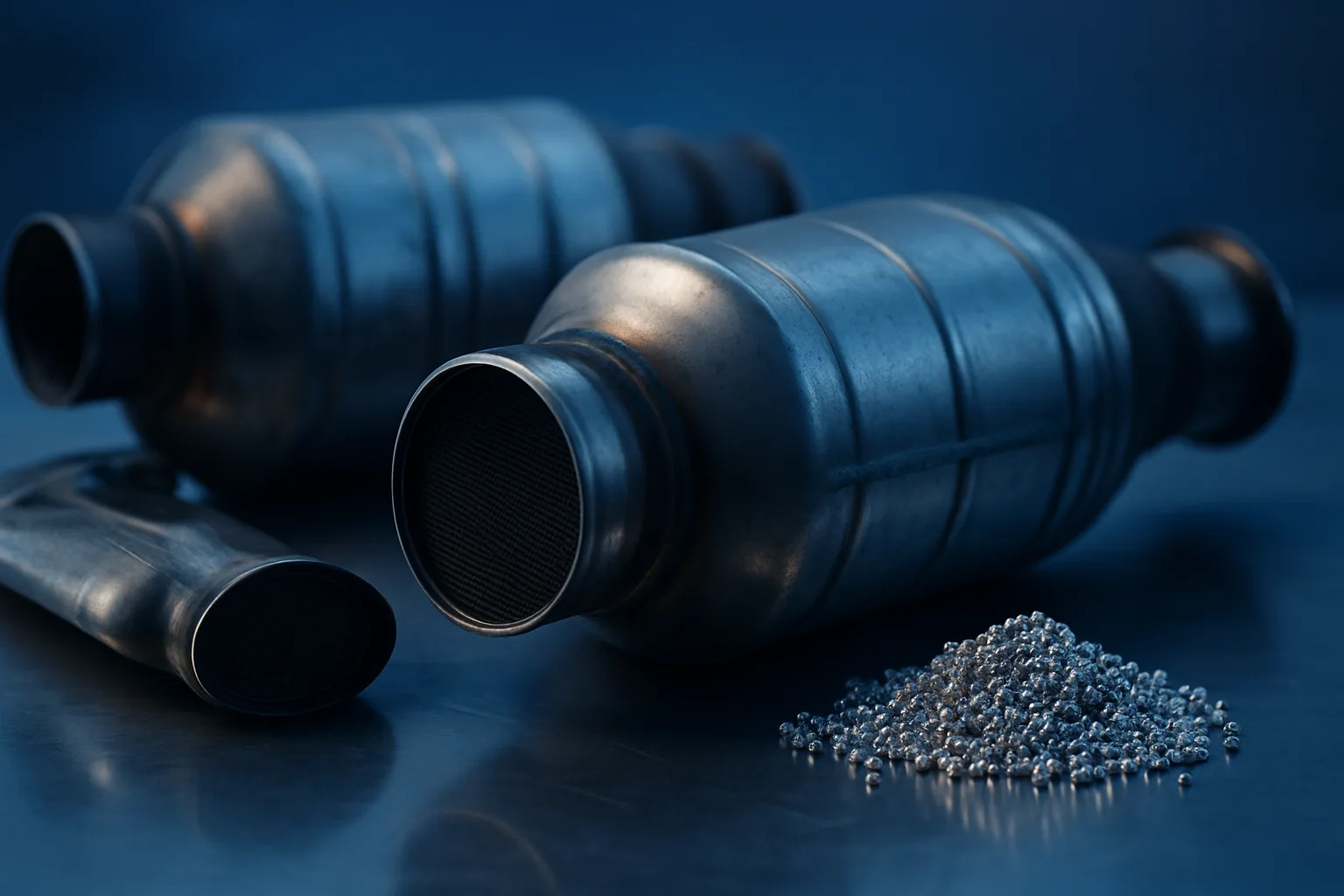
Emissions Rules Are Tightening — and That's Pushing Platinum Prices Up
Most people selling a scrap catalytic converter are focused on one thing: what's it worth today? But if you want to understand why the platinum price today swings the way it does, you need to follow the regulations. Emissions standards — not just in Canada, but across North America, Europe, and beyond — are one of the biggest forces shaping what your old cat is actually worth at the yard.
This isn't abstract policy talk. If you're sitting on a pile of used converters in Dartmouth, Nova Scotia, or running an auto shop that pulls cats regularly, understanding what drives the market puts money in your pocket. Here's what's happening in 2026 and why it matters to you right now.
What Emissions Regulations Actually Require From Automakers
Catalytic converters exist because governments force automakers to clean up exhaust gases before they leave the tailpipe. The three pollutants targeted — hydrocarbons, carbon monoxide, and nitrogen oxides — are chemically converted inside the converter using platinum group metals (PGMs): platinum, palladium, and rhodium. No viable substitute exists at commercial scale. That's the core of why these metals matter.
In 2026, emissions regulations are more demanding than ever. Canada's updated Light Duty Vehicle Emissions standards continue to align with U.S. federal benchmarks while the country pursues its broader clean air commitments. The European Union's Euro 7 standard — the most aggressive emissions framework the continent has adopted — came into full effect for passenger vehicles this year, requiring lower limits on particulate matter and NOx than Euro 6 could achieve. Automakers meeting these new thresholds need more PGM loading per converter, not less.
- Euro 7 requires stricter NOx and particulate limits for new vehicles sold in Europe
- U.S. Tier 3 and California LEV III standards continue to define North American benchmarks
- Canada's vehicle standards mirror U.S. federal rules and are being updated to reflect 2026 fleet transition targets
- Emerging markets like India (BS6 Phase 2) are also raising catalytic converter requirements for the first time
Every time a government raises the bar, OEM demand for raw platinum, palladium, and rhodium increases. That upstream demand feeds directly into secondary markets — including what you're paid when you sell a scrap cat.
How Regulation-Driven Demand Affects the Platinum Price Today
PGM pricing is a supply-and-demand story with a twist: supply is incredibly concentrated. South Africa produces roughly 70–80% of the world's platinum and palladium. Any production disruption there — a strike, a power outage, a flooding event in a deep mine — rattles global prices within days. Pair that with a regulatory environment that keeps raising the floor on industrial demand, and you have a market that can move sharply in both directions.
The platinum price today reflects multiple competing pressures at once. Automotive demand from catalytic converter manufacturing pulls platinum in one direction. Investment demand — platinum as a financial hedge — pulls in another. Recycling supply, meaning the metal recovered from scrap converters like yours, offsets some primary mining output. When scrap recycling is efficient and high-volume, it helps stabilize supply. When it's not — when cats go to the wrong buyer at the wrong price — that metal effectively disappears from productive circulation.
Here's the practical takeaway: when regulations tighten and automakers need higher PGM loadings, secondary market prices for scrap converters tend to follow. Scrap yards and buyers price cats based on what the refinery will pay for recovered platinum, palladium, and rhodium. If refinery demand is strong because OEM demand is strong, your cat is worth more. That's the chain. Knowing where you sit in it helps you negotiate better — or at least know when you're getting low-balled.
What This Means for Catalytic Converter Sellers in Dartmouth and Nova Scotia
If you're in Dartmouth or anywhere across Nova Scotia, you're not isolated from these global metal markets. The same platinum price benchmarks driving demand in Toronto or Detroit apply to what a local buyer should be paying you. The problem isn't the market — the problem is access to it.
Selling your scrap converter to a single local buyer without checking the market is the oldest mistake in the book. One buyer, one offer, no competition. That buyer has every incentive to quote you a number that protects their margin, not yours. This is especially true for individual sellers — auto shop owners, private collectors, or someone pulling a cat off a single vehicle — who don't have the volume or the relationships to push back.
In Dartmouth, the scrap recycling community is active and the auto repair industry generates a steady volume of spent converters. That's real inventory with real value. The issue is making sure that value actually reaches the seller — not just the middleman. To get the best catalytic converter price in Canada, you need more than one buyer at the table.
Platforms like SMASH were built for exactly this problem. By connecting sellers to a vetted network of buyers through a transparent auction format, competition replaces guesswork. More buyers means better price discovery. That's not a marketing line — it's how markets work when they're actually functioning.
Why the Scrap Cat Market Is Not Transparent — and How to Fix That
Let's be direct: catalytic converter pricing is deliberately opaque in many parts of the market. Buyers benefit from sellers not knowing the platinum price today, not understanding PGM loadings by make and model, and not having access to competing offers. The result is a market where the same physical converter can fetch significantly different prices depending entirely on who you call first.
Here's what drives the variation in scrap converter prices:
- PGM spot prices — platinum, palladium, and rhodium change daily based on commodity markets
- Converter type and make — some OEM converters carry far higher PGM loadings than others; a diesel truck cat is not the same as a compact car cat
- Condition — cracked, overheated, or tampered converters yield less recoverable metal
- Photo and serial documentation — buyers pay more when they can verify what they're getting before they commit
- Volume — a single unit fetches less per piece than a documented load of 20 or 50 units
A platform like SMASH addresses the documentation side directly. Serial number tracking, photo documentation, and structured inventory listings give buyers the confidence to bid competitively. Documented inventory gives buyers more confidence — and confident buyers bid higher. You can read Canadian catalytic converter pricing guides to understand how to prepare your inventory before you sell.
If you want to understand how a legitimate scrap metal auction platform works at scale, Canada's B2B scrap recycling marketplace is worth knowing about. The same auction mechanics that move large industrial scrap loads can work for high-value items like PGM-bearing catalytic converters.
Regulation Trends to Watch in the Second Half of 2026
The regulatory environment isn't static. Several developments are worth tracking through the rest of 2026 and into 2027, because they will continue to shape PGM demand and, by extension, what scrap cats are worth at the yard.
EV transition timelines are being revised. Several automakers have pulled back their internal combustion engine phase-out targets in response to slower-than-projected EV adoption. This means more ICE vehicles in production for longer — which means more catalytic converters being manufactured, and more PGM demand sustained at levels regulators and miners didn't fully anticipate.
Heavy-duty and commercial vehicle standards are catching up. While passenger vehicle standards have been the focus for years, regulators in Canada, the U.S., and the EU are now applying stricter emissions requirements to heavy-duty trucks, buses, and off-road equipment. These vehicles use large, PGM-dense converters. New production means new scrap volume in 5–15 years — and higher loadings mean higher recovery value when those units eventually reach the recycling stream.
Palladium and rhodium supply remain tight. Palladium — used heavily in gasoline engine converters — has faced ongoing supply constraints tied to South African mining output and geopolitical factors. Rhodium, the highest-value PGM per troy ounce and used to control NOx emissions, remains volatile. Both metals are critical to meeting current and upcoming emissions standards, which keeps secondary market demand elevated for converters containing them.
If you want to stay current on where the market is heading, it pays to check current Canadian catalytic converter prices regularly rather than assuming last month's quote is still valid.
Getting the Right Price for Your Scrap Converter in 2026
The global regulatory picture is clear: demand for platinum group metals isn't going anywhere. Emissions standards keep rising, EV timelines keep shifting, and scrap converters remain a critical secondary source of PGMs for refineries supplying the automotive industry. That's structural demand — not a short-term spike.
What that means for you is simple. The converter sitting in your yard, on your shop floor, or in the back of your truck has real value backed by global industrial demand. Getting paid a fair share of that value requires access, documentation, and competition. A single phone call to a single buyer doesn't give you any of those things.
Whether you're a one-off seller or running a regular volume of cats out of Dartmouth or across Nova Scotia, the path to a better price is the same: know the market, document your inventory, and put it in front of more than one buyer. If you're ready to do that, get the best Canadian price for your catalytic converter — start with a free quote at best-catalytic-converter-price.ca.
Disclaimer: Catalytic converter prices fluctuate daily based on platinum, palladium, and rhodium spot prices. Always check current rates before selling.
Frequently Asked Questions
Q: Does the platinum price today directly affect what I get paid for a scrap catalytic converter in Canada?
Yes — but it's not a one-to-one relationship. Buyers price scrap converters based on their estimated PGM recovery value, which is tied to platinum, palladium, and rhodium spot prices. When platinum prices are elevated, converters with higher platinum loadings are worth more. Your specific payout also depends on converter type, condition, and the buyer you're dealing with — which is why shopping multiple buyers matters.
Q: Why are emissions regulations relevant to what my scrap converter is worth?
Stricter emissions rules require automakers to use more platinum group metals per converter to achieve lower exhaust limits. That increases industrial demand for PGMs, which supports stronger secondary market prices for scrap cats. Regulation-driven demand is one of the structural reasons PGM prices stay elevated over time.
Q: Are there catalytic converter buyers in Dartmouth or Nova Scotia who pay fair market rates?
There are buyers operating across Nova Scotia, including in the Dartmouth area. The challenge is that individual buyers have different pricing models, and not all of them are transparent about how they calculate an offer. Using a platform that brings multiple vetted buyers to the table — like SMASH — is the most reliable way to confirm you're seeing real market pricing rather than a single buyer's margin-protected quote.
Q: What's the difference between a scrap yard price and a fair market price for a catalytic converter?
A scrap yard price is whatever the yard is willing to pay based on their own cost structure, buyer relationships, and margin targets. Fair market price reflects what a converter is actually worth based on its PGM content and current spot prices. The gap between the two is where a competitive auction format earns its keep — competition closes that gap in the seller's favour.
Q: Does it matter how I document my catalytic converter before selling it?
Absolutely. Serial numbers, photos, and make/model information allow buyers to accurately assess PGM loading before making an offer. Without documentation, buyers protect themselves by bidding low. A well-documented converter — especially in a platform that supports photo uploads and serial tracking — gives buyers the confidence to bid higher, which works directly in your favour.
Follow SMASH on LinkedIn for scrap metal market updates, PGM pricing insights, and industry news relevant to recyclers and buyers across North America.