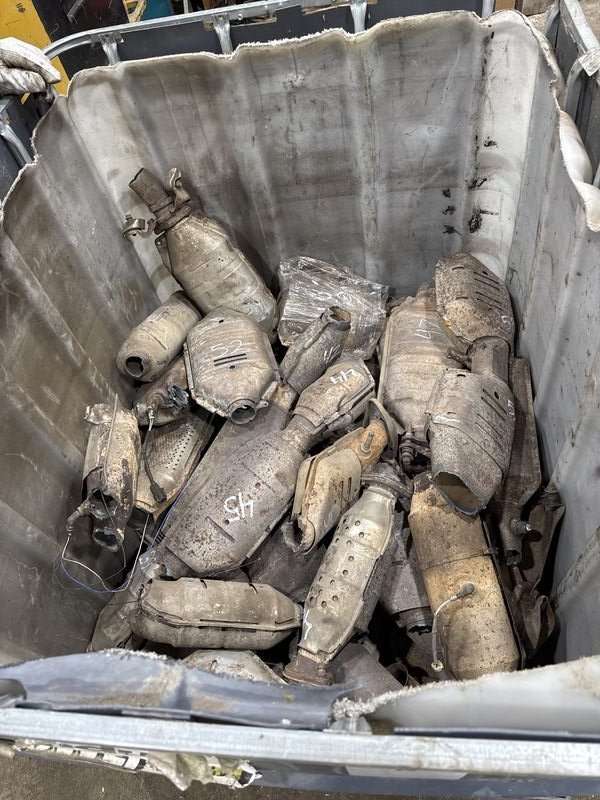
What's Actually Inside Your Catalytic Converter — and Why It Matters for Your Payout
Most people know scrap catalytic converters are worth money. Fewer people know why. The short answer: there's a small amount of some of the rarest metals on earth packed inside that ceramic honeycomb. Platinum. Palladium. Rhodium. These aren't just precious metals — they're industrial metals with serious global demand, and their prices move fast. If you're sitting on a pile of cats in Prince George and you don't understand what drives their value, you're selling blind.
This week's roundup breaks down the metals inside your converters, how each one affects the payout you see, and why getting the best catalytic converter price in Canada means understanding what you actually have before you sell it.
The Three Metals That Drive Catalytic Converter Value
Every catalytic converter contains a substrate — usually a ceramic or metalite honeycomb — coated with a washcoat that holds the precious metals. These metals act as catalysts, triggering chemical reactions that convert harmful exhaust gases into less toxic compounds. The three metals doing that work are platinum (Pt), palladium (Pd), and rhodium (Rh). Each one has a different role, a different scarcity level, and a different price per troy ounce.
Understanding all three helps you understand why two converters that look nearly identical can pay out very differently at the scrap yard. A converter heavy in rhodium can be worth several times more than one loaded with platinum, even if they're the same size. Here's the breakdown:
- Platinum (Pt): Historically the most well-known of the three. Used primarily in diesel engine converters. Platinum is relatively stable compared to the other two, but it's still subject to global supply and demand shifts. South Africa produces the majority of the world's platinum supply, which means geopolitical or mining disruptions overseas can ripple directly into what your scrap buyer pays you in British Columbia.
- Palladium (Pd): The dominant metal in gasoline engine converters. Palladium had a significant run-up in price over the past several years as automakers leaned heavily on it for emissions compliance. It remains one of the key drivers of converter value for the most common scrap units — the everyday passenger car and light truck cats you see at any recycling yard.
- Rhodium (Rh): The rarest and most volatile of the three. Rhodium is extracted almost exclusively as a byproduct of platinum mining, meaning supply is tightly constrained. Even small supply shocks or spikes in automotive production can send the rhodium price today swinging dramatically. When rhodium is high, converters that contain meaningful rhodium concentrations — typically three-way cats from gasoline engines — command serious premiums.
How Metal Concentrations Vary by Converter Type
Not all converters are built the same. The amount and type of precious metals inside depend on the vehicle's engine type, the model year, the emission standard it was designed to meet, and the manufacturer's engineering choices. This is exactly why buyers — and sellers — can't just eyeball a converter and name a fair price. The variance is real.
Here's a general framework for how converter types differ:
- Standard passenger car cats (gasoline): These typically carry a blend of all three PGMs (platinum group metals), but palladium and rhodium tend to dominate. They're the most common units in the scrap stream and form the backbone of most buyers' pricing models.
- Diesel oxidation catalysts (DOCs): Primarily platinum-loaded. These are heavier on platinum and light or absent on rhodium. Common in diesel trucks, heavy equipment, and European diesel passenger cars — categories you see regularly at Prince George scrap metal operations given the region's resource and forestry industries.
- High-value foreign cats: Vehicles from certain Japanese and European manufacturers pack higher PGM loadings. These units look similar on the outside but assay significantly higher. Without documentation or proper identification, sellers often get paid generic rates for high-value units — leaving real money on the table.
- Large diesel truck cats (DPF-equipped): Diesel particulate filters are a related but separate category. They contain different chemistry and are valued differently. Don't mix them in with your standard converter inventory without separating them first.
- Small or thin cats: Muffler converters, pre-cats, and small foreign units. Lower metal content, lower payouts. But they still have value — just don't overprice them expecting the same rates as a full-size domestic truck converter.
The practical takeaway: sorting and documenting your inventory before you sell isn't busywork. It's the difference between a generic bulk quote and a price that actually reflects what your cats contain. Platforms like smashrecycling.ca are built to handle exactly this — documented lots with photos, serial tracking, and vetted buyers who can price based on what's actually there.
Why Precious Metal Prices Are Volatile — and What That Means for Sellers in British Columbia
Precious metal prices don't move on a schedule. They respond to mining output, automotive production volumes, currency fluctuations, industrial demand from electronics and hydrogen fuel cell development, and macro market conditions. The scrap metal prices today you see for platinum, palladium, and rhodium can shift meaningfully week over week — and within a quarter, the swings can be dramatic.
For sellers in Prince George and across British Columbia, this creates a real timing challenge. A load that gets priced one week might fetch a meaningfully different number two weeks later. This isn't a reason to panic — it's a reason to pay attention. Knowing when to hold and when to sell requires at least a basic understanding of where the metals are in their cycle.
A few factors worth watching heading into Q4 2026:
- Global automotive production volumes, which directly influence automaker demand for PGMs in new catalytic converters
- South African mining conditions, which affect platinum and rhodium supply at the source
- Russian palladium exports, historically a significant share of global palladium supply
- Hydrogen economy development, which is creating new long-term demand for platinum as a catalyst in fuel cells
- Currency movements between CAD and USD, which affect the Canadian dollar value of metals priced in USD globally
None of this means you need to become a commodities trader. It means that getting a competitive quote — from more than one buyer — is the most practical hedge against leaving money behind. Disclaimer: Precious metal prices fluctuate daily. Always check current Canadian catalytic converter prices before finalizing any sale.
How the Assay Process Turns Metal Content Into Your Payout
When your converters leave the yard, they go through a processing and assay chain before the actual metal content is confirmed. Understanding this chain helps you understand why there's sometimes a gap between the quote you get upfront and the final settlement — and how to protect yourself from that gap widening at your expense.
Here's the typical flow:
- Decanning: The outer steel shell is removed, and the ceramic or metalite substrate is extracted and shredded.
- Lot sampling: The shredded material is mixed and sampled to create a representative assay sample. This is where sampling methodology matters — poor sampling practices introduce variance that can hurt sellers.
- Lab assay: The sample is analyzed, typically by XRF (X-ray fluorescence) for a quick read or fire assay / ICP (inductively coupled plasma) for more precise results. The assay determines exact PGM concentrations in grams per tonne.
- Settlement calculation: The assay result multiplied by the lot weight, minus processing charges, yields the final payable metal. That number, priced at current spot rates, gives you the settlement value.
The more buyers competing for your load, and the more documentation you bring to the table, the more leverage you have in this process. That's the core argument for using a SMASH scrap metal auction model — competition between vetted buyers creates better price discovery. No subscription fees. SMASH only wins when you do.
If you're regularly moving catalytic converter volume out of Prince George — whether you're running a yard, an auto shop, or working as an independent collector — Prince George scrap metal services connected to a competitive buyer network will consistently outperform a single-buyer relationship where only one party knows the real market.
What Serious Sellers Do Differently to Get the Best Catalytic Converter Price
Sellers who consistently get the best catalytic converter price in markets like Prince George aren't just lucky. They're disciplined about a handful of things that casual sellers skip. If you want to move from guessing to actually knowing what your cats are worth, this is where to start.
- They sort before they sell. Foil cats, domestic full-size, foreign small, diesel DOCs, DPFs — each category values differently. Mixing them into a bulk lot gives the buyer an excuse to pay you for the worst units in the pile.
- They photograph everything. Visual documentation of each unit — serial numbers, manufacturer markings, physical condition — gives buyers more confidence and gives you a record if there's a settlement dispute.
- They get multiple quotes. A single buyer quoting you is a buyer quoting you. Multiple buyers competing for your load is a market. These are not the same thing.
- They use platforms that do the work. Tools like SMASH handle inventory documentation, buyer vetting, auction format, and auto-invoicing. Less manual negotiation, more competition, cleaner paperwork.
- They track the market. Not obsessively — but enough to know whether rhodium is high or low relative to recent months. Even a general awareness of where you are in the cycle informs when to sell and when to hold.
- They use the right resources. Sites like best-catalytic-converter-price.ca exist to give Canadian sellers accurate framing for what their cats are worth — read Canadian catalytic converter pricing guides regularly to stay current on market context.
The scrap industry has always rewarded the informed seller. That's not changing. If anything, as PGM markets grow more sophisticated and the buyer side of the market becomes more data-driven, sellers who show up unprepared are leaving more on the table than ever before.
Frequently Asked Questions
Q: What precious metals are inside a catalytic converter?
Catalytic converters contain platinum (Pt), palladium (Pd), and rhodium (Rh) — collectively called platinum group metals or PGMs. These metals are coated onto the converter's ceramic or metalite substrate and act as chemical catalysts. The exact blend and concentration depends on the vehicle type, engine, and model year.
Q: Why does the rhodium price today affect my catalytic converter payout so much?
Rhodium is the rarest of the three PGMs and is extracted almost entirely as a byproduct of platinum mining. Its price is highly volatile and can swing dramatically with small changes in supply or automotive demand. When rhodium prices are elevated, converters with meaningful rhodium content — particularly three-way gasoline engine cats — command significantly higher payouts.
Q: How do I get the best catalytic converter price in Prince George?
Sort your converters by type before selling, photograph and document each unit, and get quotes from multiple buyers. Using a competitive auction platform like SMASH connects your inventory to vetted buyers across North America, which creates real price competition instead of a single take-it-or-leave-it offer. The more information you bring to the transaction, the better your negotiating position.
Q: How do scrap metal prices today affect what I get paid for my cats?
Catalytic converter payouts are directly tied to live precious metal spot prices. When platinum, palladium, and rhodium are trading higher, your cats are worth more. When prices dip, payouts follow. This is why checking current market rates before finalizing a sale matters — the number you got quoted last month may not reflect today's reality.
Q: Are there catalytic converter buyers near me in Prince George with competitive prices?
Yes — and the key word is competitive. Any buyer can quote you a number. A buyer competing against other buyers has a reason to quote you the real number. Platforms that connect Prince George sellers with multiple vetted buyers give you actual market discovery rather than a single data point. That difference adds up, especially if you're moving volume regularly.
If you're sitting on catalytic converters in Prince George — whether it's a single unit or a full pallet — the metals inside them have real value, and that value deserves a real market. Understanding what drives the price puts you in a better position every time you sell. When you're ready to find out exactly what your cats are worth in today's market, get the best catalytic converter price in Canada with a free quote at best-catalytic-converter-price.ca. No guessing. No single-buyer surprises. Just competitive pricing based on what you actually have.
Stay sharp on market moves — follow SMASH on LinkedIn at linkedin.com/company/scrap-metal-auction-sales-hub for weekly scrap metal market insights and industry updates worth knowing.