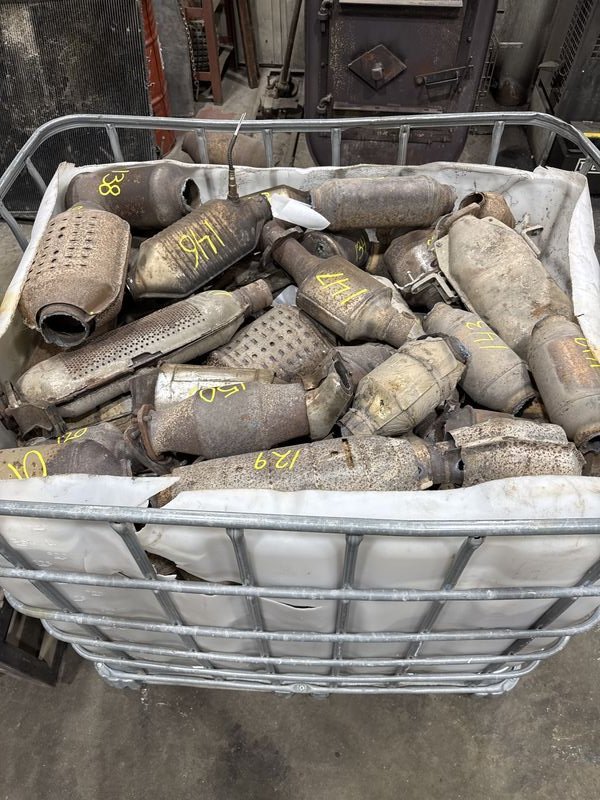
Most people leave hundreds of dollars on the table because they don't know how to remove a catalytic converter properly before scrapping it. Damage it during removal, and buyers will downgrade your unit — or reject it outright. If you're in Victoria or anywhere across British Columbia chasing cat converter prices Victoria, the removal process matters as much as where you sell.
This guide cuts through the confusion. We'll cover safe removal, what affects your catalytic converter scrap value, and how to make sure you're getting paid what your unit is actually worth.
Why Proper Removal Directly Affects Catalytic Converter Scrap Value
Your catalytic converter contains platinum, palladium, and rhodium — precious metals that buyers pay real money for. The value lives inside the substrate, the honeycomb-like ceramic or metallic core coated with those metals. If you crack that substrate during removal, you've destroyed the most valuable part of the unit.
Buyers assess condition before they make an offer. A clean, intact converter with the substrate undamaged commands a significantly better price than one that's been hammered off with a sledge or dropped on concrete. If you want to get the best catalytic converter price in Canada, the work starts in your driveway or shop — before the unit ever reaches a buyer.
Beyond the substrate, buyers also look at:
- Whether the converter is complete (shell intact, no visible holes)
- Whether it's aftermarket or OEM (OEM units typically carry more precious metal content)
- The make, model, and year of the vehicle it came from
- Whether the unit has been tampered with or opened
Doing the removal right isn't just about safety — it's about protecting your payout.
Tools You Need Before You Start
Going in unprepared is how people get hurt and how converters get ruined. Gather everything before you get under the vehicle. Rushing the job costs you time and money.
Here's what you'll need for a standard catalytic converter removal:
- Floor jack and jack stands — Never work under a vehicle supported only by a floor jack
- Penetrating oil (PB Blaster, Kroil, or equivalent) — Apply this 24–48 hours before you plan to remove the unit if you can
- Angle grinder or reciprocating saw — For cutting through rusted bolts or welded connections
- Wrench set and breaker bar — 13mm to 17mm covers most passenger vehicles
- Eye protection and gloves — Non-negotiable
- Heat-resistant gloves — If the vehicle was recently driven
- Exhaust manifold gaskets — If you're reinstalling the system afterward
One thing Victoria-area shops know that weekend mechanics often miss: British Columbia roads aren't as salt-heavy as eastern Canada, but coastal moisture still creates serious corrosion on exhaust hardware. Plan for stuck bolts. Penetrating oil applied the day before saves more time than any tool upgrade.
Step-by-Step: How to Remove a Catalytic Converter Safely
Follow these steps in order. Skipping steps — especially the cooldown period — is how burns and injuries happen.
- Let the vehicle cool completely. Exhaust systems run extremely hot. Wait at least 2–3 hours after the engine was last running. The converter itself can hold heat longer than the surrounding pipes.
- Lift and secure the vehicle properly. Jack up the vehicle from a solid frame point and place jack stands on both sides. Never trust a single point of support. If you have a lift — use it.
- Apply penetrating oil to all fasteners. Do this now if you didn't do it the day before. Let it soak for at least 20–30 minutes before attempting to turn anything. Forcing a dry rusted bolt strips threads and costs you time.
- Identify your converter location. On most passenger vehicles, the catalytic converter sits between the exhaust manifold and the muffler, underneath the vehicle. Some vehicles have two converters (bank 1 and bank 2). Know what you're dealing with before you start.
- Disconnect the oxygen sensors (if reusing them). There are typically one or two O2 sensors threaded into the converter or the surrounding pipes. Use an O2 sensor socket (a slotted socket that accommodates the wire). These can be valuable on their own — don't cut them off if you can help it.
- Loosen flange bolts at both ends. The converter is held in place by flanged joints — usually two bolts at each end. Work the penetrating oil in and use your breaker bar slowly. If bolts are seized, hit them with penetrating oil again and wait. If they won't budge, cut them with the angle grinder or reciprocating saw rather than stripping them.
- Support the converter before removing the final fasteners. Once the last bolt comes free, the unit drops. Have one hand supporting it, or use a transmission jack if the unit is large and heavy. Dropping it cracks the substrate.
- Lower and inspect the unit. Look at the shell — check for holes, cracks, or any damage to the casing. Shake it gently. A rattling sound indicates the substrate is broken or loose inside. This matters when you get it appraised.
That's the core process. For most standard passenger vehicles, a prepared mechanic or confident DIYer can complete this in under an hour. Auto shops in Victoria doing this regularly will process a unit in 20–30 minutes once the tools are ready and penetrating oil has done its job.
Know What You Have Before You Sell: Catalytic Converter Scrap Value in Canada
You need to know what you're sitting on. Catalytic converter scrap values vary enormously based on the vehicle make and the precious metal content inside the substrate. High-load converters from trucks, SUVs, and performance vehicles carry more platinum, palladium, and rhodium than smaller economy car units.
A few factors that affect your unit's value in the Canadian scrap market:
- Precious metal content — Platinum, palladium, and rhodium spot prices on global commodity markets drive converter values. When rhodium spikes, so does your payout.
- OEM vs. aftermarket — OEM converters from the original manufacturer carry significantly more precious metal loading than cheap aftermarket replacements.
- Vehicle origin — Japanese and North American OEM converters often perform differently at assay. The VIN helps buyers identify exact models and expected content.
- Condition — Intact substrate, complete shell, no tampering.
To check current Canadian catalytic converter prices, use a service that gives you real-time data against actual buyer offers — not a year-old price chart.
Platforms like SMASH Recycling — where verified buyers bid on your metal bring competition to the process. Instead of calling one buyer and accepting whatever price they quote, multiple vetted buyers compete for your load. That competition is how you find out what your converter is actually worth in today's market.
If you're based in Victoria, using Victoria scrap metal services connected to a competitive buyer network is a smarter starting point than phoning around to individual yards and hoping for a straight answer.
Scrap Metal Recycling Canada: Staying Compliant When You Sell
Catalytic converter theft is a real problem across Canada, and in British Columbia, regulations around selling scrap catalytic converters have tightened meaningfully. Legitimate scrap buyers and recyclers now require documentation before they'll transact on a converter.
When you go to sell, be prepared to provide:
- Government-issued photo ID
- Proof of vehicle ownership — registration or title matching the VIN
- Bill of sale if you purchased the vehicle
- For auto shops: repair orders or customer authorization documenting the unit came from a vehicle in for service
Reputable buyers won't work around this. If a buyer offers to skip the paperwork, that's a red flag — not a convenience. SMASH works exclusively with vetted buyers who meet compliance standards. You're not just getting a competitive price — you're getting a clean, documented transaction that protects you.
For auto shops and scrap collectors running regular volume in British Columbia, photo documentation and serial/VIN tracking through a platform like SMASH adds an audit trail that keeps your business above board and your buyers confident in the material they're acquiring.
Getting the Best Price After Removal: What to Do Next
The converter is off. It's intact. You've got your documentation ready. Now comes the part most sellers get wrong — they call one buyer, accept the first number, and walk away thinking they did fine.
You don't know if you got a fair price unless multiple buyers have competed for it.
That's exactly the problem SMASH is built to solve. Post your unit with photos, documentation, and VIN data. Verified buyers in the network see the listing, assess it, and place bids. The process brings market transparency to a business that has historically run on information asymmetry — where the buyer knows far more than the seller.
To read Canadian catalytic converter pricing guides and understand the full range of factors affecting your payout, use resources built specifically for the Canadian market — not generic price lists based on U.S. commodity data.
If you're ready to find out what your converter is actually worth, the next step is straightforward. Get a free quote, compare what buyers are willing to pay, and make an informed decision. Whether you're an individual in Victoria sitting on one converter or an auto shop moving dozens of units per month across British Columbia, the process is the same. Bring competition to it. Know your number. Don't settle for the first call.
Get the best Canadian price for your catalytic converter — get a free quote at best-catalytic-converter-price.ca.
Disclaimer: Catalytic converter scrap prices fluctuate based on platinum, palladium, and rhodium spot markets. Always check current rates before selling.
Frequently Asked Questions
Q: How much is my catalytic converter worth as scrap in Victoria?
Values vary significantly depending on the vehicle make, model, and whether the converter is OEM or aftermarket. High-content units from trucks and SUVs typically return more than economy car units. The only way to know your actual value is to get competing offers from multiple buyers — spot checks on static price lists don't reflect real market conditions.
Q: Is it legal to sell a catalytic converter for scrap in British Columbia?
Yes, but you must provide documentation — government-issued ID and proof of vehicle ownership at minimum. British Columbia has implemented stricter requirements to combat converter theft. Legitimate buyers require this paperwork before completing any transaction.
Q: Will a cracked or rattling catalytic converter still have scrap value?
It may still have some value, but buyers will downgrade it significantly. A rattling converter typically indicates a broken or loose substrate, which means precious metal content may be compromised. Full, intact units always command the best prices.
Q: Can an auto shop in Victoria sell catalytic converters on behalf of customers?
Yes. Shops handling converter replacements can retain the core for scrap. You'll need repair orders or customer authorization documenting where each unit came from. Platforms like SMASH support volume sellers with photo documentation and serial tracking to keep the process organized and compliant.
Q: How long does it take to get paid after selling a scrap catalytic converter in Canada?
Timelines vary by buyer and payment method. Many buyers complete same-day or next-day payment on verified units. Using a platform with auto-invoicing and verified buyers — like SMASH — reduces the back-and-forth and speeds up the process considerably.
Follow SMASH on LinkedIn for scrap metal market updates, catalytic converter pricing insights, and industry news across North America.