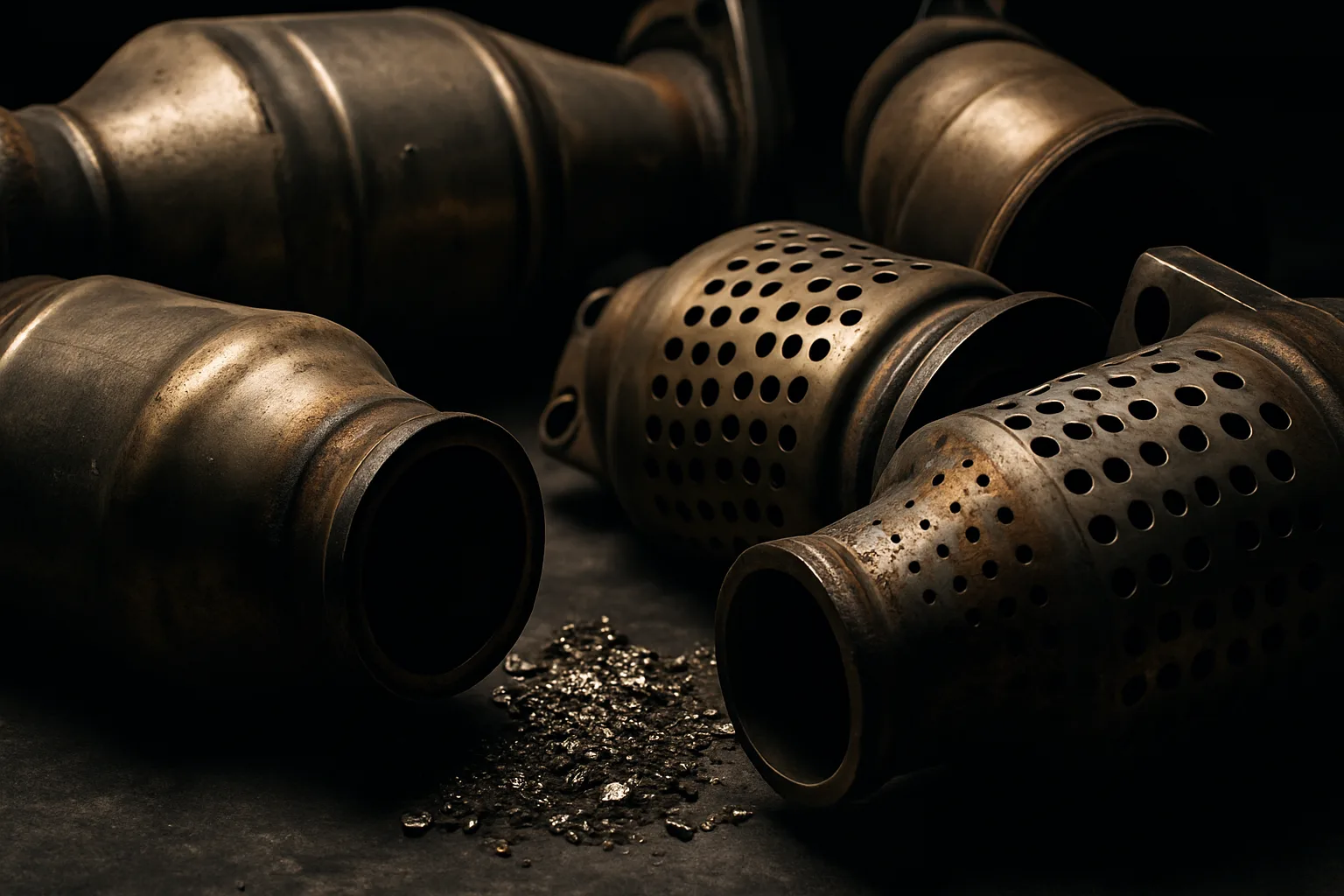
Most people have no idea their old catalytic converter contains metals worth hundreds of dollars — or that improper disposal poisons soil and groundwater for decades. If you've got a spent cat sitting in your garage, a pile building up at your shop, or a vehicle headed to the wrecker, understanding proper catalytic converter recycling Toronto matters more than most realize. This isn't just about getting paid. It's about where those metals go after you hand them over.
Catalytic converters house some of the rarest materials on earth — platinum, palladium, and rhodium. Rhodium alone regularly trades at multiples of gold's price. These metals don't disappear when a converter wears out. They stay locked inside the ceramic honeycomb substrate, waiting to be recovered. The question isn't whether someone profits from your old cat. The question is whether that someone is you, and whether the process happens responsibly.
This article breaks down why proper recycling matters, what the environmental stakes are, and how platforms like SMASH Recycling — where verified buyers bid on your metal help sellers in Toronto and across Ontario get paid fairly while keeping the supply chain clean.
Why Catalytic Converter Recycling Is an Environmental Imperative
Catalytic converters are emissions control devices. Their entire job is to reduce the toxic output of internal combustion engines — converting carbon monoxide, nitrogen oxides, and unburned hydrocarbons into less harmful compounds. The irony is that when those converters reach end-of-life and get handled improperly, they become an environmental problem themselves.
The ceramic substrate inside a converter contains trace heavy metals and chemical compounds that don't belong in a landfill. Crushed and buried, they leach. Add the spent exhaust residue baked into the substrate over years of use, and you've got material that requires controlled processing — not casual disposal. Responsible smelters and refiners recover the platinum group metals (PGMs) through a controlled hydrometallurgical or pyrometallurgical process that captures and contains those byproducts. The backyard scrapper who grinds out the honeycomb and dumps the shell doesn't do that.
- Platinum — used in diesel cats primarily; also in industrial and medical applications
- Palladium — dominant in gasoline engine cats; one of the most actively traded PGMs
- Rhodium — present in smaller quantities but commands the highest per-gram value of the three
Recovering these metals from spent converters reduces the need for new mining. Primary PGM mining is concentrated in South Africa and Russia, involves significant land disturbance and energy use, and carries serious geopolitical supply risk. Every gram recovered from a recycled cat is a gram that doesn't need to come out of the ground. Urban mining — recovering metals from end-of-life products — is one of the most efficient tools the industry has.
The Environmental Risk of Grey Market and Informal Recycling
Not every buyer who offers you cash for your cats is processing them responsibly. The grey market for catalytic converters has expanded significantly over the past several years, fueled partly by PGM price volatility and partly by the sheer volume of converters coming off aging vehicle fleets. Some buyers — particularly informal ones operating outside regulated channels — cut corners on processing, documentation, and environmental compliance.
When you sell catalytic converters online or through informal channels without vetting the buyer, you have no visibility into what happens next. That matters legally in some jurisdictions and matters ethically in all of them. Ontario has tightened scrap dealer regulations in recent years, and the paper trail associated with catalytic converter sales is increasingly scrutinized — both to address theft and to ensure proper processing.
Proper recycling through a vetted buyer means:
- The converter is assayed accurately — the PGM content is measured, not estimated
- Processing happens at a licensed, regulated refinery
- Documentation exists — bill of lading, serial tracking where applicable, chain of custody
- The substrate material is handled as an industrial byproduct, not dumped
- The seller gets paid based on actual metal content, not a lowball spot guess
If you're based in Toronto and wondering about Toronto scrap metal services that meet these standards, the answer starts with who's buying and how they operate — not just what price they quote on the phone.
Catalytic Converter Worth at the Scrap Yard: What You're Actually Leaving on the Table
One of the biggest environmental failures in converter recycling isn't dramatic — it's a quiet undervaluation that pushes sellers toward informal channels. When a yard gives you a flat $50 for a domestic full-size truck cat that contains recoverable palladium worth multiples of that, you're not just losing money. You're creating an incentive for that value to exit the legitimate supply chain entirely.
Understanding catalytic converter worth at scrap yard pricing means understanding that not all yards price the same way. Some use flat rates by vehicle type. Some use visual grades. Some use actual assay or XRF scanning. The difference between these methods can be significant — especially on high-value units from luxury imports, late-model diesel trucks, or rare industrial applications.
The environmental argument here is direct: when sellers get paid fairly, they bring material into the regulated recycling stream. When they feel shortchanged, they look for shortcuts. Competitive pricing through a transparent auction format isn't just good for your wallet — it keeps material in the right hands.
To get the best catalytic converter price in Canada, you need multiple buyers competing for your material — not one buyer with a flat sheet and no pressure to move on price.
How Selling Catalytic Converters Online Changes the Equation
The option to sell catalytic converters online in Ontario has matured considerably. It's no longer a choice between your local yard and mailing your cats to a distant refiner and hoping for the best. Auction-based platforms now give sellers access to a vetted national buyer pool, with photo documentation, inventory tracking, and competitive bids that reflect actual market conditions.
SMASH is built for exactly this. Yards, auto shops, and collectors across Ontario and the rest of North America can list their converter inventory, document it properly, and let vetted buyers compete. No subscription fees. No guessing. You win when the bids are real and the buyers are accountable.
From an environmental standpoint, this model has real teeth. Vetted buyers on a platform like SMASH are operating in the open. Their bids are on record. Their purchasing history exists. That accountability flows downstream into how they process the material they buy. A buyer who operates transparently in the auction process is far more likely to operate transparently in the refining process. That's not a guarantee — but it's a meaningful filter that informal cash transactions don't provide.
For anyone in Toronto or southern Ontario looking for catalytic converter recycling near me that connects to responsible downstream processing, the search increasingly ends with documented, competitive transactions rather than a cash handshake at the gate.
What Responsible Recyclers Look for Before Buying Your Cats
If you want to know whether a buyer is operating responsibly, pay attention to what they ask before they quote you. A serious buyer wants information. A lowball buyer just wants to move fast.
Here's what responsible buyers typically request:
- Vehicle make, model, and year — affects PGM content and converter type
- VIN or serial number — critical for accurate identification, especially on foreign vehicles
- Photos — top, bottom, and pipe ends; condition affects value and identifies the unit
- Quantity and lot composition — mixed lots price differently than sorted lots
- Documentation — proof of ownership or business source, bill of lading for larger loads
This isn't bureaucracy for its own sake. Serial tracking and photo documentation protect sellers, buyers, and the broader supply chain from fraudulent material entering the stream. It also protects you legally in Ontario, where scrap dealer regulations require transaction records for regulated materials.
Platforms that help you document your inventory properly — before the sale — put you in a stronger position to check current Canadian catalytic converter prices and negotiate from a position of knowledge rather than guesswork.
Making the Right Call in Ontario's Catalytic Converter Market
Toronto is one of the largest vehicle markets in Canada. That means a significant volume of end-of-life catalytic converters cycling through the city's auto shops, salvage yards, and private collections every year. The infrastructure to handle that volume responsibly exists — but only if sellers route their material through it.
The choice you make when you decide where to sell your cats has a downstream effect that extends well beyond your transaction. It affects how the PGMs get recovered, how the substrate gets handled, whether the chain of custody holds up, and whether the next buyer in the chain has any accountability. None of this is abstract. It's measurable, and it starts with your first decision: who buys your material, and what do they do with it?
If you want to go deeper on pricing guides and market context before you sell, read Canadian catalytic converter pricing guides to understand what drives value in different converter types and how market conditions shift through the year.
When you're ready to move your cats, SMASH gives you the competitive auction format, vetted buyer pool, and documentation tools to do it right. No subscription. No guessing. Just buyers competing for your material in the open.
Get the best Canadian price for your catalytic converter and make sure it gets handled the right way — get a free quote at best-catalytic-converter-price.ca.
Disclaimer: Catalytic converter prices fluctuate based on PGM spot markets, converter type, and regional demand. Always verify current rates before selling.
Frequently Asked Questions
Q: Why does it matter where I recycle my catalytic converter in Toronto?
Not all buyers process converters the same way. Regulated recyclers recover platinum, palladium, and rhodium through controlled refining and handle substrate byproducts responsibly. Informal buyers may not. In Ontario, transaction documentation is also legally required for scrap dealers, so choosing a vetted buyer protects you as much as it protects the environment.
Q: How do I know if I'm getting a fair price for my catalytic converter in Ontario?
Fair pricing starts with accurate identification — make, model, year, and ideally VIN or serial number. A buyer who asks for details before quoting is more likely to price on actual PGM content than one who gives you a flat rate over the phone. Auction-based platforms like SMASH let multiple verified buyers compete, which helps reveal the real market value of your load.
Q: Can I sell catalytic converters online from Toronto?
Yes. Selling catalytic converters online in Ontario is practical and increasingly the preferred route for auto shops and larger collectors. Online platforms let you document your inventory, reach a broader buyer pool, and get competitive bids — all without being limited to whoever operates closest to you. SMASH is built specifically for this type of transaction.
Q: What metals are inside a catalytic converter and why do they have value?
Catalytic converters contain platinum group metals — platinum, palladium, and rhodium — embedded in the ceramic substrate. These metals act as catalysts for the emissions conversion process and are not consumed during normal use. Because primary PGM mining is geographically concentrated and resource-intensive, recovered metals from recycled converters carry real market value and reduce mining pressure globally.
Q: Does the age or condition of my converter affect what I can get at a scrap yard?
Yes, to a degree. The condition of the outer shell matters less than the condition of the substrate inside. A physically damaged or rattled-out converter has lost substrate material, which means lower recoverable PGM content and a lower bid. Converters that have been physically intact throughout their service life — even if they're at end-of-life — tend to retain more substrate value. Photos and proper identification help buyers assess this accurately.
Follow SMASH on LinkedIn for industry updates, PGM market insights, and scrap metal pricing trends across North America.
```