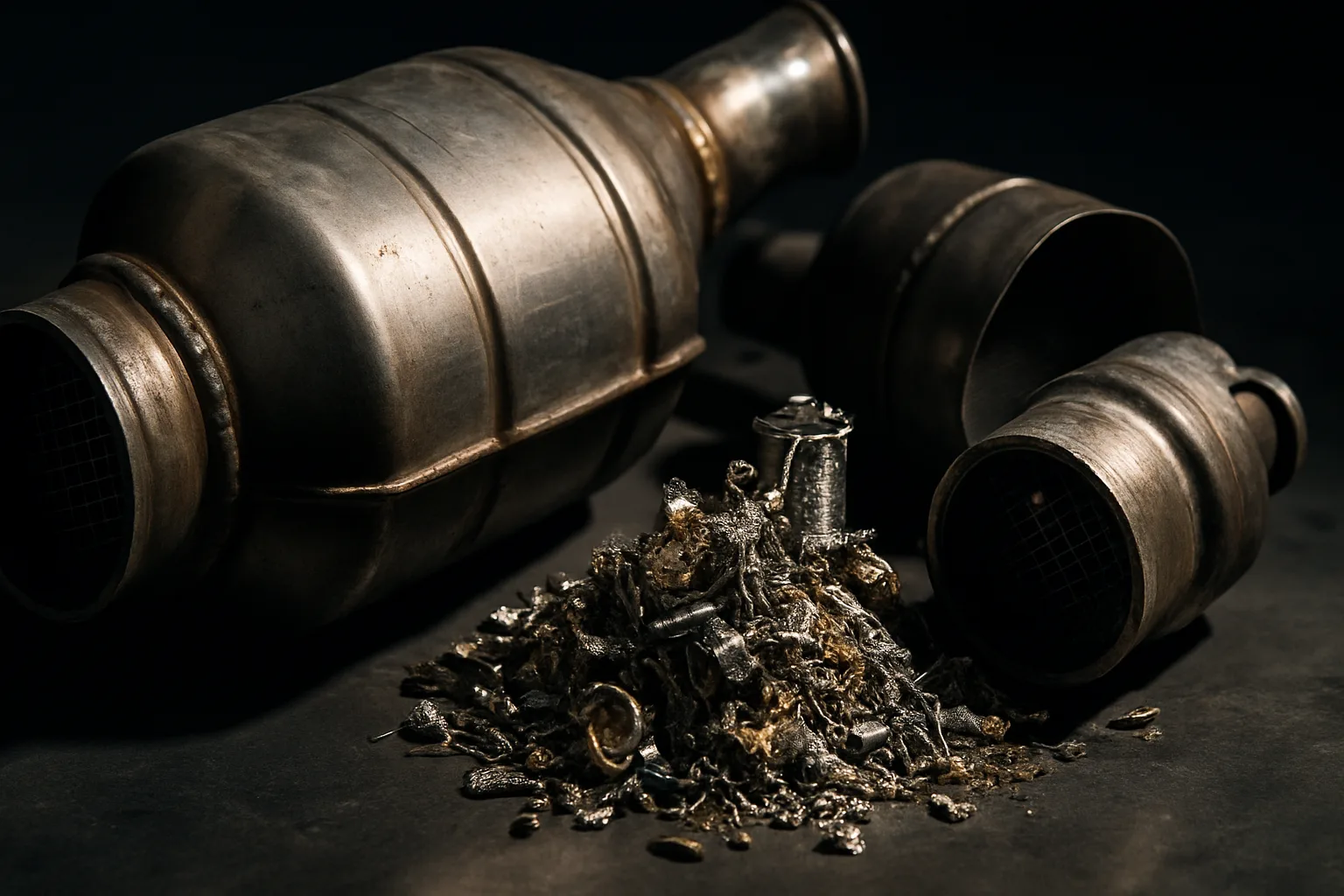
Most people selling a scrap catalytic converter have no idea what happens to it after it leaves their hands — and that gap in knowledge costs them money. If you don't understand how a converter gets valued, you can't push back on a lowball offer. You're just guessing. And in a market driven by platinum, palladium, and rhodium prices, guessing is expensive.
This week's roundup breaks down the full process — from the moment a converter is pulled off a vehicle to the assay report and smelter settlement. If you're a catalytic converter buyer Halifax is a growing market for, or a seller trying to get fair value, this is the process that determines what your cats are actually worth.
Understanding it changes everything about how you negotiate.
What Actually Happens When a Catalytic Converter Gets Processed
The converter leaves your yard. Then what? Most sellers assume it gets weighed and paid out. The reality is more involved — and more precise. The process involves mechanical processing, high-temperature smelting, and laboratory assaying. Each step affects what you ultimately get paid.
Here's the sequence at a professional processor:
- De-canning: The outer steel shell is cut away to expose the ceramic or metalite substrate inside. The shell itself has scrap steel value, but the substrate is where the PGMs (platinum group metals) live.
- Crushing and milling: The substrate is crushed into a fine, uniform powder. This is critical — inconsistent particle size creates sampling errors that hurt your settlement.
- Sampling: A representative sample is drawn from the milled powder. This sample goes to an independent assay lab. The rest gets smelted.
- Smelting: The bulk material is smelted at extremely high temperatures using a pyrometallurgical process. Platinum, palladium, and rhodium collect into a metal alloy called a "button" or "bead." Base metals are separated off as slag.
- Assaying: The lab analyzes the sample using fire assay, ICP-OES (inductively coupled plasma optical emission spectrometry), or XRF. These methods determine the exact concentration of Pt, Pd, and Rh per tonne of material.
- Settlement: The assay result is applied to the total weight processed. You get paid based on recoverable PGM content at that day's spot price, minus the processor's refining fees and payable percentage.
That last point matters. Every processor has a payable percentage — typically somewhere between 85% and 95% of recovered metal. The gap between 85% and 95% on a large load is real money. Know your terms before you ship.
Why the Assay Report Is the Only Number That Matters for Catalytic Converter Scrap Metal
When you're dealing in catalytic converter scrap metal, the assay report is your proof of value. Without it, you're trusting someone else's number with no way to verify it. A proper assay report from a certified lab tells you exactly how many grams of platinum, palladium, and rhodium were recovered per unit of material processed.
Rhodium is the wildcard. It's been the most volatile of the three PGMs over the last several years — swinging dramatically based on automotive demand and supply constraints out of South Africa. Palladium has seen similar volatility. Platinum tends to be more stable but responds to both automotive and industrial demand. Any assay that doesn't break out all three metals separately is giving you incomplete information.
A few things that affect assay accuracy:
- Lot size: Larger lots produce more statistically reliable samples. Small lots (under 50 units) carry more sampling risk for both buyer and seller.
- Material segregation: Mixing high-grade and low-grade converters in the same lot dilutes your average. Segregate by type where you can.
- Moisture: Wet substrate throws off weight-based calculations. Dry your material before shipping whenever possible.
- Substrate type: Ceramic and metalite substrates have different PGM loading patterns. A processor who doesn't segregate these is losing accuracy.
Want to read Canadian catalytic converter pricing guides that break down PGM values in more detail? The blog covers spot price movements, grading, and what drives value at the processor level.
How Scrap Metal Prices Today Affect Your Converter Settlement
The day your lot settles is the day that matters. Spot prices for platinum, palladium, and rhodium change daily. Your assay report might come back showing strong PGM content, but if rhodium dropped 15% the week your lot settled, your cheque reflects that drop.
This is why timing and price transparency matter. Sellers who ship a load with no price visibility and wait four to six weeks for a settlement are flying blind. You can't manage what you can't measure. Checking scrap metal prices today isn't just habit — it's business discipline.
Some practical ways to manage price risk:
- Ask your processor about price protection or hedging options on large lots.
- Know what percentage of the final spot price you're receiving for each metal — some processors pay 90% of platinum but only 80% of rhodium.
- Compare settlement timelines. A processor who settles in two weeks gives you more pricing visibility than one who takes six.
- Build relationships with multiple buyers so you have options when pricing moves against you.
Platforms like SMASH Recycling — where verified buyers bid on your metal create competitive pressure on buyers that helps reveal real market value rather than letting a single buyer set the terms. Competition is the most reliable price discovery tool available to sellers.
What Halifax Sellers Should Know About Catalytic Converter Recycling
For sellers in Halifax and across Nova Scotia, logistics are part of the equation. Shipping a load of cats to a processor on the other side of the country adds cost and time. That's not a reason to take the first local offer — but it is a reason to understand total net value, not just the headline price per unit.
Halifax has an active scrap and recycling sector tied to marine, automotive, and industrial sources. Converters come out of fishing fleet vehicles, commercial trucking, and the general automotive market. The mix matters. Commercial diesel applications often produce different converter types than passenger vehicles — different substrate loading, different PGM grades. Know what you have before you price it.
If you're looking at Halifax scrap metal services and want a local perspective on converter values, getting multiple eyes on your inventory before you commit to a sale is the right move. One quote from one buyer is not market intelligence — it's a starting point.
The catalytic converter recycling Halifax market benefits from the same transparency tools available nationally. Serial tracking, photo documentation, and proper inventory management give buyers more confidence, which translates to better bids. Sellers who show up with organized, documented loads close deals faster and with less friction.
How SMASH Helps Sellers Get a Fair Settlement on Converter Loads
The biggest problem in this market isn't that buyers are dishonest — it's that most sellers don't have enough buyers competing for their material. When you have one buyer, that buyer sets the price. When you have five buyers, the market sets the price. That's the entire argument for a competitive auction format.
SMASH connects sellers with vetted buyers across North America. No subscription fees. The platform only wins when you do. Listings include photo documentation and inventory details that give buyers the confidence to bid aggressively — because they know what they're bidding on.
For a load of catalytic converters, documented inventory means:
- Clear photos of each unit type
- Accurate counts by category (foil cats, ceramic, metalite, pre-cat, etc.)
- VIN lookups or vehicle application notes where available
- Weight estimates per lot
That kind of documentation isn't just paperwork. It's the difference between a buyer bidding conservatively because they're uncertain, and a buyer bidding confidently because they know what they're getting. More confidence from buyers means better catalytic converter scrap price near me outcomes for sellers.
To get the best catalytic converter price in Canada, the process starts before you ever contact a buyer. It starts with knowing what you have, documenting it properly, and putting it in front of multiple buyers at the same time.
Checking Current Canadian Catalytic Converter Prices Before You Sell
No two loads are identical. The value of a catalytic converter depends on the vehicle it came from, its condition, the current spot price of PGMs, and the buyer's processing capability. That's why generic price lists are a starting point — not a final answer.
If you want to check current Canadian catalytic converter prices and understand where your specific material fits in the market, the best approach combines current PGM spot data with converter-specific grade information. Diesel particulate filters, for example, are processed differently than standard three-way catalysts. Aftermarket converters typically carry lower PGM loading than OEM units. These distinctions matter at settlement time.
The scrap catalytic converter Canada market in 2026 continues to be driven by automotive production trends and the ongoing transition toward electrification — which is actually creating near-term demand pressure as ICE vehicle scrap volumes remain strong. That dynamic supports converter values for sellers who move material with proper documentation and competitive bidding.
Disclaimer: PGM spot prices and catalytic converter scrap values fluctuate daily based on market conditions. Always verify current pricing before finalizing any sale. The information in this article reflects general market context as of August 2026.
If you're sitting on a load of cats in Halifax or anywhere across Nova Scotia, the market right now rewards sellers who do their homework. Get quotes, understand your assay terms, and don't commit to a price until you know what your material is actually worth. That's how you get the best catalytic converter price in Canada — not by luck, but by process.
Frequently Asked Questions
Q: How long does it take to get paid after a catalytic converter assay in Canada?
Settlement timelines vary by processor but typically range from two to six weeks after your material arrives. The assay process itself takes several days. Ask your processor upfront for a specific timeline and confirm the settlement date in writing before you ship.
Q: How do I find a catalytic converter buyer in Halifax?
Start with local scrap yards and metal dealers, but don't stop there. Platforms like SMASH connect sellers with vetted buyers across North America, which means your Halifax load can attract competitive bids beyond the local market. More buyers competing for your material typically means better price discovery.
Q: What affects the scrap price of a catalytic converter near me?
The key factors are the type of converter (OEM vs. aftermarket, ceramic vs. metalite), the vehicle it came from, current platinum, palladium, and rhodium spot prices, and your processor's payable percentage. Lot size also matters — larger, well-documented lots tend to attract stronger offers.
Q: Is catalytic converter recycling legal in Nova Scotia?
Yes. Buying and selling scrap catalytic converters is legal in Nova Scotia, though regulations around documentation and anti-theft compliance have continued to evolve. Reputable buyers will require proof of ownership or source documentation. Always work with licensed scrap dealers who follow provincial requirements.
Q: What's the difference between an assay and an XRF scan for catalytic converters?
An XRF (X-ray fluorescence) scanner gives a fast surface-level read of metal content — useful for on-the-spot grading but not precise enough for final settlement. A full assay using fire assay or ICP-OES methods is far more accurate and is the standard used by processors for final payment calculations. For large loads, always insist on a formal assay report.
Ready to stop guessing what your catalytic converters are worth? Get a free quote and find out what competitive bidding can do for your next load at best-catalytic-converter-price.ca.
Stay current on scrap metal market trends and PGM pricing by following SMASH on LinkedIn — practical industry updates, no noise.
```