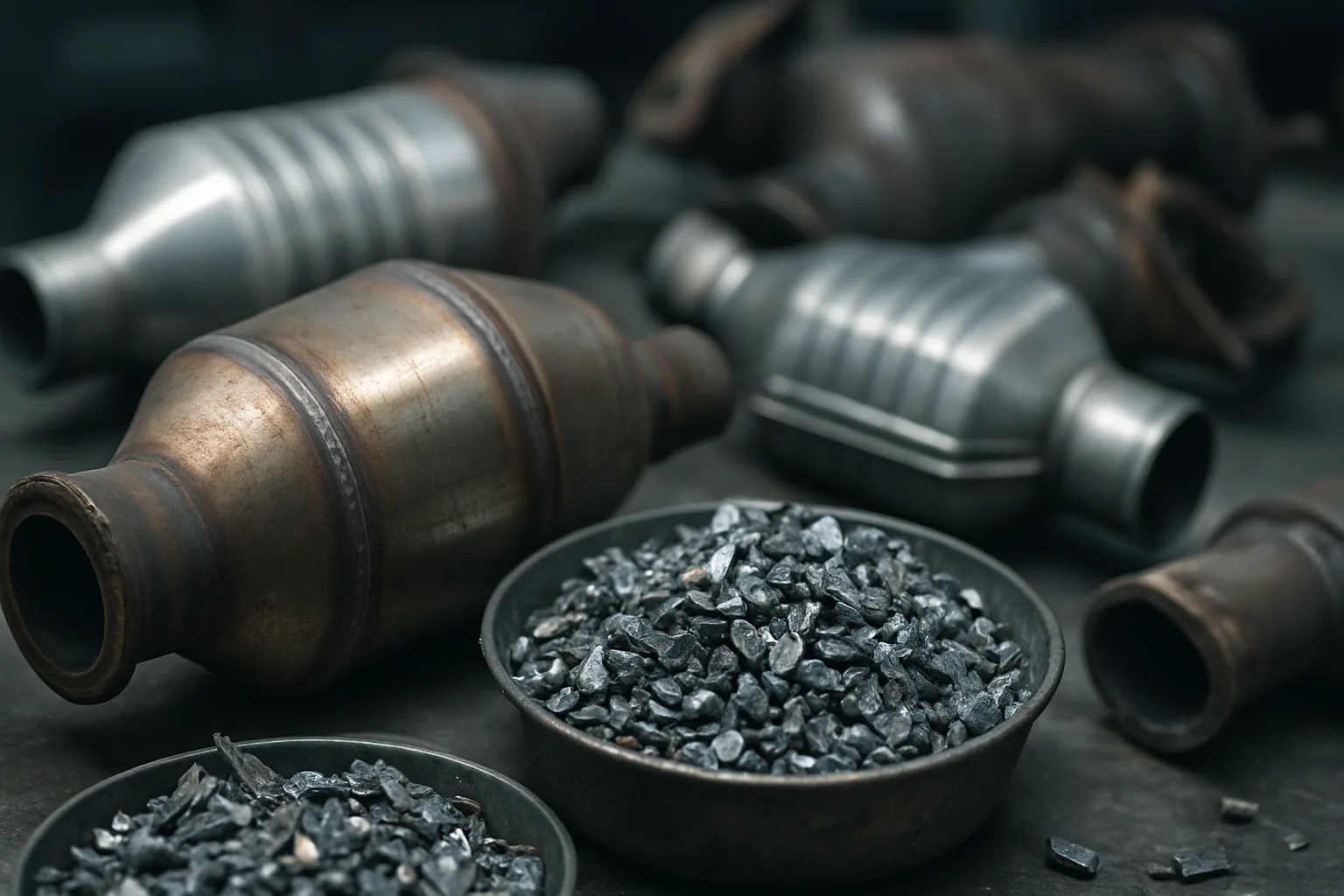
Why Emissions Rules Are Making Your Old Catalytic Converter Worth More Than You Think
Most people selling a scrap catalytic converter think they're offloading a hunk of exhaust pipe. They're not. They're sitting on a concentrated deposit of platinum, palladium, and rhodium — three metals that governments around the world are actively demanding more of. If you're a catalytic converter buyer in Surrey or anywhere else in Canada, the regulatory tailwinds pushing PGM demand aren't a distant policy story. They're the reason your scrap cat has value right now.
This week's market recap breaks down how tightening emissions standards are reshaping demand for platinum group metals (PGMs), what that means for scrap catalytic converter prices across Canada, and how sellers in British Columbia can position themselves to capture fair market value instead of leaving money on the table.
The Regulatory Engine Driving Platinum Group Metal Demand
Emissions regulations don't ease up. They tighten. The European Union's Euro 7 standards, now in force for new vehicles, require lower thresholds for nitrogen oxides, particulate matter, and carbon monoxide than any previous standard. In North America, U.S. EPA and California CARB standards have pushed in the same direction — and Canada's federal light-duty vehicle emissions rules track closely with the U.S. framework.
Every time a standard tightens, automakers need more efficient catalytic converters. More efficient converters require higher loadings of platinum, palladium, and rhodium — the metals that do the actual chemical conversion work. That's not a marketing claim. It's basic catalytic chemistry. A converter that needs to reduce NOx emissions by 90% instead of 70% needs more active metal surface area to do the job.
The practical result: new vehicle production consumes significant quantities of PGMs every year, and mining supply for these metals is geographically concentrated and structurally constrained. South Africa and Russia account for the overwhelming majority of global palladium and platinum supply. That concentration creates persistent supply risk. Recycled PGMs from scrap catalytic converters have become a critical secondary supply source — and refiners pay for that feedstock.
What Platinum, Palladium, and Rhodium Actually Do Inside a Cat
Understanding why your scrap cat has value starts with understanding what's inside it. The ceramic or metallic substrate in a catalytic converter is coated with a washcoat containing PGMs. Each metal plays a specific role in the three-way catalytic reaction that converts exhaust gases into less harmful compounds.
- Platinum handles oxidation reactions — converting carbon monoxide to CO₂ and unburned hydrocarbons to water and CO₂.
- Palladium is highly effective at oxidation and is widely used in gasoline vehicle converters. It also operates efficiently at lower temperatures, which matters for cold-start emissions compliance.
- Rhodium is the most valuable of the three on a per-gram basis and is essential for reduction reactions — converting nitrogen oxides (NOx) into harmless nitrogen and oxygen.
The loading of each metal varies by converter type, vehicle make, and emissions standard the converter was engineered to meet. A converter from a late-model half-ton truck will carry a different PGM profile than one pulled from a compact sedan. That's why serial number tracking and accurate identification matter so much when you're trying to get the best catalytic converter price in Canada. Guessing a converter's value without identifying it properly is how sellers get underpaid.
How Tighter Standards Create a Recycling Feedback Loop — and What It Means for Scrap Catalytic Converter Prices
Here's the market dynamic that most sellers miss. As emissions standards tighten, new converters get loaded with more PGMs. As those vehicles reach end-of-life — typically 10 to 20 years after manufacture — the converters entering the scrap stream carry higher metal content than older units. The regulatory decisions made in the early 2010s are influencing what your scrap yard sees on the rack today in 2026.
This feedback loop benefits sellers of newer-vintage scrap cats. A converter from a 2018 or 2019 vehicle that was engineered to meet tighter NOx standards may carry meaningfully more PGM loading than its equivalent from a decade earlier. It's also why the spread between a well-identified converter and an unidentified "mystery unit" can be significant — buyers discount hard when they can't confirm what's inside.
For sellers in Surrey and across British Columbia, this creates a practical takeaway: don't lump your cats into a single bin quote. Read Canadian catalytic converter pricing guides to understand how different converter types are valued and why identification is worth the extra step.
Platforms like SMASH bring competitive bidding to this process. Instead of one buyer giving you one number — often a number that includes their margin for uncertainty — multiple vetted buyers compete for your load. Competition helps reveal what the market actually thinks your converters are worth. That's price discovery, not a guarantee, but it's a fundamentally better starting position than a single cold call.
Catalytic Converter Recycling in Surrey: Local Context, National Market
Surrey sits in one of the most active recycling corridors in British Columbia. The region generates a steady stream of end-of-life vehicles from both private owners and fleet operators, and the proximity to major transportation routes means converter loads can move efficiently. If you're doing catalytic converter recycling in Surrey, you're feeding into a national and international PGM supply chain — your scrap doesn't stay local.
That's actually good news for sellers. Because PGM prices are set on global commodity markets, a well-documented load of cats from Surrey competes for the same buyer pool as one from anywhere else in Canada. The challenge has always been access. If your network is limited to one or two local buyers, your price is limited by their margin requirements, not by what the market would actually bear.
Local auto shops, independent mechanics, and small recyclers across Surrey often accumulate cats over time without a clear path to a competitive sale. The Surrey scrap metal services available through best-catalytic-converter-price.ca are built to close that gap — connecting local sellers to buyers who are actually competing for the material.
For comparison, sellers looking at catalytic converter scrap prices in Edmonton or other markets are working with the same underlying PGM fundamentals. The regional price variation you see across Canada comes from logistics costs, local buyer concentration, and how well-documented a load is — not from fundamentally different metal markets.
What Sellers Get Wrong About Scrap Metal Prices Today
The most common mistake: treating your cat converter like a fixed-price commodity. Scrap metal prices today — and PGM prices specifically — move with rhodium, palladium, and platinum spot prices on global exchanges. A quote you got three weeks ago may not reflect what the market will pay today. Prices fluctuate, sometimes significantly, based on macroeconomic conditions, mining output news, and automotive production data.
The second mistake: selling without documentation. Buyers who can confirm the make, model, year, and converter serial number can bid with confidence. Buyers who can't confirm anything apply a discount for the unknown. Photo documentation and serial number tracking — features built into platforms like SMASH — close that gap and give buyers the confidence to bid higher.
The third mistake: assuming one quote is the market. It isn't. One buyer giving you one number is one data point. Getting multiple vetted buyers to compete for your load is how you find out what the market actually thinks. To check current Canadian catalytic converter prices and get a real read on your material's value, you need a process that creates competition — not just a single phone call.
Disclaimer: Catalytic converter scrap prices fluctuate based on live PGM commodity markets. Always check current rates before selling. The information in this article reflects general market conditions as of August 2026 and should not be used as a pricing guarantee.
How SMASH Connects the Regulatory Story to Your Actual Sale Price
Regulatory demand for PGMs doesn't automatically translate to a better price in your pocket. That translation requires access to buyers who are actually paying for that demand — and a process that creates competition between them.
SMASH is built for exactly that. The platform connects sellers — yards, auto shops, scrap collectors — with vetted buyers across North America. The auction format means your catalytic converter load doesn't go to one buyer at one price. It goes to a competitive process where buyers who need your material have to bid for it. No subscription fees. SMASH earns when sellers earn.
For anyone in Surrey or elsewhere in British Columbia looking to sell catalytic converters in Canada at a price that reflects actual market demand, the path is straightforward: document your material properly, get it in front of multiple buyers, and let competition do the work. Find the best price for your scrap in Canada through a process built on transparency and real buyer competition.
If you're ready to stop guessing and start selling, get the best Canadian price for your catalytic converter — get a free quote at best-catalytic-converter-price.ca.
Frequently Asked Questions
Q: How do emissions regulations affect what I get paid for a scrap catalytic converter in Surrey?
Tighter emissions standards have required automakers to load more platinum, palladium, and rhodium into converters over time. That means newer converters — especially those engineered to meet stricter NOx and CO standards — often carry higher PGM content and may command better scrap prices. Identifying your converter accurately is key to capturing that value.
Q: Where can I find a reliable catalytic converter buyer in Surrey?
Best-catalytic-converter-price.ca connects Surrey sellers with vetted buyers across Canada. Platforms like SMASH use a competitive auction format rather than a single fixed quote, which helps ensure you're getting a price that reflects actual market demand rather than one buyer's margin.
Q: Does it matter whether I sell my scrap cats individually or in a load?
It can. Volume loads often attract more serious buyers, but individual high-value units — like those from diesel trucks or late-model vehicles with heavy PGM loading — can be worth identifying and selling separately. The key in either case is documentation: photos, serial numbers, and vehicle information help buyers bid with confidence.
Q: Are catalytic converter scrap prices the same across Canada?
The underlying PGM spot prices are global, so the metal value is consistent. Regional variation comes from logistics costs, local buyer competition, and how well the material is documented. Sellers in Surrey, British Columbia, Edmonton, and other major markets are working with the same commodity fundamentals — the difference is in how well you access the buyer market.
Q: How often do catalytic converter scrap prices change?
PGM prices can move daily based on global commodity markets, automotive industry data, and geopolitical factors affecting mining supply. It's worth checking current rates close to your sale date rather than relying on a quote from weeks prior. Rhodium in particular has historically shown significant price volatility.
Follow SMASH on LinkedIn for weekly scrap metal market updates, PGM price insights, and industry news relevant to yards and collectors across North America.
```