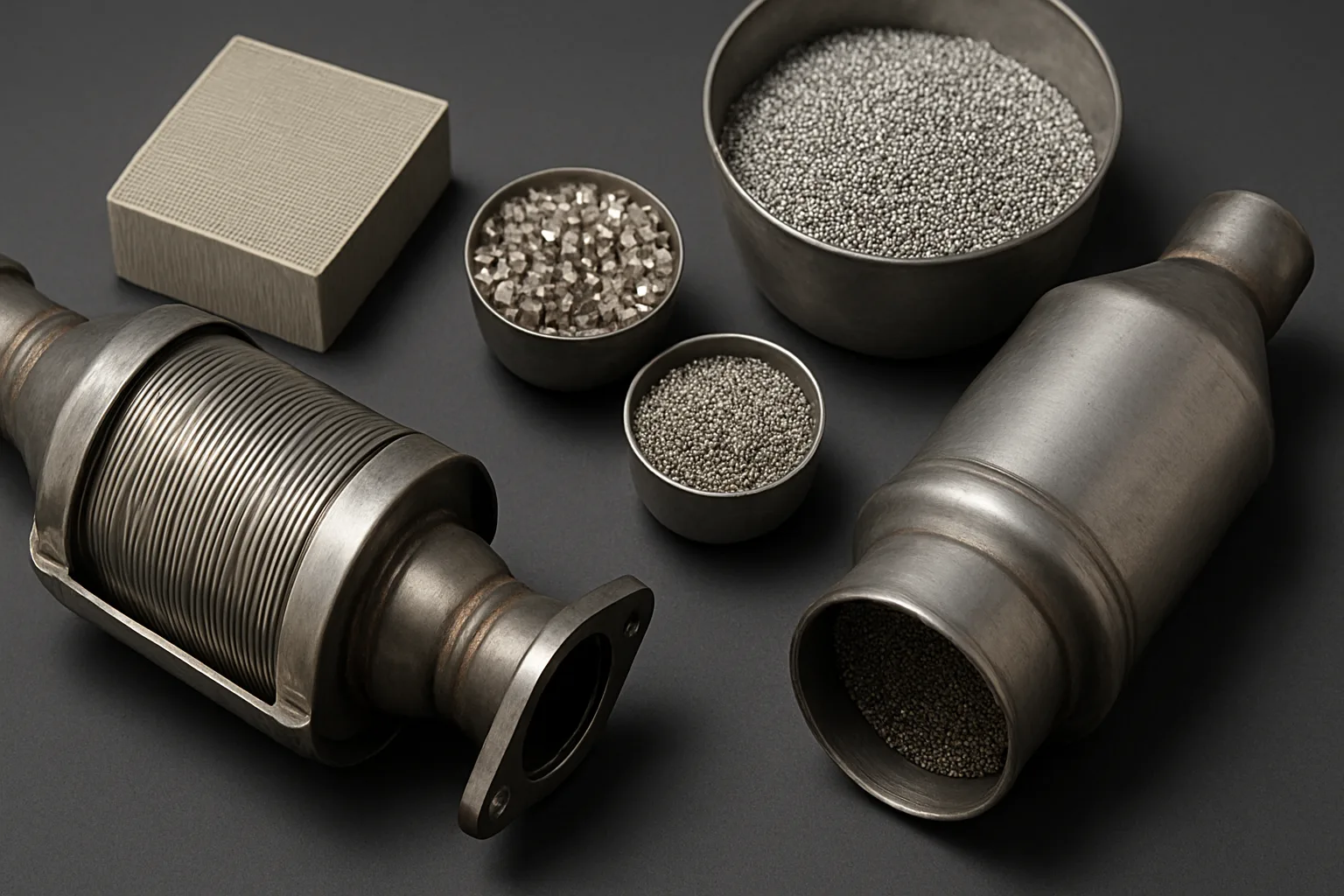
Most people selling scrap catalytic converters know the basics — pull the cat, weigh it, get paid. But not all converters are equal, and two of the most misunderstood types are foil-style and bead-style catalytic converters. If you've been lumping these in with your regular ceramic cats, you may be leaving real money on the table. Understanding the difference can directly affect what you're offered — and whether you accept it.
Whether you're an auto recycler in Sudbury, a mechanic clearing out a backlog, or a collector building a load, knowing what's inside your converter matters. This guide breaks down both types, what makes them unique, and what they're actually worth in today's Canadian scrap market.
What Is a Foil-Style Catalytic Converter?
Foil-style catalytic converters use a metallic substrate instead of the ceramic honeycomb most people are familiar with. Inside, you'll find thin corrugated layers of metal foil — typically a high-grade steel alloy — coated with platinum group metals (PGMs): platinum, palladium, and rhodium. The foil is wound or stacked in a tight pattern to maximize surface area while keeping weight low.
These are common in European vehicles — think BMW, Mercedes-Benz, Audi, and Volkswagen — as well as some high-performance and diesel applications. Because the substrate itself is a metal alloy rather than ceramic, foil cats handle extreme temperature swings better and tend to survive longer in demanding drive cycles. That durability is part of why European automakers adopted them widely.
From a recycler's perspective, foil cats require different processing than ceramic. The metal substrate can't be crushed and sampled the same way. Buyers who handle foil cats need to use appropriate assay methods to accurately measure PGM content, which is why working with a knowledgeable catalytic converter buyer in Sudbury or across Ontario matters more than it might seem.
What Is a Bead-Style Catalytic Converter?
Bead-style converters use small ceramic beads — typically aluminum oxide or a similar material — as the substrate instead of a honeycomb or foil matrix. The beads are coated with PGMs and packed inside the converter housing. When exhaust gas flows through, it passes around and between the beads, triggering the catalytic reaction.
You'll find bead-style converters most commonly in older domestic vehicles, some GM products, and certain industrial or heavy-equipment applications. They were more prevalent in production through the 1980s and into the 1990s before ceramic honeycomb designs largely took over for passenger vehicles.
Bead cats have a reputation in the recycling world for being trickier to value. The beads can shift, settle, or partially escape if the housing is damaged — meaning PGM content can vary significantly even within the same model type. Damaged housings or leaking bead material reduces the value. Always check the housing integrity before you sell. A converter that's been rattling around loose in a bin may have lost a meaningful portion of its beads.
- Common bead cat sources: Older GM vehicles (Chevy, Buick, Oldsmobile), some Chrysler applications, certain forklifts and industrial equipment
- Common foil cat sources: European imports (BMW, Audi, Mercedes, VW), performance vehicles, select diesel applications
- Key difference: Foil = metallic substrate, bead = loose ceramic spheres packed in housing
How Much Are Foil and Bead Cats Worth? Understanding PGM Value in Canada
Here's the honest answer: it depends. Catalytic converter prices in Canada — for foil, bead, or ceramic — are driven by live platinum, palladium, and rhodium spot prices on global commodity markets. These move daily. A foil cat worth one figure on Monday may be worth noticeably more or less by Friday depending on what's happening in the PGM market.
That said, here's how foil and bead cats generally stack up against ceramic honeycomb converters:
- Foil-style cats typically have competitive PGM loadings, but because the substrate is metal, the gross weight of the unit is higher relative to PGM content. Buyers price them based on assayed PGM yield, not by weight alone. High-quality European foil cats from premium vehicles can carry strong value.
- Bead-style cats can be surprisingly valuable when intact and in good condition — the beads are often heavily loaded with PGMs relative to their volume. But condition is everything. Partial bead loss means partial PGM loss, and that hits the payout directly.
- Ceramic honeycomb cats are the most common and easiest to price based on established type/grade lookups. Foil and bead cats require more experience to assess accurately.
For Canadian sellers, getting an accurate quote on foil or bead cats means working with buyers who understand these subtleties — not just someone with a generic price list. Platforms like SMASH connect sellers with vetted buyers who know the difference between a low-PGM bead cat and a premium European foil unit. That competition and transparency leads to better price discovery. Get the best catalytic converter price in Canada by working with buyers who assess accurately, not guessing.
Disclaimer: Catalytic converter prices fluctuate daily based on live PGM spot prices. Always check current Canadian catalytic converter prices before selling — market conditions in July 2026 may differ from when you're reading this.
How to Identify Foil vs. Bead Cats Before You Sell
You don't need a lab to figure out which type you have. Here's a practical approach for recyclers and collectors handling mixed loads.
Visual and physical clues:
- Shake test: Rattle the converter. A bead cat with loose or shifting beads will make a distinct sound — like small pebbles moving inside. A foil cat won't rattle; the foil substrate is fixed. Ceramic honeycomb cats that are broken internally will also rattle, but the sound is different — more like crumbling ceramic chunks.
- Vehicle origin: If the cat came off a European import, assume foil until confirmed otherwise. If it came off an older American domestic vehicle (pre-1990s especially), bead is more likely.
- Housing shape and weight: Foil cats tend to be denser and heavier for their size. Bead cats feel different in hand — more solid weight distributed evenly.
- Cut or core inspection: If you're processing at volume and cutting converters, foil substrate looks like tightly wound corrugated metal — almost like rolled metal sheeting. Beads look like small, uniform ceramic spheres.
For Sudbury auto recyclers and scrap collectors in Ontario, proper identification up front means you get the right quote the first time. Misidentifying a foil cat as a generic converter is a common way to undervalue your load. Take the extra two minutes — it's worth it.
Why Catalytic Converter Recycling in Sudbury Requires the Right Buyer
Sudbury's industrial history makes it one of Canada's most metal-aware cities. The region knows resource value. But catalytic converter recycling isn't the same as bulk scrap — it's a specialized market driven by precious metals, and the buyers you work with have an outsized impact on your return.
The old model — one phone call, one buyer, one price — doesn't serve you well when you have foil cats, bead cats, or a mixed load with units that need proper grading. A single buyer with no competition has zero reason to assess your material generously. That's where smashrecycling.ca changes the equation. SMASH puts your inventory in front of multiple vetted buyers, creating genuine competition. More competition means better price discovery — especially for specialty units like foil and bead converters that demand real expertise to value correctly.
Whether you're clearing a few units from an Ontario shop or building consistent loads, the right platform matters. You can also explore Sudbury scrap metal services to connect with buyers who serve your area directly.
If you want to go deeper on how pricing works across Canada, read Canadian catalytic converter pricing guides that break down the factors driving value in today's market.
Tips to Maximize Your Payout on Foil and Bead Converters
Getting top dollar for specialty cats isn't complicated, but it does require a few deliberate steps. These apply whether you're in Sudbury, anywhere else in Ontario, or across Canada.
- Keep the housing intact. For bead cats especially, a compromised housing means lost beads and lost PGMs. Store and transport bead cats carefully — upright where possible, in a sealed container if the housing shows any cracks.
- Document what you have. Photos, vehicle origin, unit type. Buyers who can confirm the vehicle source (VIN helps) can assess more accurately and confidently — which typically translates to better offers.
- Sort before you sell. Don't mix foil and bead cats with ceramic honeycomb units in a single unsorted lot. Buyers will grade the whole lot down to account for uncertainty. Sorted loads get sharper pricing.
- Get multiple quotes. This isn't optional — it's the single most effective thing you can do to protect your margin. One quote is just someone else's number. Multiple competing quotes show you the actual market.
- Understand the PGM market timing. Rhodium in particular can swing dramatically. If you have a large volume of high-value foil cats, understanding whether the market is up or down before you sell is worth the few minutes it takes to check spot prices.
Selling smarter doesn't require being a precious metals trader. It just requires knowing what you have and working with buyers who do the same.
Frequently Asked Questions
Q: How do I know if I have a foil or bead catalytic converter?
The shake test is a quick first check — bead cats rattle like loose gravel inside. Foil cats won't rattle. Vehicle origin also helps: European imports commonly use foil substrate, while older North American domestic vehicles are more likely to have bead-style converters. If you cut the unit open, foil substrate looks like corrugated metal layers; bead substrate is small, round ceramic spheres.
Q: Are foil catalytic converters worth more than ceramic ones?
Not automatically — value depends on PGM loading, which varies by vehicle make, model, and application. Some high-end European foil cats carry strong PGM content and command premium prices. Others have modest loadings. The key is getting them accurately assessed rather than lumped into a generic ceramic price. Working with a knowledgeable catalytic converter buyer in Sudbury or across Ontario ensures you're not leaving money behind.
Q: What happens to bead catalyst material when the housing is damaged?
Beads can escape through cracks or loose seams, and those beads carry PGMs. Once the beads are gone, so is that portion of your value. A damaged bead cat is worth less than an intact one — sometimes significantly less depending on how much material has been lost. Always inspect housing integrity and store them carefully before selling.
Q: How does catalytic converter recycling in Sudbury work?
The process starts with identifying your converters, documenting them accurately (photos, vehicle source, type), and connecting with vetted buyers who serve the Sudbury and Ontario market. Platforms like SMASH streamline this by putting your inventory in front of multiple competing buyers simultaneously. You get transparent pricing without the guesswork of a single cold-call offer.
Q: Do prices for foil and bead cats change often?
Yes — catalytic converter prices in Canada move with live platinum, palladium, and rhodium spot prices on global markets. These can shift daily. It's worth checking current rates before you commit to a sale, especially if you're holding a significant volume. Never base a sale decision on a quote from a week ago without confirming it's still current.
If you have foil or bead cats sitting in your yard, don't guess at what they're worth. Get the best catalytic converter price in Canada with a free quote — and sell knowing you did your homework.
Stay sharp on scrap metal markets and pricing trends — follow SMASH on LinkedIn for industry updates, market insights, and practical guidance for recyclers across North America.
```