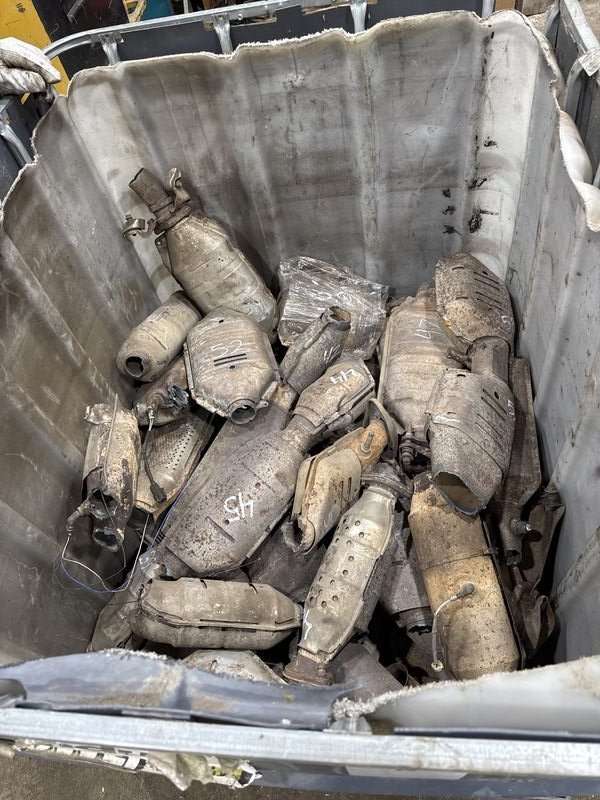
Most scrap sellers know the chunky honeycomb-style catalytic converter. But hand a yard operator a foil-type or bead-type cat and watch the conversation get complicated fast. These converters look different, behave differently in processing, and — critically — price out differently than what most people expect. If you are sitting on a pile of miscellaneous cats and you do not know what you have, you are likely leaving money on the table.
Here is everything you need to know about foil and bead catalytic converters: what they are, why they matter, and what drives their scrap value in Canada — including how the rhodium price today plays a bigger role than most sellers realize.
What Are Foil and Bead Catalytic Converters?
Most people are familiar with the ceramic honeycomb substrate inside a standard OEM catalytic converter. But not all cats are built the same way. The substrate — the structure that holds the platinum group metals (PGMs) — comes in several forms. Foil and bead types are two of the less common but still widely traded varieties.
Foil catalytic converters use a corrugated metallic foil substrate instead of ceramic. Think of it like a rolled sheet of thin stainless steel, layered in a way that creates channels for exhaust gases. These are common in high-performance and heavy-duty applications — diesel trucks, industrial equipment, and some European performance vehicles. The foil substrate holds PGMs (platinum, palladium, and rhodium) just like a ceramic cat, but the processing method is different and the yield calculation changes.
Bead catalytic converters use small ceramic pellets or beads coated with PGMs as the substrate. Instead of a rigid honeycomb, exhaust passes through a loose bed of catalyst beads inside the converter canister. These were more common in older North American vehicles from the 1970s through the early 1990s. You still find them in some industrial and stationary engine applications today.
Both types contain recoverable platinum, palladium, and rhodium. Both have real scrap value. But neither should be priced the same as a standard ceramic honeycomb cat — and that is where many sellers get burned.
How the Rhodium Price Today Affects Foil and Bead Cat Values
Rhodium is the wild card in catalytic converter pricing. It is rarer than platinum or palladium, produced in tiny volumes as a byproduct of platinum mining, and its price swings are extreme. When the rhodium price today is elevated, even a converter with modest rhodium loading can be worth significantly more than sellers expect. When it drops, the math changes fast.
Both foil and bead converters contain rhodium — though the exact PGM loading varies by manufacturer, vehicle application, and production year. Foil-type converters used in diesel and heavy-duty applications often carry a heavier platinum loading with lower rhodium. Bead-type converters from older vehicles can have unpredictable PGM distributions because the manufacturing standards were less consistent decades ago.
This is exactly why guessing a price off the top of your head is a losing strategy. The value of any cat — foil, bead, or ceramic — flows directly from live PGM commodity prices. Rhodium, platinum, and palladium trade on international markets every day. The price you quoted on Monday may not hold on Friday. To check current Canadian catalytic converter prices, you need access to a lookup tool that ties into live data — not a static price sheet from six months ago.
Disclaimer: Catalytic converter scrap prices fluctuate daily based on PGM commodity markets. Always verify current rates before selling.
OEM Catalytic Converter Value: Foil vs. Ceramic vs. Bead
Here is a straight comparison of how these three substrate types generally stack up from a scrap value standpoint. These are directional observations, not guaranteed prices — every converter has to be assessed individually.
- Ceramic honeycomb (standard OEM): The baseline for most price lookups. Well-documented, widely traded, and the easiest to price using a VIN or serial number. OEM catalytic converter value for ceramic cats is the most predictable category in the market.
- Foil (metallic substrate): Often higher gross weight but may have lower PGM loading per gram of substrate compared to a ceramic cat. Processing costs are different — smelters treat foil material differently. Price per unit can vary widely. Not all buyers accept foil cats, and those who do may price them conservatively without documentation.
- Bead: Older material, inconsistent PGM loading, and a smaller buyer pool. Beads also present a containment challenge — they are loose inside the canister, so damaged or crushed units can lose material. Value exists but requires a buyer who specifically handles bead-type converters.
The takeaway: do not assume a foil or bead cat is worth less than a ceramic one. Do not assume it is worth more either. Get it in front of the right buyer with the right processing capability. That is the only way to know what you actually have.
Selling Foil and Bead Catalytic Converters in Ontario — What You Need to Know
If you are in Oshawa or anywhere else in Ontario, you have probably noticed that not every local buyer handles all converter types. Some yards stick to ceramic cats because that is what their pricing systems are built around. Foil and bead types end up priced low — or declined entirely — because the buyer is not set up to process them properly.
That is the core problem with the single-buyer model. You call one yard, they offer you a flat rate that may or may not reflect the actual PGM content. You take it or leave it. There is no competitive pressure, no transparency, and no incentive for the buyer to pay you closer to market.
The smarter move: sell catalytic converters online through a platform that puts your material in front of multiple vetted buyers who actually specialize in different converter types. When you the SMASH Recycling auction platform, your cats — foil, bead, ceramic, or a mixed load — go to buyers who bid competitively. That competition is what reveals what your material is actually worth. More buyers means better price discovery, especially for non-standard converter types that a generalist yard might undervalue.
Sellers across Ontario, including those running shops and collector yards in the Oshawa area, have found that the auction format removes the guesswork. You document what you have, you get it in front of the right buyers, and the market tells you the price. That is a better outcome than a single phone call and a gut-feel offer.
If you are looking for Oshawa scrap metal services that handle specialty converter types, it is worth asking specifically whether a buyer has experience with foil and bead material before you commit to a price.
How to Document Foil and Bead Converters for Maximum Value
Documentation is money. This is true for ceramic cats, and it is even more true for foil and bead types where buyers have less institutional familiarity. The more information you provide upfront, the more confident a buyer is — and buyer confidence drives higher offers.
Here is what you should capture before listing any converter for sale:
- Photos: Both ends of the converter, the full body, and any visible serial numbers or part markings. For bead converters, photograph the canister intact — a damaged unit with lost beads is worth less.
- Weight: Gross weight of the unit. For foil cats, note whether the outer shell is included or stripped.
- Vehicle or application source: If you know the vehicle make, model, and year — or the industrial application — record it. This helps buyers cross-reference known PGM loading data.
- Serial or part numbers: Even partial numbers help. SMASH's inventory tool and serial tracking features are built to handle this kind of data, making your lot easier to price accurately.
- Condition: Note any damage, crushing, or signs that the substrate may be compromised. Honesty here protects you and builds credibility with repeat buyers.
Platforms like SMASH are built to handle exactly this kind of documented lot. Auto-invoicing, photo documentation, and serial tracking are standard features — not add-ons. When a buyer can see exactly what they are bidding on, they bid with more confidence. That confidence shows up in the offer.
Using a Catalytic Converter Scrap Price Lookup Before You Sell
Before you sell anything — foil, bead, or ceramic — run a price lookup. A used catalytic converter price lookup or catalytic converter scrap price lookup gives you a baseline so you know whether an offer is reasonable or whether someone is taking advantage of your uncertainty.
Price lookups work best when you have a part number or serial. For foil and bead cats, part numbers may be harder to find — but even a vehicle application lookup can give you a directional range. Combine that with the live rhodium price today and current platinum and palladium rates, and you have enough information to evaluate any offer intelligently.
To get the best catalytic converter price in Canada, start with good data. Know what you have. Know what the PGMs are trading at today. And get your material in front of buyers who are actively competing for it — not just one yard that has no reason to move off their first number.
If you want to read Canadian catalytic converter pricing guides that break down what drives value for different converter types, there is a growing library of resources built specifically for Canadian sellers navigating this market.
Whether you are clearing out a single bead-type cat from a 1988 pickup or moving a pallet of mixed foil units from a diesel fleet rebuild, the approach is the same: document it properly, check the current market, and sell competitively. That is how you stop guessing and start getting paid what your material is actually worth.
If you are ready to stop taking the first number that comes in over the phone, start with a free quote at best-catalytic-converter-price.ca. The process is straightforward, there are no subscription fees, and you only pay when you sell.
Frequently Asked Questions
Q: Are foil catalytic converters worth more or less than standard ceramic cats?
It depends on the specific unit, its PGM loading, and current market conditions — including the rhodium price today. Foil cats from heavy-duty or performance applications can carry significant platinum content, but the processing method differs from ceramic. Always document the unit and get it in front of multiple buyers rather than accepting a single yard's flat offer.
Q: How does the rhodium price today affect what I get for my scrap cats?
Rhodium is one of the three primary PGMs recovered from catalytic converters, along with platinum and palladium. When the rhodium price today is high, converters with measurable rhodium loading are worth substantially more. Prices move daily, so checking current rates before selling — not last week's numbers — makes a real difference in your return.
Q: Can I sell bead-type catalytic converters in Oshawa or do I need a specialty buyer?
Not every yard in Oshawa or across Ontario handles bead-type converters, since they require different processing than ceramic cats. Your best approach is to use a platform that connects you with multiple vetted buyers, some of whom specialize in older or non-standard converter types. That way your material goes to whoever can actually pay the most for it — not just whoever answers the phone locally.
Q: What is the best way to look up the value of my catalytic converter before selling?
Start with a part number or serial number if you have one — a catalytic converter scrap price lookup tool will give you a directional value based on known PGM content and current commodity prices. If you do not have a part number, identifying the vehicle make, model, and year gets you close. Platforms like SMASH also use photo documentation and serial tracking to help buyers price your material accurately.
Q: Is there a fee to list catalytic converters for sale through SMASH?
SMASH does not charge subscription fees. The platform operates on a model where they only make money when you do — so there is no upfront cost to list your material. This applies whether you are selling a single bead-type converter or a mixed pallet of foil and ceramic cats from an Ontario shop or collection yard.
Follow SMASH on LinkedIn for live scrap metal market updates, PGM pricing trends, and industry insights: Scrap Metal Auction Sales Hub on LinkedIn.