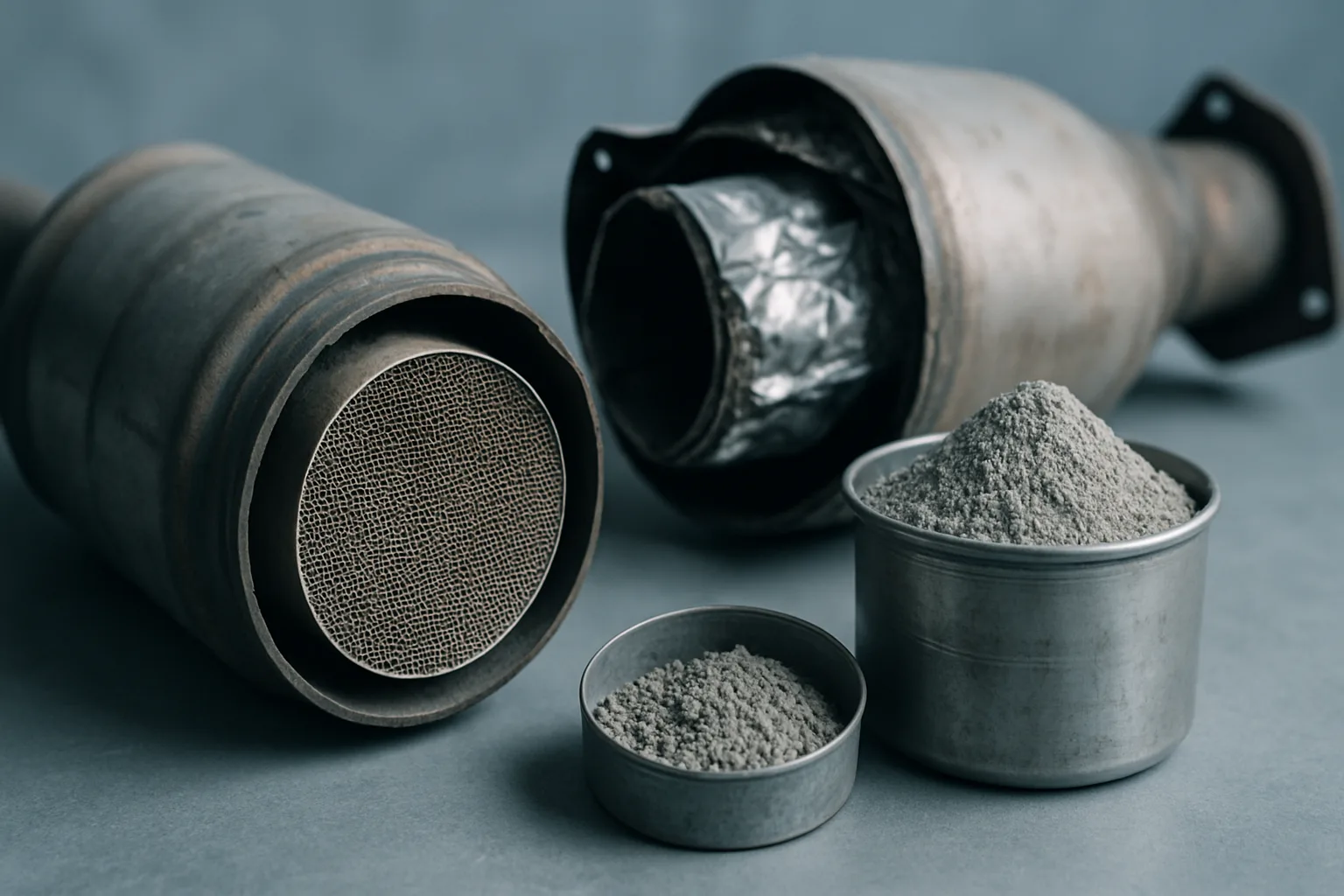
Most people selling scrap catalytic converters know the big, heavy units — the ones that come off trucks and SUVs, chunky and unmistakable. But foil and bead style converters? They get overlooked, misidentified, and consistently undersold. If you've got a pile of cats and you're not sure what's in it, that uncertainty is costing you money. Understanding catalytic converter scrap value starts with knowing what you actually have.
This isn't a hypothetical. Yards and collectors across New Brunswick — including right here in Saint John — regularly leave value on the table because foil and bead converters get tossed in the generic pile without a second look. Let's fix that.
What Are Foil Style Catalytic Converters?
Foil style converters use a metallic substrate — thin corrugated metal foil wound into a honeycomb structure — instead of the ceramic brick you find in most standard cats. That foil is typically made from a ferro-chromium-aluminum alloy. The precious metals (platinum, palladium, and rhodium) are coated onto that foil surface in a wash layer.
You'll find foil style converters most often in:
- European performance vehicles (BMW, Mercedes, Porsche, Audi)
- High-temperature applications where ceramic substrates crack
- Diesel particulate filter systems
- Motorcycle and small engine exhaust systems
The foil substrate is more thermally resilient than ceramic, which is why manufacturers use it in demanding applications. From a scrap standpoint, the washcoat loading — meaning how much precious metal per unit of substrate — can vary significantly. Some foil cats carry solid PGM (platinum group metal) content. Others are relatively lean. That's why identification and proper assay matter so much before you price them out.
Visually, foil cats often look similar to standard cats from the outside. Cut one open and you'll see the difference: the interior looks metallic and tightly wound rather than the familiar ceramic brick with round or square channels.
What Are Bead Style Catalytic Converters?
Bead style converters use small ceramic beads — about the size of BBs — coated with precious metal catalyst. The exhaust passes through the loose bed of beads rather than through fixed channels. This design was common in North American vehicles from the mid-1970s through the late 1980s, during the early years of emissions control technology.
General Motors used bead-style converters extensively in that era. If you're pulling cats off older American iron — Chevrolets, Buicks, Oldsmobiles from that period — there's a reasonable chance you're dealing with beads.
Key things to know about bead cats:
- The beads themselves can be loose or compacted over time
- Contamination (oil, coolant, physical damage) significantly affects value
- The outer shell is usually steel and has its own scrap value separately
- Bead content and PGM loading varies by make, model, and year
- Some older bead units carry higher platinum content than newer ceramic cats
Bead converters are less common in today's scrap stream because most of the vehicles that used them are decades old. But they still show up — at estate sales, in old barn finds, in mixed lots from demolition or fleet cleanouts. When they do, knowing what you have puts you in a position to ask the right price. Understanding the difference helps you get the best catalytic converter price in Canada rather than guessing at a flat rate.
Catalytic Converter Scrap Value: What Determines What You Get Paid
Whether you're holding foil cats, bead cats, or a mixed load, the same fundamental factors drive catalytic converter scrap value:
- PGM content — Platinum, palladium, and rhodium are the metals driving value. The assay result determines how much of each metal is present per unit weight.
- Current spot prices — The palladium price today, alongside platinum and rhodium, fluctuates with global markets. A cat worth one amount this week might be worth more or less next week. This is real — check current rates before you sell.
- Substrate condition — Cracked, oil-contaminated, or melted substrate recovers fewer PGMs. Condition matters.
- Weight and type — Buyers need accurate weights and correct identification to quote accurately. Foil and bead cats are processed differently than standard ceramic units.
- Buyer competition — One buyer quoting your load is a guess at best and a lowball at worst. Multiple buyers competing on the same inventory is how you find the actual market.
That last point is critical. The single-buyer model — one phone call, one quote, take it or leave it — is how scrap sellers get burned. Platforms like SMASH change that dynamic entirely. When vetted buyers compete for your load, you get real price discovery instead of someone else's margin built in at your expense.
For Saint John collectors and shops moving volume, this isn't a small detail. It's the difference between pricing cats by gut feel and pricing them by actual market data. You can check current Canadian catalytic converter prices before you commit to anything.
Selling Foil and Bead Cats in Saint John — What the Local Market Looks Like
Saint John has an active scrap and recycling sector. The port, the industrial base, and a steady stream of end-of-life vehicles mean catalytic converters move through here regularly. But the local market — like most regional markets — doesn't always reflect national commodity prices. If you're searching for catalytic converter buyers near me, proximity matters for logistics, but it shouldn't be the only factor driving your price.
Foil and bead cats in particular get undervalued at local level because they're less common and less understood. A buyer who primarily handles standard ceramic cats may not have the assay relationships or processing connections to properly value a load of foil units from a European import. That's a gap that costs sellers money.
What works better: document your inventory accurately, identify foil versus bead versus ceramic, note condition, and bring that documented load to a platform where multiple buyers can see it and compete. That process removes the information asymmetry that local single-buyer transactions create. If you're looking for Saint John scrap metal services, make sure you're working with buyers who understand the full range of converter types — not just the easy ones.
New Brunswick sellers also have the advantage of being able to sell scrap metal online without being limited to whoever's within driving distance. An auction platform opens up the buyer pool significantly, and for specialty units like foil cats, that wider pool can meaningfully affect what you're paid.
How SMASH Helps You Get More for Specialty Converters
Foil and bead cats are exactly the type of inventory where the old way fails hardest. One buyer, one quote, limited transparency — that's a recipe for leaving money behind on units that are already harder to value.
SMASH is built for this. The platform lets you document your inventory — photos, weights, serial tracking where applicable, condition notes — and bring it to vetted buyers who compete in an auction format. That competition is what creates real price discovery. No subscription fees. SMASH only wins when you win.
For a load of mixed foil and bead cats coming out of Saint John, that means your inventory gets seen by qualified buyers who know what they're looking at, not just whoever picks up the phone locally. Documentation gives buyers confidence. More buyer confidence means stronger bids. Stronger bids mean better outcomes for the seller.
The inventory tool makes it straightforward to build out a load with the detail buyers actually need. VIN lookup, photo documentation, packing lists — everything that turns a vague "got some cats" conversation into a properly documented lot that buyers can price with accuracy.
You can sell your scrap metal on SMASH Recycling and reach buyers across North America who are actively looking for this material. For specialty converter types, that reach matters more than almost anything else.
A Practical Checklist Before You Sell Foil or Bead Catalytic Converters
If you've got foil or bead cats in your inventory right now, here's what to do before you price them:
- Identify the type — Confirm foil versus bead versus ceramic. Cut one if you're unsure.
- Check condition — Look for physical damage, contamination, or melted substrate.
- Weigh accurately — Buyers need real weights. Don't estimate.
- Document with photos — Both ends of each unit, plus any visible damage or identifying marks.
- Check current spot prices — Know where platinum, palladium, and rhodium are trading before you accept any quote. The palladium price today and rhodium spot are publicly available and move fast.
- Get multiple quotes — Don't accept the first number. Get competitive bids.
- Know what you have before you ask for a price — Vague loads get vague quotes. Documented loads get real ones.
The catalytic converter pricing guides on the blog can help you understand what factors buyers are looking at and how to position your load before you go to market.
Whether you're a Saint John auto shop with a steady stream of used catalytic converter scrap value questions, or an independent collector moving specialty units periodically, the process is the same: know what you have, document it, and let buyers compete for it.
Disclaimer: Catalytic converter prices fluctuate with global PGM spot markets. Platinum, palladium, and rhodium prices change daily. Always check current rates before selling. The information in this article reflects general market dynamics as of July 2026 and should not be taken as a price guarantee.
If you're sitting on foil or bead cats and you're not sure what they're worth, the answer isn't to guess — it's to get a real quote. Get the best catalytic converter price in Canada with a free quote at best-catalytic-converter-price.ca.
Frequently Asked Questions
Q: Are foil catalytic converters worth more than ceramic ones?
It depends on the specific unit and its PGM loading. Some foil cats from high-performance European vehicles carry strong precious metal content, while others are relatively lean. The only way to know for sure is accurate identification and assay. Don't assume foil is automatically better or worse — document it and let the market price it.
Q: How do I know if I have a bead style catalytic converter?
Bead cats are most common on North American vehicles manufactured between the mid-1970s and late 1980s. Shake the converter — if you hear beads rattling inside, that's a strong indicator. Opening the unit reveals small ceramic spheres rather than a honeycomb brick. If you're in Saint John pulling cats off older American vehicles, bead units are a real possibility worth watching for.
Q: Does the palladium price today affect what I get paid for scrap catalytic converters?
Yes, directly. Palladium is one of the three primary PGMs (alongside platinum and rhodium) recovered from catalytic converters. When palladium spot prices rise, the recovered value of palladium-rich cats rises with them. Check current spot prices before accepting any quote — buyers price loads against the current market, and so should you.
Q: Can I sell catalytic converters in New Brunswick without going to a local yard?
Yes. Online auction platforms like SMASH let you document and list your inventory for vetted buyers across North America. This is especially valuable for specialty units like foil and bead cats, where local buyers may not have the expertise or buyer network to properly value what you have. Selling online expands your buyer pool and improves price discovery.
Q: What makes a catalytic converter worth more when I sell it?
Clean condition (no oil or coolant contamination), accurate identification of the converter type, complete documentation with photos and weights, and selling to multiple competing buyers rather than accepting a single quote. All of these factors contribute to stronger outcomes. Documented, well-identified inventory consistently attracts more confident bids than vague or poorly described lots.
Stay current on catalytic converter market trends and scrap metal pricing — follow SMASH on LinkedIn for regular industry updates and insights from across the North American scrap metal market.