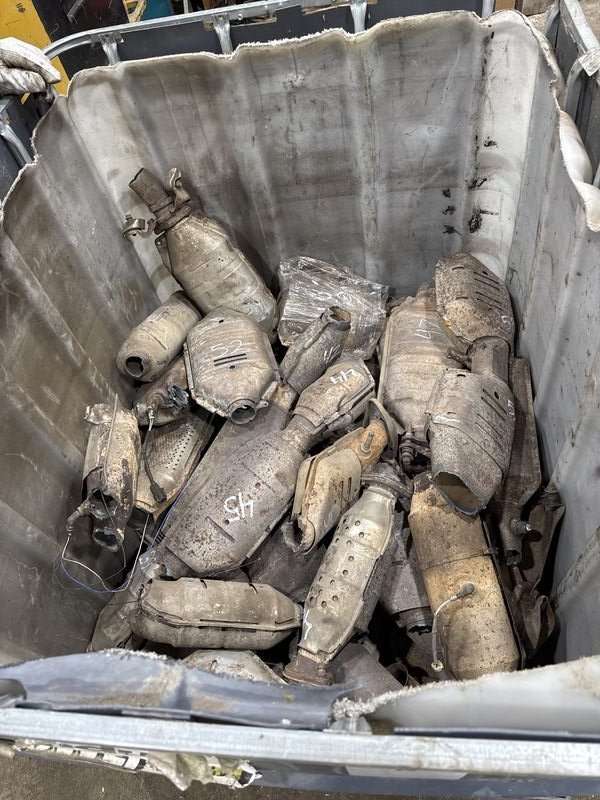
Most people toss a catalytic converter in the scrap bin and take whatever the yard offers. But inside that beat-up shell sits platinum, palladium, and rhodium — three of the most valuable metals on earth. If you're in Guelph and you're not checking what's actually inside your cats before you sell, you're leaving real money on the table.
Understanding what drives cat converter prices in Guelph — and across Ontario — starts with understanding what you're actually selling. It's not the steel shell. It's the ceramic honeycomb coated with precious metals that refiners want. And the spread between a good price and a bad one can be significant, depending on how you sell and who you sell to.
What's Actually Inside a Catalytic Converter?
Strip away the outer casing and you'll find a ceramic or metallic substrate — often called a honeycomb — coated with a wash of precious metals. These metals do the chemical work: converting toxic exhaust gases like hydrocanic oxide, carbon monoxide, and nitrogen oxides into less harmful compounds. But for scrap purposes, it's the metal content that matters, not the chemistry.
The three metals refiners are after are:
- Platinum (Pt) — A dense, silvery-white metal used across all three-way converters. Historically a driver of scrap catalytic converter value, platinum has seen its price swing considerably depending on automotive demand and industrial use.
- Palladium (Pd) — Lighter than platinum and found heavily in gasoline engine converters, palladium has at times commanded higher prices per troy ounce than gold. It's a major reason why newer vehicle cats often carry strong scrap catalytic converter prices.
- Rhodium (Rh) — Present in the smallest quantities, but often the most valuable by weight. Rhodium can trade at multiples of gold. Even trace amounts matter at the refinery level.
The exact mix of platinum, palladium, and rhodium varies significantly by vehicle make, model, engine type, and year of manufacture. A small cat off an economy sedan holds less than a large cat off a full-size truck or an SUV with a V8. This is why serial number identification and VIN lookup tools matter — knowing what you have changes what you should accept.
How Precious Metal Content Drives Scrap Catalytic Converter Value
The scrap catalytic converter price you get is fundamentally tied to two variables: the metal content inside the unit and the market price for those metals on a given day. Refiners and processors sample and assay each lot, then pay based on the recoverable metal content minus their processing costs. The cleaner and more accurately categorized your cats are, the better price discovery you'll get.
This is where documentation changes everything. Buyers with complete information — accurate serial numbers, vehicle source data, photos — can underwrite a price with more confidence. That confidence typically shows up in the offer. Buyers guessing at content will discount their offer to protect themselves. Every unknown you introduce gives the buyer a reason to lower their number.
Palladium and rhodium prices have been particularly volatile over the past several years. Market swings tied to mine supply constraints, automotive production levels, and energy transition timelines all ripple back to what your Guelph-area cats are worth on any given week. There's no fixed "right price" — which is exactly why checking scrap metal prices today before you commit to a sale matters.
Platforms like SMASH bring competitive buyers to your inventory rather than relying on a single yard's assessment. More buyers, more price discovery. That's the structural advantage of an auction format over a one-call, one-offer approach.
Why Vehicle Type and Converter Grade Matter for Cat Converter Prices in Guelph
Not all cats are created equal, and buyers at the refinery level know the difference. Scrap processors generally sort catalytic converters into grades — often called "large domestic," "small domestic," "foreign small," "foreign large," and "high-grade" categories. These grades roughly correlate to precious metal content.
Here's a practical breakdown of what tends to drive higher or lower values:
- Large domestic trucks and SUVs — Typically carry more substrate volume and therefore more PGM (platinum group metals) content. Full-size pickups, vans, and body-on-frame SUVs often produce larger cats.
- Foreign and import vehicles — Japanese and European vehicles often run higher palladium loadings, sometimes pushing their cats into higher price categories.
- Diesel vehicles — Diesel cats work differently and may contain different precious metal profiles. They often include diesel oxidation catalysts (DOCs) and diesel particulate filters (DPFs), which carry their own value.
- Hybrid vehicles — Because hybrids run their combustion engine less, the catalyst sees less heat cycling and can retain higher PGM loadings at end of life.
- Damaged or "cracked" substrates — Physical damage to the honeycomb reduces recoverable metal content. Some buyers discount these significantly; others will still price on assay. Know your material.
If you're running a shop in Ontario and pulling cats off a mix of makes and models, sorting by vehicle type before you sell gives buyers a cleaner picture and gives you more negotiating leverage. You can get the best catalytic converter price in Canada by knowing your grades before you pick up the phone — or list on a platform.
The Old Way of Selling vs. How to Actually Get Paid for Precious Metals
The traditional scrap yard model is simple: you bring cats in, the buyer looks at them, quotes a price, and you take it or leave it. For a one-off seller with a single converter, that might be fine. But for shops, collectors, and recyclers moving volume in and around Guelph, that model bleeds money.
Here's the problem. A single buyer with no competition has zero incentive to sharpen their pencil. They know your alternatives are limited. They know you probably haven't looked up the serial numbers. They know you just want to close the transaction and move on. That information gap is expensive — for you, not for them.
The SMASH approach is structurally different. Vetted buyers compete for your load. Your inventory is documented — serial numbers, photos, vehicle sourcing data where available. Buyers see a credible, organized lot, which reduces their uncertainty and increases their willingness to bid competitively. You don't need to know every buyer in the market. The auction format does the work.
You can even sell catalytic converter online without title — SMASH handles inventory documentation so the transaction is clean and traceable. For shops and collectors moving multiple units, this removes a major friction point. To read Canadian catalytic converter pricing guides and understand how the process works from listing to payment, start there.
Checking Scrap Metal Prices Today Before You Sell
Precious metals trade daily. Platinum, palladium, and rhodium prices shift based on global supply and demand dynamics — automotive production volumes, mining output in South Africa and Russia, and industrial demand from sectors beyond automotive all factor in. What your cats were worth three months ago may be meaningfully different from today's market.
Before selling a significant volume of cats, it's worth checking current market signals. This doesn't mean you need to become a commodities trader — but knowing whether palladium is up or down over the trailing 30 days gives you context when evaluating offers. A suspiciously low offer in a strong market is a red flag. A fair offer in a depressed market is still a fair offer.
Disclaimer: Precious metal prices fluctuate daily. The values referenced in any pricing guide reflect market conditions at time of publication. Always check current Canadian catalytic converter prices before finalizing any sale.
If you're in the Guelph area and want a current read on what your specific cats might fetch, connecting with Guelph scrap metal services that specialize in catalytic converters is the fastest way to get an accurate, market-based number.
Selling Smart: Documentation, Buyers, and Getting Paid
The yards and shops getting the strongest returns on their catalytic converter scrap value aren't doing anything complicated. They're doing three things consistently: they know what they have, they document it properly, and they sell to multiple buyers instead of one.
Documentation means:
- Photographing each converter before sale
- Recording the serial number stamped on the unit (or OEM part number where available)
- Noting the vehicle source — year, make, model — where you have it
- Separating damaged units from intact ones
- Sorting by grade or vehicle category if you're moving volume
Platforms like SMASH support all of this with built-in inventory tools, serial tracking, and photo documentation features. When your lot hits the market documented and organized, vetted buyers bid with more confidence. That confidence translates to better offers. It's not complicated — it's just a better process than one call to one buyer who controls the entire conversation.
If you're ready to stop guessing and start getting competitive prices for your Ontario catalytic converter scrap, you can sell your scrap metal on SMASH Recycling and see how the auction model works firsthand.
The precious metals inside your cats are real. Platinum, palladium, and rhodium don't lose their value because you didn't know they were there — you just don't capture it. Get the best Canadian price for your catalytic converter and get a free quote at best-catalytic-converter-price.ca. The market is moving. Your price should be too.
Frequently Asked Questions
Q: What precious metals are in a catalytic converter and why do they affect cat converter prices in Guelph?
Catalytic converters contain platinum, palladium, and rhodium — three platinum group metals (PGMs) that are among the most valuable metals traded globally. The type and quantity of each metal varies by vehicle, which is why prices differ between converter grades. In Guelph and across Ontario, buyers assess your cats based on the estimated PGM content, which is why knowing your vehicle source and serial numbers matters for price.
Q: Can I sell a catalytic converter online without a title in Canada?
Yes. Catalytic converters are scrap parts, not titled vehicle components — you don't need a vehicle title to sell them. What matters is proper documentation: photos, serial numbers, and a record of the vehicle source if you have it. Platforms like SMASH handle inventory documentation to make the transaction clean and compliant.
Q: How much is a scrap catalytic converter worth in Canada in 2026?
Scrap catalytic converter prices vary significantly based on the converter grade, vehicle make and model, and current precious metal market prices. There is no single fixed price. Always check current market rates before selling, and consider using an auction platform to get competitive offers rather than accepting a single yard's quote.
Q: How do I find out the scrap value of my specific catalytic converter?
The fastest way is to record the serial number stamped on your converter and look it up using a converter database or VIN lookup tool. SMASH's platform includes identification tools to help you understand what you have before you list. The more accurately you can describe your lot, the more confident buyers will be — and confident buyers bid higher.
Q: Why do catalytic converter prices change so frequently?
Because they're priced off live precious metals markets. Platinum, palladium, and rhodium trade daily on global commodity exchanges, and their prices respond to factors like automotive production volumes, mine supply disruptions, and industrial demand. A converter worth a certain amount this week may be worth more or less next month. Checking current prices before you sell is always worthwhile.
Stay ahead of scrap metal market movements — follow SMASH on LinkedIn for industry updates and catalytic converter pricing insights across Canada.