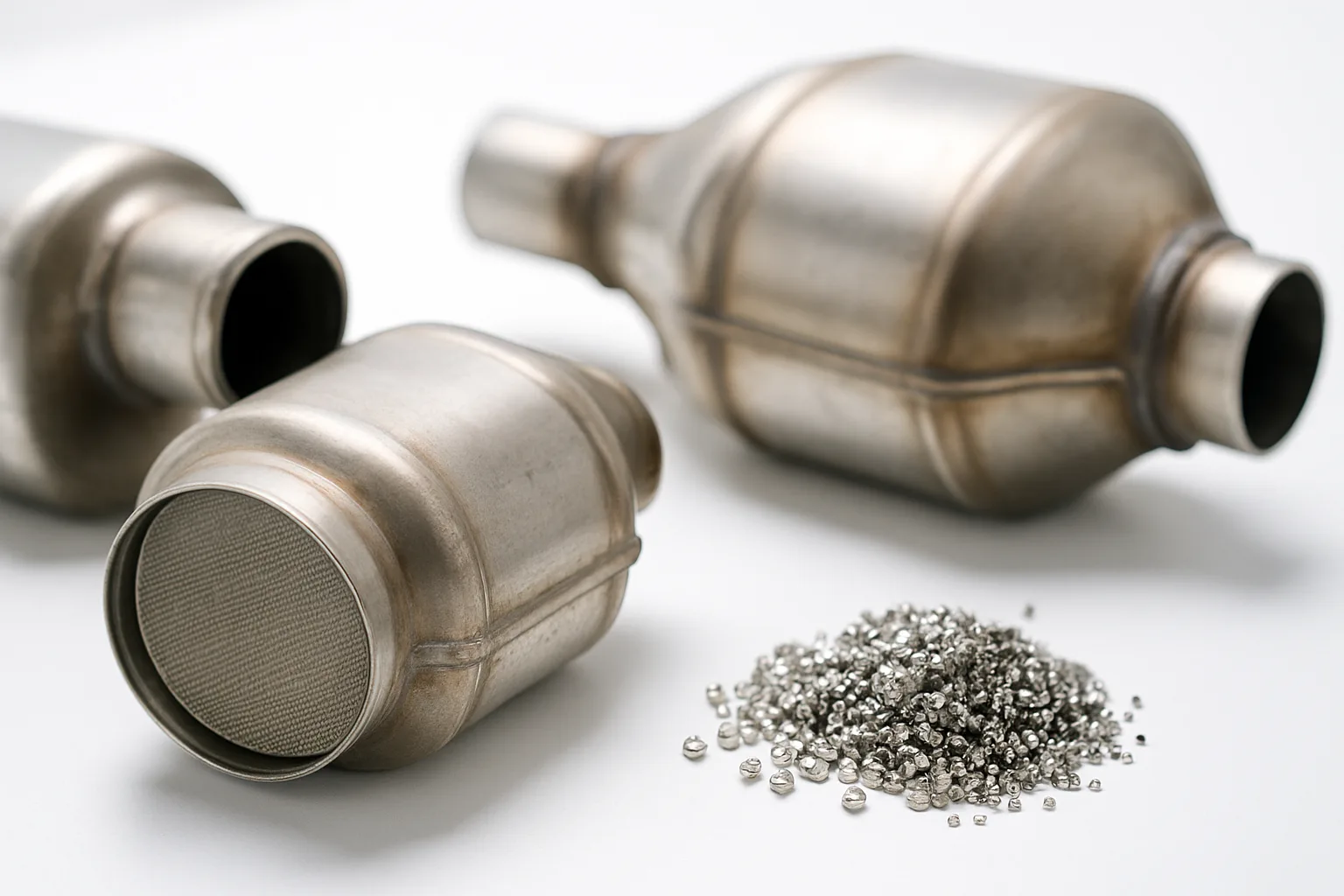
Most people selling a scrap catalytic converter have no idea what's actually inside it — or why two nearly identical-looking cats can be worth completely different amounts. If you've ever gotten a lowball offer and wondered how the buyer landed on that number, this article breaks it down. Understanding OEM catalytic converter value starts with three metals most sellers have never weighed in their hand: platinum, palladium, and rhodium.
These aren't marketing buzzwords. They're the actual reason your cat is worth anything at all — and knowing how they're priced can be the difference between leaving money on the table or walking away with a fair number.
What's Actually Inside a Catalytic Converter?
A catalytic converter isn't a solid chunk of metal. Inside the steel shell is a ceramic or metalite substrate — a honeycomb structure coated with a wash of precious metals. That wash is called the platinum group metals (PGMs), and it contains some combination of platinum, palladium, and rhodium depending on the vehicle make, model, engine type, and year.
These PGMs act as catalysts. They trigger chemical reactions that convert toxic exhaust gases — carbon monoxide, hydrocarbons, nitrogen oxides — into less harmful compounds. The process works, but it slowly depletes the substrate. That's why a high-mileage converter is worth less than a low-mileage one off the same vehicle. Less PGM content remains.
Here's what makes this complicated for sellers:
- There's no external label telling you the PGM loading of your specific unit.
- The same vehicle trim can have different cats depending on the model year or regional emissions requirements.
- An OEM unit from a Toyota Prius carries a very different PGM profile than an aftermarket replacement from an off-brand supplier.
- Condition, mileage, and whether the substrate is intact all affect the final assay value.
This is exactly why serial numbers and VIN lookup tools matter. Without that data, you're guessing — and whoever's buying knows that.
How Platinum, Palladium, and Rhodium Prices Drive OEM Catalytic Converter Value
PGM prices trade on global commodity markets, quoted in troy ounces. They move daily based on supply, industrial demand, mining output from South Africa and Russia, and macroeconomic pressure. A single converter might contain only a few grams of each metal, but at current market prices, those grams add up fast.
Rhodium is particularly volatile. It has historically swung from under $1,000 USD per troy ounce to peaks exceeding $20,000 — and back down again. Palladium and platinum are more stable but still move meaningfully week to week. When rhodium spikes, certain converter types — especially those from higher-displacement gasoline engines — can nearly double in value over a short period.
This is why catalytic converter prices today can look dramatically different from what you saw quoted six months ago. It's not a bait-and-switch. The commodity markets moved. A buyer offering you a flat price without referencing the current PGM spot rates isn't doing you any favors — they're absorbing the upside for themselves.
For context on how price discovery should work in a transparent market, get the best catalytic converter price in Canada through a platform that ties your quote to current assay data and live market rates — not a static price list from three months ago.
OEM vs. Aftermarket: Why Origin Changes Everything
OEM stands for Original Equipment Manufacturer. An OEM catalytic converter was built to the original vehicle specifications — usually by the same supplier that equipped the car at the factory. Aftermarket units are replacements manufactured by third parties, often to meet minimum emissions standards rather than optimize for PGM content.
This distinction is critical when you're trying to establish OEM catalytic converter value. OEM units typically carry higher PGM loadings because automakers need them to pass stringent emissions tests for the life of the vehicle warranty. Aftermarket replacements often use less precious metal — sometimes significantly less — because they only need to pass the test, not sustain performance over 150,000 kilometres.
If you're selling a cat pulled from an original factory vehicle that hasn't had its converter replaced, you're likely holding something worth more than the buyer's first offer. If the converter was replaced at a muffler shop five years ago, you might be selling an aftermarket unit that carries a fraction of the OEM PGM loading. Knowing which one you have changes your negotiating position entirely.
Platforms that use serial number tracking and VIN lookup — like the SMASH Recycling auction platform — make this identification step straightforward. You enter the serial number or pull the VIN, and the system cross-references known converter types to help establish what you're actually holding before you accept a price.
Why Hamilton and Ontario Sellers Often Leave Money Behind
Hamilton's industrial history means there's no shortage of scrap material moving through yards across the city. Steel, non-ferrous, cores — it all flows through Ontario's recycling ecosystem. But catalytic converters are a category where local pricing varies more than most sellers realize, and not always in the seller's favor.
The typical scenario: a shop pulls a cat, calls the one buyer they've always used, gets a number that sounds reasonable, and moves on. That number might be fair. It might also be 20% below what a competitive bid process would have surfaced. Without comparison, you'll never know.
Hamilton sellers dealing in volume — auto recyclers, shops pulling multiple cats per week, fleet operators — absorb that pricing gap repeatedly. Over a year, it compounds. The fix isn't complicated: it's getting more than one offer on every load. A B2B scrap metal marketplace with vetted buyers and an auction format creates that competition automatically. You don't have to make six phone calls. The platform does it.
If you're based in Hamilton and want to understand what your volume of cats is actually worth, Hamilton scrap metal services through best-catalytic-converter-price.ca can give you a starting point grounded in real market data — not a generic price list.
More buyers means better price discovery. That's not a slogan — it's just how auctions work. For Canadian catalytic converter pricing guides that explain the mechanics in plain terms, the blog covers the specifics in detail.
The Problem with Static Price Lists — Including International Ones
If you've searched for a catalytic converter price list online, you've probably landed on pages referencing South African buyers, U.S. recyclers, or offshore assay services. Some of that data is real. Most of it is stale. None of it reflects what a Canadian buyer is paying today for your specific converter type.
South African pricing — often searched as "catalytic converter price list South Africa" — reflects that country's PGM mining and processing ecosystem. South Africa produces the majority of the world's rhodium and platinum. The prices quoted there for smelters and refiners are part of the global supply chain, but they're not what a yard in Ontario is offering on a Tuesday morning.
The relevant price for you is what a vetted Canadian buyer will pay after assay, accounting for current spot rates, freight, processing fees, and realistic yield assumptions. That number changes. Any static list — regardless of where it originates — is already outdated the moment you read it.
The better approach: use a platform connected to active buyers who are bidding in real time based on current market conditions. That's the core mechanic behind the SMASH scrap metal auction model. Instead of a price list, you get competitive bids from multiple vetted buyers. The market sets the number. You see it.
How to Get the Most Accurate Value Before You Sell
Getting fair value for your cats isn't complicated, but it does require a few deliberate steps. Here's a practical checklist before you accept any offer:
- Identify your converter type. Pull the serial number from the unit itself. If you have the vehicle it came from, note the VIN. OEM units from the original vehicle have significantly different values than aftermarket replacements.
- Check current PGM spot rates. Platinum, palladium, and rhodium prices are publicly available. If the price has moved significantly since your last sale, your converter's value has moved with it.
- Document the condition. Intact substrate, no cracks, no broken shell — photo documentation gives buyers confidence and supports stronger offers. A damaged substrate means lower PGM yield, which lowers the offer.
- Get competitive bids. A single offer from a single buyer is a guess about the market. Multiple vetted buyers bidding on your load is the market. Use a platform like SMASH that facilitates that process.
- Understand what's being deducted. Refining fees, assay costs, and freight are real — but they should be transparent. Ask for a net-to-seller breakdown before you agree to any terms.
For sellers in Hamilton and across Ontario, these steps are the difference between taking the first number offered and actually knowing what your load is worth. Check current Canadian catalytic converter prices before you commit to anything.
Disclaimer: Catalytic converter prices fluctuate based on daily PGM spot rates and market conditions. All pricing referenced in this article is general in nature. Always verify current rates before finalizing any sale.
Frequently Asked Questions
Q: What makes OEM catalytic converter value higher than aftermarket units?
OEM converters are manufactured to meet factory emissions specifications over the full warranty life of the vehicle. That requires higher platinum, palladium, and rhodium loadings than most aftermarket units carry. When you scrap an OEM cat, the PGM content — and therefore the value — is typically higher than an equivalent aftermarket replacement pulled from the same vehicle.
Q: How often do catalytic converter prices today change?
PGM prices trade on global commodity markets every business day. Rhodium, palladium, and platinum spot rates can shift meaningfully week to week depending on mining supply, industrial demand, and macroeconomic conditions. A price quoted to you a month ago may not reflect today's market. Always reference current spot rates before accepting an offer.
Q: Are there catalytic converter buyers near me in Hamilton with competitive prices?
Yes — Hamilton and the broader Ontario market have active buyers for scrap catalytic converters. The challenge is getting more than one offer. Using a platform that connects you with multiple vetted buyers, rather than calling a single local contact, gives you a real market price rather than one buyer's number. Platforms like SMASH facilitate that competitive process across North America.
Q: Why don't price lists from South Africa or the U.S. apply to my Canadian sale?
International price lists reflect different processing costs, refining ecosystems, currency exchange rates, and regional buyer margins. A South African smelter price or a U.S. yard quote doesn't account for Canadian freight, CAD/USD exchange, or what vetted Canadian buyers are actually bidding right now. Use a source tied to current Canadian market data for an accurate number.
Q: How does a scrap metal auction platform help me get a better catalytic converter price?
An auction format creates competition. Instead of one buyer setting the price, multiple vetted buyers bid against each other for your load. That competition drives the price toward actual market value rather than whatever margin the single buyer wants to capture. The SMASH scrap metal auction model applies this mechanic specifically to B2B scrap loads, including catalytic converters.
Ready to find out what your cats are actually worth? Get the best Canadian price for your catalytic converter — get a free quote at best-catalytic-converter-price.ca and let the market give you a real number.
Stay current on scrap metal market shifts and PGM pricing trends — follow SMASH on LinkedIn for industry updates and insights that actually matter to recyclers and sellers across North America.