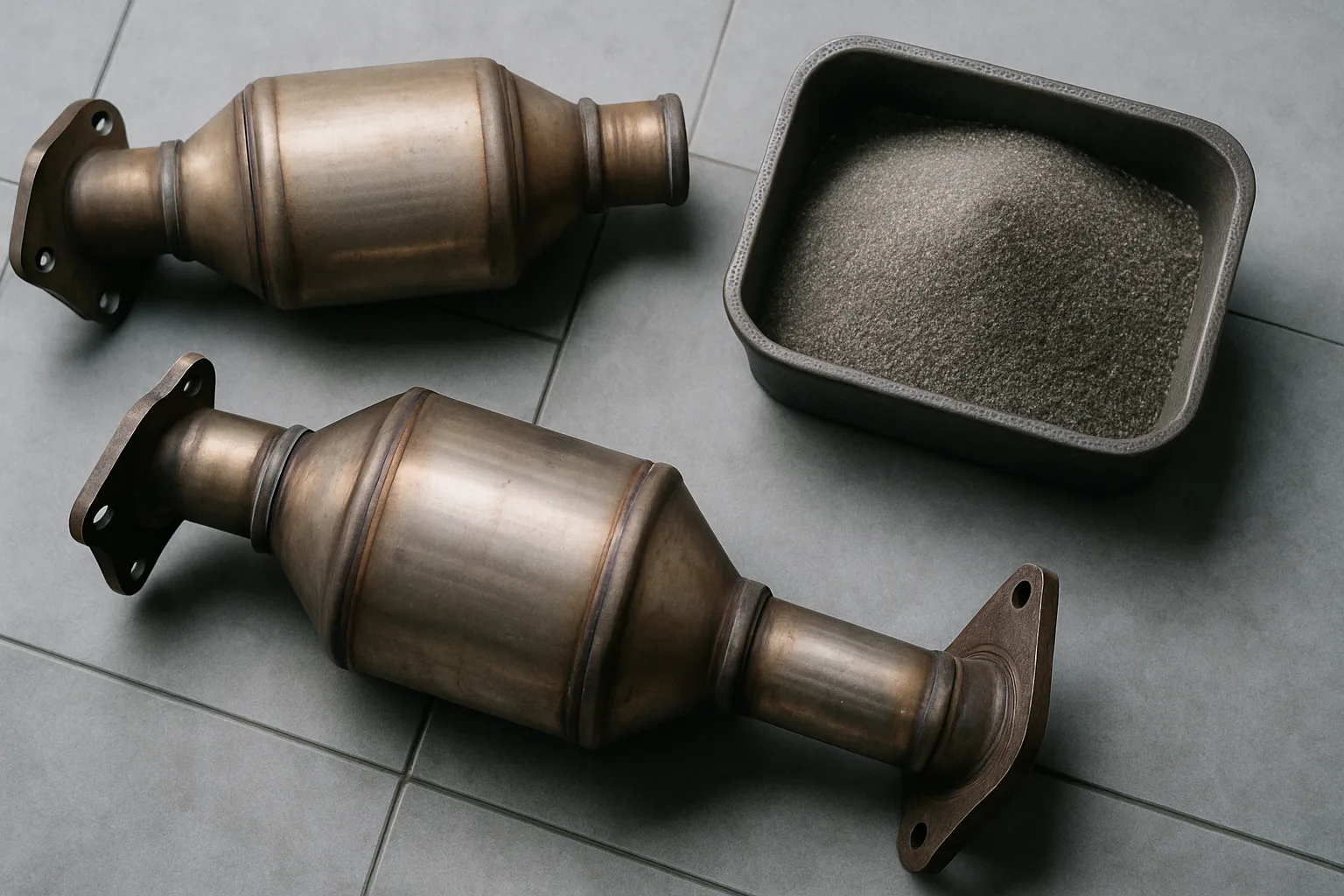
What's Actually Inside Your Catalytic Converter — And Why It Matters for Price
Most people treat a catalytic converter like a piece of exhaust pipe. It rusts, it fails, you pull it off and toss it in a bin. But that grey metal canister holds something worth serious money — and if you don't understand what's inside, you'll sell it for less than it's worth. OEM catalytic converter value isn't random. It's driven by chemistry, by global commodities markets, and by how well you document what you're selling.
This article breaks down the three precious metals inside every catalytic converter, explains what drives their price, and shows you how sellers in Coquitlam and across British Columbia can stop leaving money on the table.
The Three Precious Metals Driving Catalytic Converter Prices Today
Catalytic converters work by passing exhaust gases over a ceramic or metallic substrate coated with a precise blend of platinum group metals (PGMs). These metals trigger chemical reactions that reduce toxic emissions. The converter is essentially a mini-refinery bolted to your exhaust. That's what makes it valuable — and that's what makes catalytic converter prices today so sensitive to global market shifts.
The three metals you need to know:
- Platinum (Pt): Used heavily in diesel vehicle converters. Platinum catalyzes oxidation reactions and remains stable at high temperatures. It's been a cornerstone of catalytic converter manufacturing for decades. Prices fluctuate significantly based on South African mining output (the source of roughly 70% of global supply) and industrial demand beyond automotive.
- Palladium (Pd): The dominant metal in gasoline-powered vehicle converters. Palladium surged in value over the past decade as emission standards tightened globally, pushing automakers to load more PGM content into each unit. It remains one of the more volatile PGMs to track.
- Rhodium (Rh): The rarest and historically the most expensive of the three. Rhodium handles the reduction of nitrogen oxides (NOx) — one of the toughest emissions targets for regulators. Even tiny amounts of rhodium in a converter can represent a significant share of the unit's total scrap value. Supply is extremely tight and prices can swing dramatically.
Every converter contains a different ratio of these three metals depending on the vehicle make, model, engine size, and the emission standards it was designed to meet. That's why two converters that look identical on the outside can have very different scrap values.
OEM vs. Aftermarket: Why OEM Catalytic Converter Value Is Higher
Not all catalytic converters are created equal. OEM (Original Equipment Manufacturer) units are built to the exact specifications of the vehicle they came on. They carry higher PGM loadings to meet strict emissions certifications. An OEM converter pulled from a Honda, Toyota, or GM vehicle typically holds more precious metal content than a generic aftermarket replacement.
Aftermarket converters are designed to meet minimum legal standards — not to maximize PGM content. They use less platinum, palladium, and rhodium. That directly impacts their scrap value. If you're pulling cats and mixing OEM units with aftermarket replacements without tracking the difference, you're undervaluing your OEM inventory every time you sell.
Here's what separates high-value OEM loads from average aftermarket loads:
- Vehicle make and model (some manufacturers use significantly higher PGM loadings)
- Engine displacement — larger engines generally require more catalyst surface area and more PGM
- Vehicle age — older OEM units from pre-2010 vehicles often carry higher loadings than modern designs optimized for cost efficiency
- Country of manufacture and emissions standard — U.S. and Canadian market vehicles often have different specs than export models
- Converter condition — intact substrate, no rattling, no moisture contamination
If you want to get the best catalytic converter price in Canada, knowing whether you're holding OEM or aftermarket units is step one. Don't guess. Use serial numbers and VIN-linked data to confirm what you have before you price it.
How PGM Markets Move — And What That Means for Sellers in British Columbia
Platinum, palladium, and rhodium are globally traded commodities. Their prices shift daily based on mining output, currency exchange rates, EV adoption trends, and industrial demand from sectors well beyond automotive. A supply disruption in South Africa, a shift in Chinese emission regulations, or a spike in hydrogen fuel cell development can all move PGM prices within a week.
For sellers in Coquitlam and across British Columbia, this creates a real timing challenge. The converter you pull today might be worth more or less than the same unit pulled three weeks ago — not because anything changed about the part itself, but because the commodities market moved. That's why checking catalytic converter prices today matters before you commit to a sale price.
There's also a currency factor. PGMs are priced in USD on global markets, but Canadian sellers receive CAD. When the Canadian dollar weakens against the USD, scrap PGM values in CAD terms tend to rise — even if the USD price holds steady. Understanding this dynamic helps you time larger loads more strategically.
Want to stay current on the market? Read Canadian catalytic converter pricing guides to track how PGM shifts affect scrap values in real time.
Why Selling Through a B2B Scrap Metal Marketplace Gets You More
Here's the old way: you pull a load of cats, call one buyer, take whatever price they quote, and move on. No comparison. No competition. No way to know if you left money behind. That approach made sense when there were no better options. There are better options now.
A B2B scrap metal marketplace puts your load in front of multiple vetted buyers simultaneously. Instead of one offer, you get competing bids. That competition is what reveals the actual market — not one buyer's margin target. SMASH operates exactly this way. The SMASH scrap metal auction format is built for recycling yards and scrap collectors who want transparent price discovery on high-value loads like catalytic converters.
SMASH isn't a subscription service. There are no monthly fees. The model is simple: you win, SMASH wins. That alignment matters when you're selling something as volatile and value-dense as PGM-bearing cats.
The platform also supports detailed inventory documentation — serial tracking, photo uploads, VIN lookups, and packing lists. When buyers can see exactly what they're bidding on, they bid with more confidence. More confidence means tighter spreads and better price discovery for sellers. Sell your scrap metal on SMASH Recycling and see what competitive bidding actually looks like on a catalytic converter load.
Selling Catalytic Converters in Coquitlam: What Local Sellers Need to Know
Coquitlam sits in one of British Columbia's most active automotive recycling corridors. Between the Lower Mainland's high vehicle density, active import/export activity through Metro Vancouver ports, and a well-established network of auto wreckers and recycling yards, there's no shortage of catalytic converter volume moving through the region. The challenge isn't finding converters — it's finding buyers who pay fair market value for them.
Local scrap buyers in Coquitlam and the broader Lower Mainland vary widely in how they price PGM-bearing material. Some use assay-based pricing. Others use flat-rate tables. Others make offers based on the vehicle model alone, without looking at actual PGM data. If you're a yard operator or an auto shop accumulating cats, the difference between these pricing methods can be substantial across a year's worth of volume.
If you're searching for catalytic converter buyers near me and finding quotes that feel low, the issue usually isn't geography — it's competition. One buyer, one quote, no leverage. Platforms like SMASH solve that by expanding your buyer pool beyond what's physically near you. You keep your location. You get national (and cross-border) buying competition. That's the structure that produces real price discovery.
To check current Canadian catalytic converter prices and compare what you're being offered locally, it takes about five minutes. That five minutes could change what you get for your next load.
How to Document Your Cats Before You Sell
Documentation is the difference between a buyer who bids confidently and a buyer who hedges low because they're uncertain what they're getting. High-value PGM loads require more than a photo and a weight. Here's what serious buyers want to see:
- Serial numbers: Every OEM converter has a serial number stamped on the shell. These tie to assay databases and let buyers confirm PGM content estimates.
- Photos: Clear images of the serial number, the substrate condition (intact vs. damaged), and the overall unit. Rattling substrate = loss of assay value.
- VIN or vehicle information: Where available, linking converters to the vehicle they came from strengthens the OEM classification and supports higher bids.
- Packing lists and counts: Accurate counts by converter type prevent disputes and speed up settlement.
- Weight: Total weight of the load, ideally broken down by converter type if you're mixing OEM and aftermarket units.
SMASH's inventory tools support all of this. Serial tracking, photo documentation, and structured listings are built into the platform — not bolted on as an afterthought. That structure benefits sellers directly because it gives buyers fewer reasons to discount their bids.
Disclaimer: Catalytic converter prices fluctuate daily based on PGM spot prices, exchange rates, and market conditions. Always get the best catalytic converter price in Canada by checking current rates before committing to a sale.
Whether you're running a yard in Coquitlam, working out of a shop in the Fraser Valley, or collecting cats across British Columbia, the process is the same: document well, get competing bids, and know what the market is actually paying. That's how you stop guessing and start selling smart. If you're ready to find out what your load is worth, get a free quote at best-catalytic-converter-price.ca — no obligation, no subscription, just real market pricing.
Frequently Asked Questions
Q: What makes OEM catalytic converter value higher than aftermarket units?
OEM converters are manufactured to meet the precise emissions certification for a specific vehicle, which requires higher loadings of platinum, palladium, and rhodium. Aftermarket units are built to minimum legal standards and typically contain less PGM content. This difference in precious metal concentration directly affects scrap value — sometimes significantly depending on the vehicle make and model.
Q: How do I find out what my catalytic converter is worth in Canada?
Start by identifying the serial number on the converter shell — this ties to assay databases that estimate PGM content. From there, compare offers from multiple buyers rather than accepting the first quote. Platforms like SMASH create competitive bidding on catalytic converter loads, which helps reveal the actual market price rather than a single buyer's margin.
Q: Where can I sell catalytic converters in Coquitlam?
There are local scrap buyers in the Coquitlam and Metro Vancouver area, but local quotes vary widely. For higher-value OEM loads, consider listing through a B2B scrap metal marketplace like SMASH, which exposes your load to vetted buyers across North America — meaning you're not limited to whoever happens to be operating within a few kilometres of you.
Q: Why do catalytic converter prices change so frequently?
Catalytic converter scrap prices track the spot prices of platinum, palladium, and rhodium — all of which trade daily on global commodities markets. Supply disruptions, shifts in EV adoption trends, industrial demand from non-automotive sectors, and currency fluctuations between CAD and USD all affect what your converter is worth on any given day. Always check current rates before selling a significant load.
Q: Is it worth selling catalytic converters through a scrap metal auction versus a local buyer?
For small volumes or low-value units, local buyers are convenient. But for OEM converters, mixed loads, or any situation where you're uncertain whether you're getting fair market value, a competitive auction format typically produces better price discovery. SMASH operates on a no-subscription, performance-aligned model — meaning there's no cost to list unless you sell, which removes the barrier to trying a different approach.
Follow SMASH on LinkedIn for ongoing market updates, PGM pricing insights, and scrap metal industry news across North America.