Most people assume platinum drives the value of a scrap catalytic converter. It's the name everyone knows. But if you're selling cats in 2026 and not thinking about rhodium, you're leaving money on the table — possibly a lot of it.
Rhodium is the reason some catalytic converters are worth dramatically more than others. Understanding platinum price today matters, but rhodium is the metal that can make or break your payout. Here's why — and how to make sure you're getting paid fairly for every gram of it.
Platinum, Palladium, and Rhodium: What's Actually Inside Your Catalytic Converter
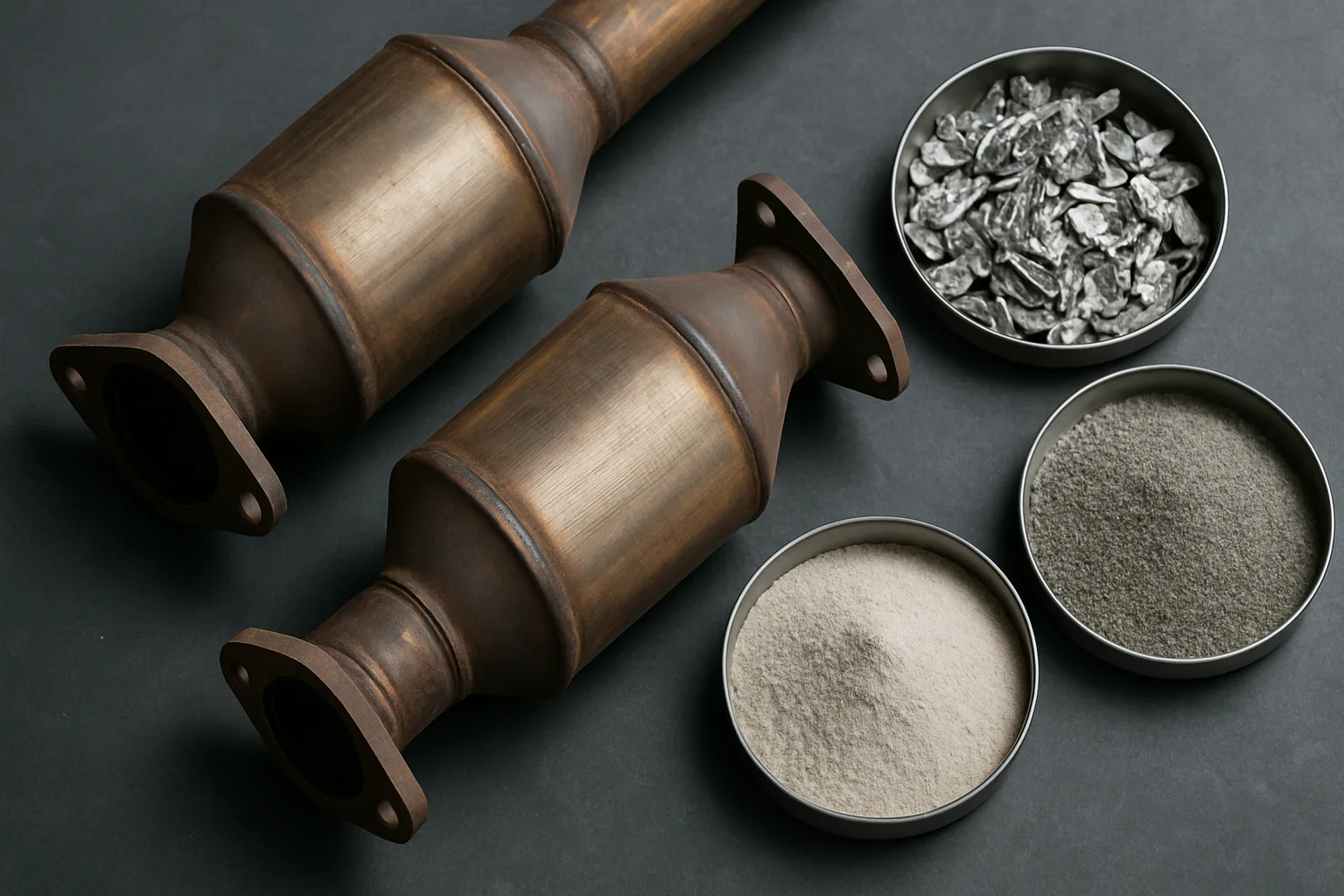
Every catalytic converter contains a ceramic or metalite substrate coated with a wash of precious metals. Those metals do the actual work — converting toxic exhaust gases into less harmful emissions. The three metals responsible are platinum, palladium, and rhodium, and they don't show up in equal amounts or equal value.
Here's how they break down in practical terms:
- Platinum (Pt): Used primarily in diesel-engine cats. Handles oxidation of carbon monoxide and hydrocarbons. Historically the benchmark metal — most people track the platinum price today as a proxy for cat values.
- Palladium (Pd): Dominant in gasoline-engine three-way catalysts. More efficient at high operating temperatures than platinum. Prices spiked hard through the early 2020s due to supply constraints from South Africa and Russia.
- Rhodium (Rh): The smallest quantity, the most critical function, and by far the highest per-gram price. Rhodium handles nitrogen oxide (NOx) reduction — the part of emission control that platinum and palladium can't do alone.
A typical catalytic converter might contain anywhere from 1 to 7 grams of platinum, 2 to 7 grams of palladium, and just 0.5 to 2 grams of rhodium. The rhodium quantity looks small. The dollar value it represents does not.
Why Rhodium Commands the Highest Price Per Gram
Rhodium is one of the rarest naturally occurring elements on Earth. It's not mined independently — it comes almost entirely as a byproduct of platinum group metal (PGM) mining in South Africa and, to a lesser extent, Zimbabwe and Russia. That supply concentration makes it uniquely vulnerable to disruption. When supply tightens, prices don't drift — they spike.
Rhodium hit extraordinary highs in recent years that made headlines even outside the scrap industry. While prices have moderated from those peaks, rhodium still consistently trades at a significant premium over both platinum and palladium. Even at lower price cycles, a converter with meaningful rhodium content is worth substantially more than one without it.
The key driver is demand inelasticity. You cannot substitute another metal for rhodium in three-way catalytic converter chemistry without degrading NOx performance — and modern emissions regulations in North America, Europe, and increasingly Asia don't allow that compromise. As long as internal combustion engines require emission controls, rhodium stays essential. That's the core reason it holds its premium.
Note: Precious metal prices fluctuate daily based on market conditions. Always check current Canadian catalytic converter prices before making any selling decisions.
Which Catalytic Converters Contain the Most Rhodium?
Not all cats are created equal, and rhodium content varies significantly by vehicle type, engine size, and manufacturer. If you're sorting a pile of cores, this matters. Knowing which units carry the highest PGM loading helps you negotiate from a position of knowledge instead of guessing.
High-rhodium converters tend to come from:
- Large-displacement V6 and V8 gasoline engines: More exhaust volume means more NOx to control, which means more rhodium in the substrate wash.
- Pre-2010 vehicles from certain manufacturers: Older emissions standards sometimes required higher PGM loading to meet targets with less efficient substrate designs.
- OEM (original equipment) converters: Factory-installed units almost always carry higher PGM content than aftermarket replacements. An aftermarket cat bolted on to pass a safety inspection typically contains a fraction of the precious metals of the original.
- Luxury and performance vehicles: Higher-spec engines with stricter factory emission targets often run richer catalyst formulations.
- Trucks and SUVs with larger engines: The substrate surface area is larger, and the catalyst loading is proportionally higher.
Small four-cylinder economy car cats, particularly aftermarket replacements, generally sit at the lower end of the value range — not because they're worthless, but because the PGM content is lower. Sorting matters. If you're moving volume and want to read Canadian catalytic converter pricing guides, understanding this breakdown will help you grade your inventory accurately.
Why Tracking Platinum Price Today Doesn't Tell the Full Story
Here's where a lot of sellers get caught. They check the platinum price today, see a number, and assume that's the primary driver of what a buyer will pay. It's not — or at least, it's not the whole picture.
A catalytic converter's value is a function of all three PGMs simultaneously. On a day when platinum is flat but rhodium is elevated, a high-rhodium converter can pay significantly more than a calculation based on platinum alone would suggest. The reverse is also true — a diesel-heavy platinum converter may underperform expectations when diesel converter demand is soft.
Professional catalytic converter buyers price cats using assay data and current spot prices for all three metals. That's three separate variables, all moving daily. Sellers who rely on a single metal price or a static price list are working with incomplete information — and that gap usually costs them money.
This is exactly where competitive auctions change the dynamic. When multiple catalytic converter buyers in British Columbia and across North America are bidding on your inventory, the price reflects actual market demand — not what a single buyer decides to offer you that morning. Platforms like SMASH Recycling are built on that principle: competition does the work, not guesswork.
Selling Catalytic Converters in Nanaimo: What Local Sellers Need to Know
If you're selling cats from Nanaimo, you're not limited to whoever happens to be operating a yard in your immediate area. The market for scrap catalytic converters is national, and the buyers who will pay the most for high-value cores are often not local. That's not a knock on local buyers — it's just the reality of how PGM refining and trading works. The refiners and processors who extract and sell the actual metal operate at a continental scale.
What this means for a Nanaimo seller is straightforward: your leverage comes from access, not geography. If you're working through Nanaimo scrap metal services connected to a broader buyer network, you're in a better position than if you're calling one local number and accepting whatever they quote.
Volume helps too. A single cat from one vehicle is worth what it's worth. A sorted, documented lot of 20 or 50 converters — properly photographed, with VINs or serial references where applicable — is a different proposition to a serious buyer. It signals professionalism, reduces their due diligence burden, and makes competitive bidding more likely. If you want to get the best catalytic converter price in Canada, documentation is part of the process, not an afterthought.
SMASH supports exactly this kind of structured selling — inventory documentation, photo records, and auction-format exposure to vetted buyers. No subscription fees. They only benefit when you do.
5 Reasons Rhodium Makes Catalytic Converter Sorting Worth Your Time
If you're moving any volume of scrap cats — from an auto shop, a dismantling operation, or accumulated personal vehicles — sorting by likely rhodium content is one of the highest-leverage things you can do before you sell. Here's why it pays off:
- Price spread between high and low rhodium units can be significant. The difference between a high-value three-way gasoline converter and a low-grade aftermarket unit isn't trivial. Mixing them into one unsorted lot averages your price down.
- Buyers price risk into unsorted lots. When a buyer can't easily assess what's in a pile, they pad their margin. Sorted, identified inventory removes uncertainty — and buyers pay more when they have clarity.
- Rhodium content doesn't correlate cleanly with converter size. A compact, dense OEM cat from the right vehicle can outvalue a large-looking unit with low PGM loading. Visual judgment alone misses this.
- The catalytic converter auction format rewards documentation. When multiple buyers compete on a documented lot, rhodium-rich units pull stronger bids. Competitive pressure does what a single-buyer negotiation can't.
- You only get paid for what's in the converter once. You can't go back and renegotiate after the fact. Getting the valuation right before you sell is the only opportunity you have.
Frequently Asked Questions
Q: Why is rhodium more valuable than platinum in catalytic converters?
Rhodium is far rarer than platinum and has no practical substitute in three-way catalytic converter chemistry. It's the only metal that effectively reduces nitrogen oxide (NOx) emissions, which means demand is structurally tied to global emissions regulations. That combination of scarcity and inelastic demand keeps rhodium prices consistently elevated relative to other PGMs.
Q: Does tracking the platinum price today tell me what my catalytic converter is worth?
Only partially. Your converter's value depends on the spot prices of all three PGMs — platinum, palladium, and rhodium — weighted by the actual content of each in that specific unit. Checking the platinum price today is useful context, but it won't give you an accurate payout figure on its own. Use a professional pricing resource or get quotes from multiple buyers.
Q: Are catalytic converter buyers in British Columbia connected to national markets?
Most serious buyers and processors in British Columbia operate within national and international PGM refining networks. Your converter's value is ultimately tied to global spot prices, not local supply and demand. This is why accessing multiple buyers — through platforms like SMASH — typically results in better price discovery than going to a single local source.
Q: How do I know if my cat has high rhodium content before I sell it?
The most reliable indicators are vehicle type (large gasoline engines, OEM fitment, pre-2010 models from certain manufacturers) and converter condition. Many professional buyers use serial number databases or VIN lookups to identify converter type and estimated PGM loading. If you're unsure, working with a buyer who uses assay-based pricing rather than flat-rate pricing is your best protection.
Q: Is it worth selling catalytic converters from Nanaimo through an online auction platform?
Yes — especially if you have more than a few units. Online auction platforms connect you to vetted buyers across North America, which creates genuine price competition rather than a single take-it-or-leave-it offer. For Nanaimo sellers, this means your geography doesn't limit your payout. Shipping logistics are manageable for sorted, documented lots, and the price differential often makes it worthwhile.
Rhodium is small in quantity and massive in impact — on your emissions system and on your payout. If you're selling cats in Nanaimo or anywhere across British Columbia, knowing what's actually in your converters is the starting point. From there, getting multiple buyers competing for that value is how you close the gap between what you're offered and what you should receive. When you're ready to move your inventory, get the best catalytic converter price in Canada — head to best-catalytic-converter-price.ca for a free quote and see what your cats are actually worth in today's market.
Stay current on PGM markets and scrap metal trends — follow SMASH on LinkedIn for regular market insights, pricing context, and industry updates that matter to Canadian sellers.